Epithalon
Telomerase peptide
A synthetic tetrapeptide investigated in research on telomerase activity, circadian regulation and aging.
Mechanism#
A short peptide reported to activate telomerase — the enzyme that maintains telomere length — and to influence the pineal gland, placing it at the centre of telomere, circadian and aging research.
Areas of research#
- Telomerase and telomere-length research
- Circadian and pineal-gland models
- Antioxidant pathways
- Aging and longevity research

Identity and specification#
| Also known as | Epitalon; Epithalone; AEDG tetrapeptide |
|---|---|
| Sequence | Ala-Glu-Asp-Gly (AEDG) |
| Length | 4 residues — the shortest peptide in this catalogue |
| Molecular formula | C14H22N4O9 |
| Molecular weight | 390.35 g/mol |
| CAS number | 307297-39-8 |
| Origin | Synthetic analogue of epithalamin, a pineal extract; developed by Khavinson |
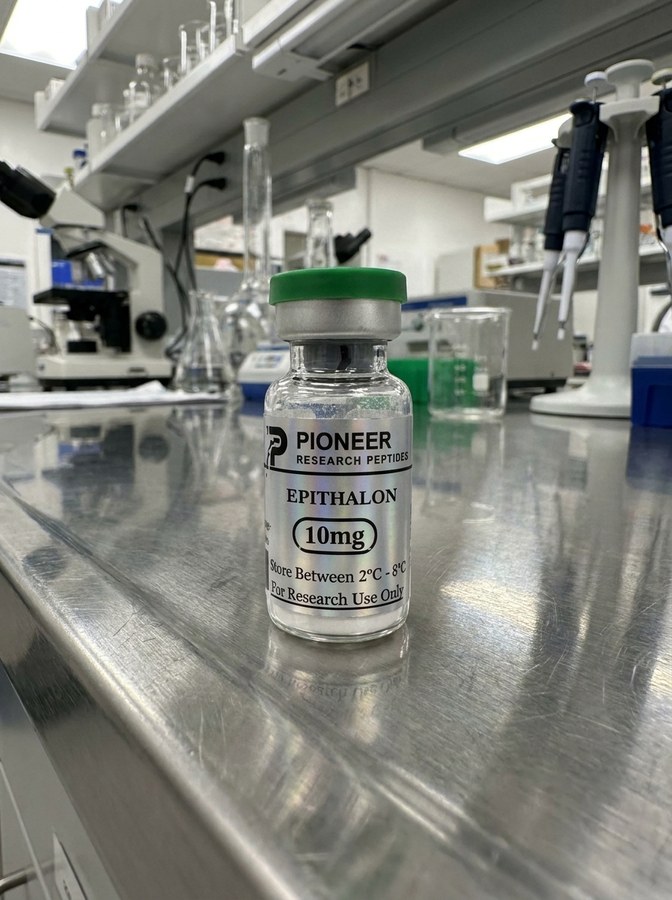
| Appearance | White lyophilised powder |
| Solubility | Water — freely soluble, strongly acidic sequence |
| Storage | 2–8°C, both sealed and once in solution |
At 390.35 this is barely a peptide at all. Four residues puts Epithalon closer to small-molecule territory than to the 3000-dalton chains elsewhere in this catalogue, and that changes how it behaves analytically. Reversed-phase HPLC separates peptides largely by hydrophobicity, and there is almost nothing hydrophobic here to retain — so this compound elutes early, close to the solvent front, where separation is hardest. A purity figure for Epithalon is a harder number to earn than the same figure for a longer peptide, which is a reason to read the method on the certificate rather than only the percentage.
There is no chromophore whatsoever. Alanine, glutamate, aspartate, glycine. Not one aromatic ring between them. A280 measures tryptophan, tyrosine and weakly phenylalanine, and this peptide has none of the three, so a concentration quoted from a 280 nm reading cannot be meaningful. Quantification has to come from amino-acid analysis or from a peptide-bond reading in the 205–215 nm range.
The Asp-Gly at the end is a known weak point. Aspartate followed by glycine is the classic rearrangement site in peptide chemistry: the pair can cyclise to a succinimide and reopen as isoaspartate, which has the same mass as the original and so is invisible to a simple mass check while being a different molecule. In a four-residue peptide that pair is half the chain. It is the single best reason to keep this one cold, dry and at neutral pH rather than in solution on a shelf.
Two of the four residues carry free carboxylates, which is why it dissolves in plain water without argument and why its isoelectric point sits low.
Handling and storage#
Dissolves readily in water. Keep the sealed vial at 2–8°C and dry — the Asp-Gly rearrangement above is accelerated by moisture, warmth and alkaline conditions, so a vial left in a warm room with a loose cap is the failure mode to avoid. Once in solution, refrigerate at 2–8°C, keep it near neutral pH, use it promptly and avoid repeated freeze-thaw cycles.
For how Epithalon sits alongside Cortagen, Crystagen and Cartalax, and what the short-peptide class has in common, see our guide to peptide bioregulators.
Sizes and pricing#
| Size | Price per vial | Availability |
|---|---|---|
| 10mg | £13.50 | In stock |
| 50mg | £49.99 | In stock |
Buying more than one? Mix and match any peptide vials: 3 vials 8%, 5 vials 12%, 10 or more 15% off the peptides in your basket. You get whichever is better, the bulk or the volume discount, never both — applied automatically at checkout. How it works.
Check your certificate#
- Molecular weight 390.35 (monoisotopic 390.14), C14H22N4O9. On a mass spectrum, expect the singly charged ion near 391.1.
- The Asp-Gly pair can rearrange without changing the mass. It can cyclise and reopen as isoaspartate, a different molecule of identical mass. A mass check cannot see it; only chromatography can.
- One residue from its neighbours. Cartalax (AED) is 333.30 and Cortagen (AEDP) is 430.41. Check the sequence on the certificate reads Ala-Glu-Asp-Gly.
- Purity, with the method named, measured on that batch rather than quoted as a minimum. This peptide elutes early in reversed-phase HPLC, near the solvent front, so the method deserves a read as well as the percentage.
Ask about the documentation for the batch we would ship before you order. How to check a certificate yourself: verifying a COA.
What’s in the vial#
| Fill | 10mg or 50mg of peptide per vial |
|---|---|
| Appearance | White lyophilised powder |
| Purity and content | Purity is the share of what was detected that is this peptide. Net peptide content, how much of the powder’s weight is peptide rather than salt and water, is a separate number. How much is in the vial. |
Handling at a glance#
| Solvent | Bacteriostatic or sterile water. Freely soluble. |
|---|---|
| Sealed vial | 2–8°C and dry. Moisture, warmth and alkaline conditions accelerate the Asp-Gly rearrangement. Let it reach room temperature before opening. |
| Once in solution | 2–8°C, near neutral pH, and used promptly. Avoid thawing and refreezing the same volume. |
| Worth knowing | There is no aromatic residue at all, so a concentration from a 280 nm reading cannot be meaningful. Quantification has to come from amino-acid analysis or a peptide-bond reading at 205–215 nm. |
Working out a concentration: the reconstitution calculator. Technique: the reconstitution guide and the storage guide.
What the research covers#
Epithalon has the largest English-language literature of the bioregulators, but most of it comes from the St Petersburg group that developed it, much of it in Russian: cell studies of telomere length, and a study of night-time melatonin levels in old monkeys and elderly people. Independent work is limited to a 2025 cell study from Brunel University London and a 2026 independent review, which concluded that it is clinically unproven, with the human evidence limited to small studies. Read the full guide, with sources: Peptide Bioregulators Explained: Epithalon, Cortagen, Cartalax.
Published literature#
- Khavinson VK, Popovich IG, Linkova NS, et al. (2021). Molecules 26(22):7053. Systematic review by the St Petersburg group setting out their gene-regulation hypothesis for short peptides. PubMed 34834147
- Khavinson VKh, Kuznik BI, Ryzhak GA (2013). Adv Gerontol 26(1):20–37. Review of the St Petersburg group’s clinical studies of their peptide preparations, including Epithalamin and Cortexin. PubMed 24003726
- Khavinson VKh, Bondarev IE, Butyugov AA, et al. (2004). Bull Exp Biol Med 137(5):503–6. Epithalon and telomere length in cultured human fetal fibroblasts, from the originating group. PubMed 15455129
- Korkushko OV, Lapin BA, Goncharova ND, et al. (2007). Adv Gerontol 20(1):74–85. Study of pineal peptide preparations, including synthetic Epitalon, and night-time melatonin levels in old monkeys and elderly people. PubMed 17969590
- Al-Dulaimi S, Thomas R, Matta S, et al. (2025). Biogerontology 26(5):178. Independent cell study from Brunel University London of epitalon and telomere length in normal and breast-cancer cell lines. In the cancer lines the lengthening ran through a telomerase-independent route (ALT). PubMed 40908429
Listed so the work can be read at source. A paper on this list is evidence of what was studied, not of what any product does.
Questions#
What is Epithalon?
A synthetic tetrapeptide, Ala-Glu-Asp-Gly (AEDG), also spelled Epitalon. It is a synthetic analogue of epithalamin, a pineal extract, from the Khavinson bioregulator series.
What molecular weight should the certificate show?
390.35 (monoisotopic 390.14), usually seen as an ion near 391.1. Cartalax (AED) is 333.30 and Cortagen (AEDP) is 430.41.
How should it be stored?
Sealed vial at 2-8°C and dry, brought to room temperature before opening. Once reconstituted with bacteriostatic or sterile water, keep it at 2-8°C near neutral pH, use it promptly, and avoid thawing and refreezing the same volume.
Why can't its concentration be read at 280 nm?
It has no tryptophan, tyrosine or phenylalanine, the residues a 280 nm reading depends on. Quantification has to come from amino-acid analysis or a peptide-bond reading at 205-215 nm.
Is it for human use?
No. It is supplied for laboratory research only, and we do not give guidance on human or animal use.
A batch-specific Certificate of Analysis is available on request. New to handling lyophilised material? See our reconstitution guide, storage guide and how to read a COA.