Thymosin alpha-1
28-amino-acid peptide
A 28-residue acetylated peptide first isolated from calf thymus in 1977, and a Toll-like receptor agonist. Licensed as thymalfasin in much of the world, never licensed by the FDA or the EMA, and the subject of an unusually clear run of clinical trials.
Mechanism#
Characterised as an agonist at Toll-like receptors 2 and 9 on myeloid and dendritic cells. Work using it sits in TLR signalling, T-cell maturation and cytokine response models.
Areas of research#
- T-cell and immune-modulation research
- Host-defence and antiviral models
- Inflammation regulation
- Immunology research

Identity and specification#
| Also known as | Thymosin α1; Tα1 |
|---|---|
| Sequence | Ac-Ser-Asp-Ala-Ala-Val-Asp-Thr-Ser-Ser-Glu-Ile-Thr-Thr-Lys-Asp-Leu-Lys-Glu-Lys-Lys-Glu-Val-Val-Glu-Glu-Ala-Glu-Asn-OH |
| Length | 28 residues, N-terminally acetylated |
| Molecular formula | C129H215N33O55 |
| Molecular weight | 3108.28 Da |
| CAS number | 62304-98-7 |
| Class | Thymic peptide; immune-signalling research compound |
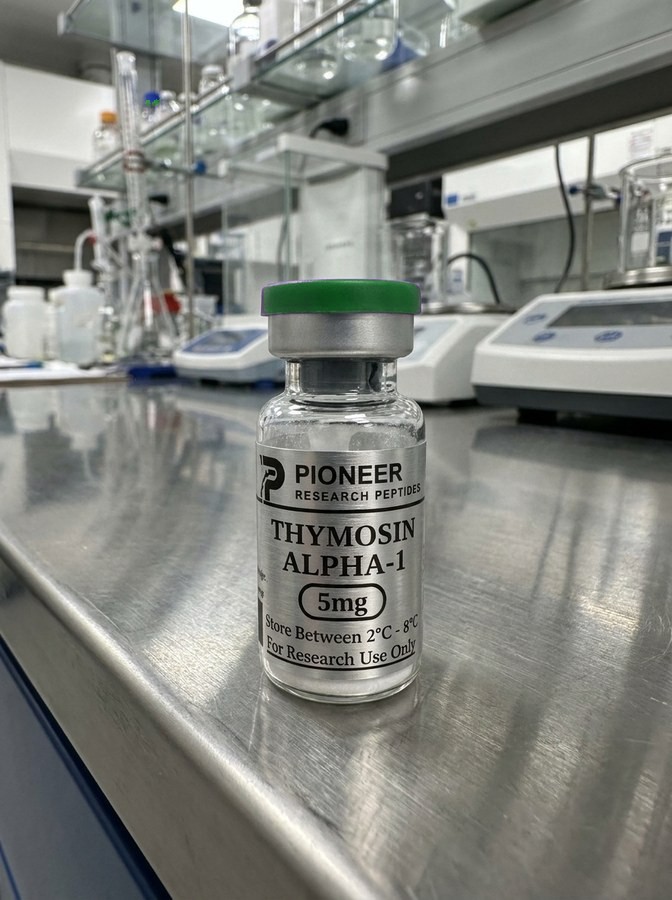
| Appearance | White lyophilised powder |
| Solubility | Water; the sequence is strongly acidic and dissolves readily |
| Storage | 2–8°C, both sealed and once in solution |
Two things in that table are worth more than they look, and both of them are checks worth running against a certificate.
The acetyl group is 42 daltons. Thymosin alpha-1 is acetylated at its N-terminus, and that modification is part of the molecule's identity rather than a decoration. The acetylated 28-mer is 3108.28 Da; the same chain with a free N-terminus is roughly 3066. A mass spectrum landing near 3066 is not a rounding difference or an instrument drift — it is a peptide that was never acetylated, and that is an identity failure worth rejecting a batch over.
This peptide cannot be quantified at 280 nm. A280 works because tryptophan, tyrosine and, weakly, phenylalanine absorb there. Read the sequence above: there is no Trp, no Tyr and no Phe anywhere in the 28 residues. There is no chromophore to read, so an A280 concentration figure quoted for thymosin alpha-1 cannot mean what it appears to mean. Concentration has to come from amino-acid analysis, or from a peptide-bond reading in the 205–215 nm range.
The composition also explains the handling. Six glutamates, three aspartates and a C-terminal asparagine make this a markedly acidic peptide with a low isoelectric point, which is why it goes into plain water without the solubility arguments that shorter, more hydrophobic sequences can start.
Where it came from, and the name it shares#
Thymosin alpha-1 was isolated in 1977 from thymosin fraction 5, a crude protein preparation made from calf thymus. That origin explains a confusion that runs through the whole category and that is worth settling before anything else.
Thymosin alpha-1 and thymosin beta-4 are not related molecules. They are different lengths, different sequences, different compositions and different gene products, and they share a name only because both were pulled out of the same crude thymic extract in the same programme. “Thymosin” names where a fraction came from, not a family of related peptides. Sources that treat the two as variants of one thing, or that carry a claim about one across to the other, have made a mistake of nomenclature rather than of science. Our guide to TB-500, thymosin beta-4 and the fragment covers the other side of it.
Licensed in much of the world, and what that is worth#
The synthetic form is called thymalfasin, sold as Zadaxin, and it is approved in more than thirty-five countries for hepatitis B and hepatitis C. Neither the FDA nor the EMA has approved it. The FDA has granted orphan drug designation for several conditions — that is a development incentive awarded before efficacy is established, not an approval, and the two are conflated in almost every summary of this compound that exists.
There is a further wrinkle, and it is the honest one. The indication those thirty-five approvals were granted for has largely been overtaken: direct-acting antivirals changed hepatitis C treatment so completely that the older immunomodulatory approach is now of historical interest in most settings. A licence is evidence that a regulator was satisfied at the time it was granted. It is not evidence that a compound is still the right answer to the question it was approved for.
Sepsis: what a confirmatory trial is for#
This compound has something most of the catalogue does not: a clean, legible clinical arc, recently completed. It is worth following in order, because it is the best worked example in this sector of why an encouraging result is not a finding.
In 2013 the ETASS trial reported in Critical Care. Multicentre, randomised, 361 patients with severe sepsis. Twenty-eight-day mortality was 26.0% on thymosin alpha-1 against 35.0% on control — nine percentage points, which looks substantial. The confidence interval on that difference ran from −0.5% to 18.5%, the relative risk was 0.74 with an interval of 0.54 to 1.02, and the primary analysis returned P = 0.062. In other words the interval included no difference at all. The authors said so, called the result marginal, and asked for a larger confirmatory study.
They got one. TESTS reported in the BMJ in January 2025: multicentre across twenty-two Chinese centres, double-blinded, placebo-controlled, phase 3, 1,089 patients. Mortality at twenty-eight days was 23.4% on thymosin alpha-1 and 24.1% on placebo. Hazard ratio 0.97, interval 0.76 to 1.24, P = 0.82. The authors’ conclusion: no clear evidence that thymosin alpha-1 decreases twenty-eight-day all-cause mortality in adults with sepsis.
Nine points became seven tenths of one point, and the direction of the result stopped meaning anything. Nothing went wrong in either study. The first was underpowered and reported itself as such; the second was built to answer the question and did. That is the system working exactly as intended, and it is the reason a marginal P value in a small trial is a reason to run a bigger one rather than a reason to believe something.
Worth saying plainly, because the opposite inference gets drawn: a null result in sepsis is a result in sepsis. It does not settle the TLR signalling work, the hepatitis literature or anything else. It settles the question it asked.
Handling and storage#
Supplied as a lyophilised cake. Add solvent slowly down the vial wall and swirl rather than shake. Keep the sealed vial at 2–8°C; once in solution, refrigerate at 2–8°C and avoid repeated freeze-thaw cycles. Where a solution has to be held for longer, splitting it into single-use aliquots before freezing costs nothing and removes the freeze-thaw problem entirely.
For the full sequence walk-through, the acetylation check, and why the usual purity readings behave differently here, see our guide to Thymosin alpha-1.
Why a 28-mer is harder to make than a hexapeptide#
Most of this catalogue is five to ten residues. At twenty-eight, solid-phase synthesis is a materially different proposition, and the certificate is reading a harder problem.
Each residue is added in a coupling step that is efficient but never perfect. Those efficiencies multiply, so the share of chains that received every residue falls away as the sequence lengthens — and every chain that missed one is a deletion sequence differing from the target by a single residue’s mass. On a short peptide those are rare and conspicuous. On a 28-mer they are the main impurity class, they cluster close to the target mass, and separating them is the whole of the purification problem.
Which is why two numbers that look similar are not. A purity figure on a hexapeptide and the same figure on a 28-mer describe different achievements, and the same figure is harder to reach here. Read alongside it: the named analytical method, the acetylation check above, and the fact that concentration cannot have come from A280 on this sequence. Our guide to reading a certificate of analysis works through a real one line by line.
Sources#
- The efficacy and safety of thymosin α1 for sepsis (TESTS) — BMJ, January 2025; 1,089 patients, phase 3, no mortality benefit
- The efficacy of thymosin alpha 1 for severe sepsis (ETASS) — Critical Care, 2013; the earlier marginal result
- Thymosin alpha 1: a comprehensive review of the literature — isolation from thymosin fraction 5 in 1977, TLR-2 and TLR-9 agonism, and the thymalfasin approvals
- Thymosin alpha-1: isolation and sequence analysis — the original characterisation
Sizes and pricing#
| Size | Price per vial | Availability |
|---|---|---|
| 5mg | £26 | Made to order — 1-2 weeks |
| 10mg | £48 | Made to order — 1-2 weeks |
Buying more than one? Mix and match any peptide vials: 3 vials 8%, 5 vials 12%, 10 or more 15% off the peptides in your basket. You get whichever is better, the bulk or the volume discount, never both — applied automatically at checkout. How it works.
Check your certificate#
- Molecular weight 3108.28 (monoisotopic 3106.50). On a mass spectrum, expect charged ions near 1554.3, 1036.5 and 777.6.
- Near 3066 means no acetyl group. The N-terminal acetyl is 42 daltons and part of the molecule’s identity. A mass near 3066 is a peptide that was never acetylated, an identity failure rather than a rounding difference.
- It cannot be quantified at 280 nm. There is no tryptophan, tyrosine or phenylalanine in the sequence, so a concentration or net peptide content reported by A280 cannot be right for this compound.
- Purity, with the method named, measured on that batch rather than quoted as a minimum. Net peptide content and the counter-ion, acetate or trifluoroacetate, are separate figures.
Ask about the documentation for the batch we would ship before you order. How to check a certificate yourself: verifying a COA.
What’s in the vial#
| Fill | 5mg or 10mg of peptide per vial |
|---|---|
| Appearance | White lyophilised powder |
| Purity and content | Purity is the share of what was detected that is this peptide. Net peptide content, how much of the powder’s weight is peptide rather than salt and water, is a separate number. How much is in the vial. |
Handling at a glance#
| Solvent | Bacteriostatic or sterile water. Strongly acidic, so it dissolves readily. |
|---|---|
| Sealed vial | 2–8°C, dry and dark. Let it reach room temperature before opening. |
| Once in solution | 2–8°C. Avoid thawing and refreezing the same volume. |
| Worth knowing | Concentration has to come from a peptide-bond reading around 214 nm or from amino-acid analysis. It has no cysteine and no tryptophan, which makes it comparatively robust for a 28-residue peptide. |
Working out a concentration: the reconstitution calculator. Technique: the reconstitution guide and the storage guide.
What the research covers#
Thymosin alpha-1 was isolated from calf thymus in 1977 and has a larger clinical literature than most research peptides. In sepsis, a 2013 randomised trial in 361 intensive-care patients reported a borderline mortality difference, and a phase 3 double-blind, placebo-controlled trial at 22 Chinese centres, reported in 2025, found no difference in 28-day mortality. Its laboratory work sits in Toll-like receptor signalling and T-cell models. It is licensed as thymalfasin in more than 35 countries (as of 2009), but not in the UK. Read the full guide, with sources: Thymosin Alpha-1: Structure, Identity and Handling.
Published literature#
- Goldstein AL, Low TL, McAdoo M, et al. (1977). Proc Natl Acad Sci U S A 74(2):725–9. Isolation and sequencing of thymosin alpha-1 from calf thymus: 28 residues, heat-stable and highly acidic. PubMed 265536
- Goldstein AL, Goldstein AL (2009). Expert Opin Biol Ther 9(5):593–608. Review of the clinical use of thymosin alpha-1 by the group that discovered it. States that it was approved in over 35 countries. PubMed 19392576
- Dominari A, Hathaway D, Pandav K, et al. (2020). World J Virol 9(5):67–78. Review of the biochemistry of thymosin alpha-1 and its clinical history under the name thymalfasin. PubMed 33362999
Listed so the work can be read at source. A paper on this list is evidence of what was studied, not of what any product does.
Questions#
What is Thymosin alpha-1?
A 28-residue peptide, acetylated at its N-terminus, corresponding to the first 28 residues of prothymosin alpha. It was first isolated from calf thymus in 1977 and is not related to thymosin beta-4.
What molecular weight should the certificate show?
3108.28 (monoisotopic 3106.50), usually seen as ions near 1554.3, 1036.5 and 777.6. A mass near 3066 is the same chain without its acetyl group.
How should it be stored?
Sealed vial at 2-8°C, dry and dark, brought to room temperature before opening. Once reconstituted with bacteriostatic or sterile water, keep it at 2-8°C and avoid thawing and refreezing the same volume.
Is it a licensed medicine?
Not in the UK. It is licensed as thymalfasin in more than 35 countries, but neither the FDA nor the EMA has approved it. We supply it as a research compound only.
Is it for human use?
No. It is supplied for laboratory research only, and we do not give guidance on human or animal use.
A batch-specific Certificate of Analysis is available on request. New to handling lyophilised material? See our reconstitution guide, storage guide and how to read a COA.