GHRP-2
Pralmorelin · growth hormone releasing peptide-2
Growth hormone-releasing peptide-2, also called pralmorelin: a synthetic hexapeptide that acts at the ghrelin receptor, GHS-R1a. It is one of the compounds whose study led to the discovery of ghrelin itself.
Three names, one molecule, CAS 158861-67-7. GHRP-2 is the common abbreviation and carries most laboratory and supplier material; growth hormone releasing peptide-2 is the full form used in most published papers; pralmorelin is the International Nonproprietary Name and appears in regulatory and clinical indexing. A literature search under one of them will miss work filed under another, which is worth knowing before concluding the literature on this compound is thin.
Mechanism#
An agonist at the growth hormone secretagogue receptor GHS-R1a, the receptor at which the endogenous peptide ghrelin also acts. Work using GHRP-2 sits in GH-secretagogue pharmacology and ghrelin-receptor signalling.
Areas of research#
- GH-secretagogue research
- Ghrelin-receptor signalling
- Appetite-regulation models
- GH/IGF-1 axis studies
Where GHRP-2 came from#
The ordinary sequence in pharmacology is that a hormone is found, then its receptor, then molecules are built to act at it. This family ran in reverse, and that is why both the compound and the receptor carry such awkward names.
In the early 1980s Cyril Bowers, an endocrinologist at Tulane, observed that analogues of enkephalin amide — opioid peptides, with no obvious connection to growth hormone — showed growth-hormone-releasing activity in pituitary preparations. GHRP-6 was the first synthetic peptide built on that observation. GHRP-1, GHRP-2 and hexarelin followed.
So a set of synthetic hexapeptides existed, and did something reproducible, with nobody able to say what they were acting on. The receptor was identified in 1996 and reported in Science as a receptor in pituitary and hypothalamus that functions in growth hormone release. It was named the growth hormone secretagogue receptor — after the synthetic compounds, because no natural ligand was known to name it after. The natural ligand arrived three years later: ghrelin, isolated from stomach tissue and published in Nature in 1999.
That order explains two things worth knowing before reading the literature. GHRP-2 carries a descriptive label rather than a proper drug name because it was characterised before anyone knew what it bound. And papers published before 1996 describe activity at a site that had no name yet, which makes the early work considerably harder to search than the compound's age suggests.

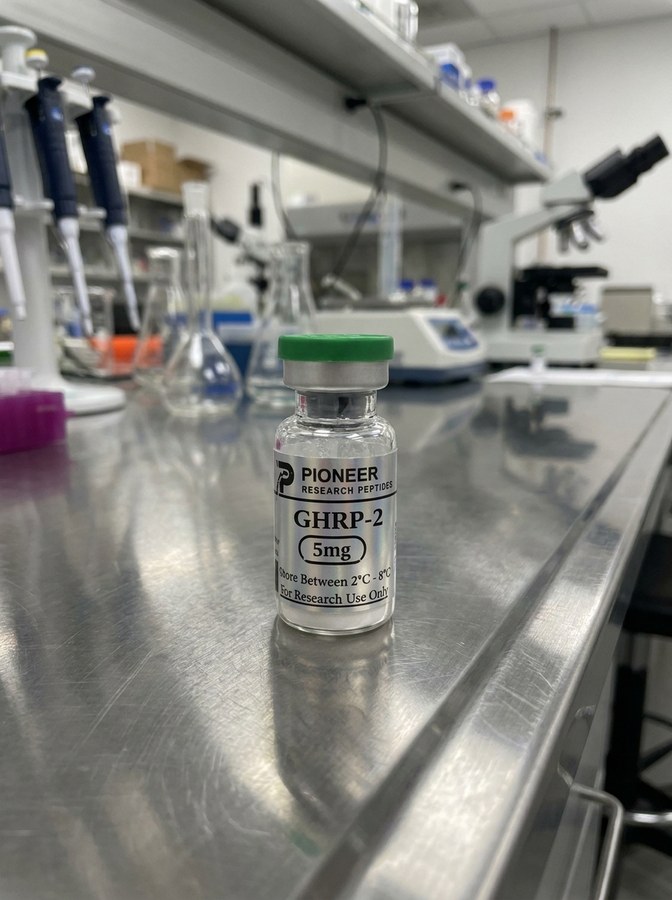
Identity and specification#
| Also known as | Pralmorelin; GH-releasing peptide-2 |
|---|---|
| Sequence | D-Ala-D-2-Nal-Ala-Trp-D-Phe-Lys-NH2 |
| Length | 6 residues, C-terminally amidated |
| Molecular formula | C45H55N9O6 |
| Molecular weight | 817.99 g/mol (average) |
| Monoisotopic mass | 817.43 Da; [M+2H]2+ at m/z 409.7 |
| CAS number | 158861-67-7 |
| Class | Synthetic hexapeptide; ghrelin receptor (GHS-R1a) agonist |
| Appearance | White lyophilised powder |
| Solubility | Bacteriostatic or sterile water |
| Storage | 2–8°C, both sealed and once in solution |
Three of the six residues in GHRP-2 are D-amino acids: D-alanine at position 1, D-2-naphthylalanine at position 2, and D-phenylalanine at position 5. The naphthylalanine is not a proteinogenic amino acid in either configuration. That is deliberate. A short chain of ordinary L-amino acids is cleared quickly by serum peptidases, and the D-substitutions are most of what gives the molecule a usable working life in an assay. The C-terminal amide — the NH2 at the end of the sequence rather than a free acid — does the same job at the other end of the chain, and is one of the things a mass spectrum on the certificate confirms.
The naming is a common source of confusion in the literature. GHRP-2 and pralmorelin are the same compound, and older papers may use the development code KP-102. Where the names disagree, CAS 158861-67-7 does not.
What a certificate for GHRP-2 should show#
Two measurements, reported separately. HPLC gives purity — the share of detected material falling under the target peak. Mass spectrometry gives identity — whether the mass found matches the molecule named on the label. Neither substitutes for the other, and a certificate offering one combined figure is reporting less than it appears to.
Identity is where this compound has a specific trap. The molecular weight printed on most catalogue entries, 817.99, is the average mass, calculated across the natural isotope distribution. A mass spectrometer measures the monoisotopic mass, which for C45H55N9O6 is 817.43. At this size the two differ by more than half a dalton, and expecting to see 817.99 on a spectrum is a common way to misread a perfectly accurate certificate. In practice GHRP-2 is usually reported doubly charged, at m/z 409.7 — the figure the anti-doping literature uses to identify it.
Three impurities are worth looking for, and each follows from how the molecule is assembled.
- The free acid. GHRP-2 is amidated at the C-terminus. A chain that was not fully amidated ends in a free carboxylic acid instead, and is 0.98 Da heavier. That is inside one dalton of the target: it can sit under a single chromatographic peak while remaining visible to a spectrometer with the resolution to separate the two.
- Epimers. With three D-residues in a six-residue chain, a centre that inverts during synthesis produces a molecule of identical formula and identical mass. Mass spectrometry cannot see it at all — there is nothing for it to see. Only the chromatography can, and only if the method resolves it. This is the case where the more impressive-sounding measurement is the blind one.
- Deletion sequences. A chain missing a residue is lighter by that residue's mass: 71 Da for the alanine, 147 for the phenylalanine, 167 for the naphthylalanine, 186 for the tryptophan. These are large, unambiguous gaps, which makes them the easiest of the three to rule out and the least informative to find.
One more thing a purity figure is not. It is a ratio of UV-absorbing material, an area percentage, and not a weight. Counterion, residual water and residual solvent do not appear in it, because the detector does not see them. Net peptide content is a separate measurement by a separate assay, so a vial can carry a high area% and still hold less peptide by mass than the label implies. The two numbers answer different questions, and a certificate that reports only the first has not answered the second. We publish purity as measured for the batch. We do not publish a floor.
None of that is a reason to distrust a certificate. It is a reason to read the method alongside the number, and to read a single percentage with no stated technique as the least useful thing on the page. Our guide to reading a certificate of analysis works through a real one line by line.
Pralmorelin as a licensed product#
GHRP-2 is not a licensed medicine in the United Kingdom, and Pioneer supplies it only as a research reagent. It is worth knowing, though, that the compound holds an authorisation somewhere: in Japan, pralmorelin hydrochloride is marketed by Kaken Pharmaceutical as a preparation used in the assessment of growth hormone deficiency. It is a diagnostic preparation rather than a treatment, and the compound was never marketed for the therapeutic indications it was taken into phase II trials for.
That distinction matters when weighing sources. An authorisation in one country, for one diagnostic purpose, is routinely cited elsewhere as though it settled something general. It does not. Authorisations are granted territory by territory on the dossier submitted, which is why they are sought separately rather than recognised globally, and nothing about the Japanese licence carries any weight here.
Status in sport#
GHRP-2 is named on the World Anti-Doping Agency's Prohibited List, in section S2 under growth hormone and its releasing factors, where it appears as “GHRP-2 (pralmorelin)” alongside GHRP-1 and GHRP-3 to GHRP-6, examorelin, ipamorelin and the ghrelin mimetics. Section S2 is prohibited at all times, in and out of competition, rather than in competition only.
It is also readily detected. Published anti-doping methods report a limit of detection for pralmorelin in urine of around 0.3 ng/mL.
Handling and storage#
Supplied as a lyophilised cake under vacuum. Add solvent slowly down the inside wall of the vial rather than directly onto the powder, and swirl rather than shake — peptides denature at an air-liquid interface, and a vigorous shake makes one. Keep the sealed vial at 2–8°C. Once in solution, refrigerate at 2–8°C, keep it out of the light, and avoid repeated freeze-thaw cycles; each one costs a little intact peptide.
For receptor selectivity, the mass difference between the two, and what each one looks like on a certificate, see our guide to GHRP-2 and GHRP-6 compared.
Sources#
- Synthetic growth hormone-releasing peptides: a historical appraisal — Bowers’ enkephalin-amide observation and the order the GHRPs were made in
- A receptor in pituitary and hypothalamus that functions in growth hormone release — Science, 1996
- Ghrelin is a growth-hormone-releasing acylated peptide from stomach — Nature, 1999
- Analysis of growth hormone-releasing peptides for doping control — the 409.7 ion and the 0.3 ng/mL detection limit
- WADA Prohibited List — section S2, prohibited at all times
- Pralmorelin — development codes KP-102, GPA-748 and WAY-GPA-748, and the Kaken product
Sizes and pricing#
| Size | Price per vial | Availability |
|---|---|---|
| 5mg | £8.50 | Made to order — 1-2 weeks |
| 10mg | £14 | In stock |
Buying more than one? Mix and match any peptide vials: 3 vials 8%, 5 vials 12%, 10 or more 15% off the peptides in your basket. You get whichever is better, the bulk or the volume discount, never both — applied automatically at checkout. How it works.
Batch documentation. Ask about the documentation for the batch we would ship before you order.
Check your certificate#
- Molecular weight 817.99 is the average mass (monoisotopic 817.43). On a mass spectrum, GHRP-2 is usually reported doubly charged at m/z 409.7. Expecting to see 817.99 is a common way to misread an accurate certificate.
- Not GHRP-6. GHRP-6 is 873.03, 55 heavier, and ipamorelin is 711.86. The three are unmistakable from one another.
- The free acid is 0.98 heavier. A chain that was not fully amidated can sit under the same chromatographic peak, so the spectrometer’s resolution matters.
- Epimers have the same mass. With three D-residues in six, an inverted centre gives a molecule of identical formula. Only the chromatography can see it, and only if the method resolves it.
- Purity, with the method named, measured on that batch rather than quoted as a minimum.
Ask about the documentation for the batch we would ship before you order. How to check a certificate yourself: verifying a COA.
What’s in the vial#
| Fill | 5mg or 10mg of peptide per vial |
|---|---|
| Appearance | White lyophilised powder |
| Purity and content | Purity is the share of what was detected that is this peptide. Net peptide content, how much of the powder’s weight is peptide rather than salt and water, is a separate number. How much is in the vial. |
Handling at a glance#
| Solvent | Bacteriostatic or sterile water |
|---|---|
| Sealed vial | 2–8°C, dry and dark. Let it reach room temperature before opening. |
| Once in solution | 2–8°C and out of the light. Avoid thawing and refreezing the same volume. |
| Worth knowing | It contains tryptophan, one of the more light-sensitive residues, so an amber vial or foil wrap is a reasonable default. |
Working out a concentration: the reconstitution calculator. Technique: the reconstitution guide and the storage guide.
What the research covers#
GHRP-2 was taken into phase II trials but never marketed for those indications. Published human work includes a small study in seven healthy men that measured food intake with GHRP-2 against saline, and Japanese studies validating a GHRP-2 test of pituitary growth hormone release in 135 people and comparing it with the insulin tolerance test in 71 patients. In Japan, pralmorelin hydrochloride is authorised as a diagnostic preparation used in assessing growth hormone deficiency. It is not a licensed medicine in the UK. Read the full guide, with sources: GHRP-2 and GHRP-6 Compared.
Published literature#
- Howard AD, Feighner SD, Cully DF, et al. (1996). Science 273(5277):974–7. Cloning of the receptor these compounds act on, the growth hormone secretagogue receptor, now usually called the ghrelin receptor. PubMed 8688086
- Kojima M, Hosoda H, Date Y, et al. (1999). Nature 402(6762):656–60. Identification of ghrelin, the receptor’s natural ligand, from the stomach. PubMed 10604470
- Bowers CY (2012). Methods Enzymol 514:3–32. The originator’s own history of the field, from the first synthetic GHRPs in the 1970s to the discovery of ghrelin. PubMed 22975043
- Laferrère B, Abraham C, Russell CD, et al. (2005). J Clin Endocrinol Metab 90(2):611–4. Small study in seven healthy men measuring food intake during a GHRP-2 infusion, compared with saline. PubMed 15699539
- Chihara K, Shimatsu A, Hizuka N, et al. (2007). Eur J Endocrinol 157(1):19–27. Japanese multicentre study in 135 people validating a GHRP-2 test of pituitary growth hormone release. PubMed 17609397
- Kinoshita Y, Tominaga A, Usui S, et al. (2013). Endocr J 60(1):97–105. Japanese comparison in 71 patients of the GHRP-2 test with the standard insulin tolerance test. Notes that the GHRP-2 test is one of the recommended alternatives in Japan. PubMed 23079545
Listed so the work can be read at source. A paper on this list is evidence of what was studied, not of what any product does.
Questions#
What is GHRP-2?
A synthetic hexapeptide, D-Ala-D-2-Nal-Ala-Trp-D-Phe-Lys-NH2, that acts at the ghrelin receptor (GHS-R1a). GHRP-2 and pralmorelin are the same compound, and older papers may use the code KP-102.
What molecular weight should the certificate show?
817.99 is the average mass printed in catalogues. A mass spectrometer measures the monoisotopic mass, 817.43, and GHRP-2 is usually reported doubly charged at m/z 409.7. 873.03 is GHRP-6.
How should it be stored?
Sealed vial at 2-8°C, dry and dark. Once reconstituted with bacteriostatic or sterile water, keep it at 2-8°C and out of the light, and avoid thawing and refreezing the same volume.
Is there a batch certificate?
Yes. The certificate for the current batch is available on request: email orders@pioneerpeptides.co.uk with the product and size.
Is it for human use?
No. It is supplied for laboratory research only, and we do not give guidance on human or animal use.
A batch-specific Certificate of Analysis is available on request. New to handling lyophilised material? See our reconstitution guide, storage guide and how to read a COA.