DSIP
Batch documentation. Ask what exists for the batch we would ship before you order — email us ›
Delta sleep-inducing peptide
Delta sleep-inducing peptide, investigated in research on sleep regulation, stress response and neuromodulation.
Mechanism#
A small peptide that crosses the blood-brain barrier and modulates neurotransmission. Research examines its effects on sleep architecture, stress hormones and antioxidant defence.
Areas of research#
- Sleep-architecture and EEG models
- Stress-response and HPA-axis research
- Neuromodulation
- Antioxidant pathways

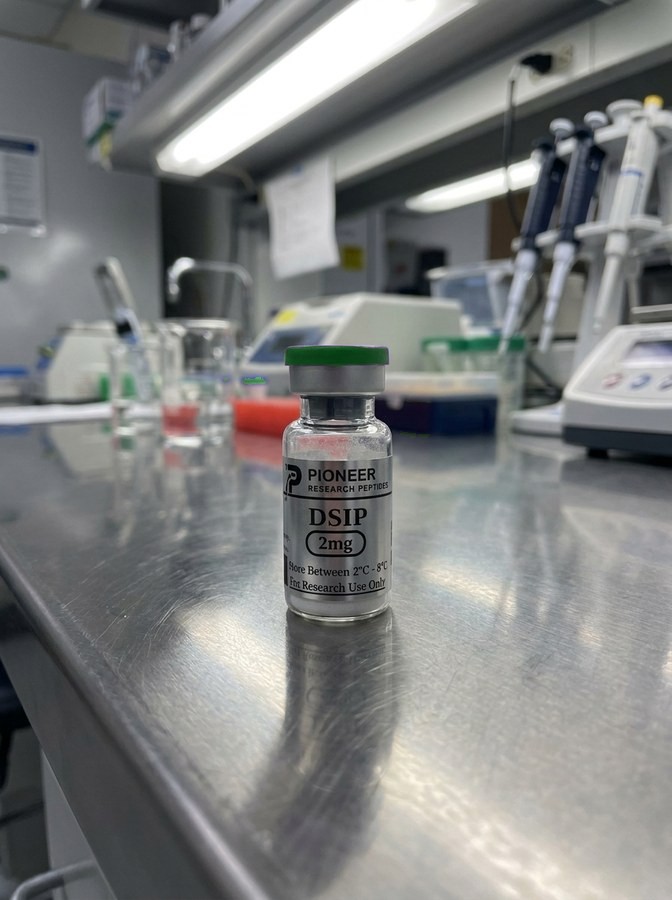
Identity and specification#
| Also known as | Delta sleep-inducing peptide |
|---|---|
| Sequence | Trp-Ala-Gly-Gly-Asp-Ala-Ser-Gly-Glu (WAGGDASGE) |
| Length | 9 residues (nonapeptide) |
| Molecular formula | C35H48N10O15 |
| Molecular weight | 848.83 g/mol |
| CAS number | 62568-57-4 |
| Class | Endogenous neuropeptide, first isolated from rabbit cerebral venous blood |
| Appearance | White lyophilised powder |
| Solubility | Water — highly hydrophilic |
| Storage | 2–8°C, both sealed and once in solution |
Three glycines out of nine. Glycine has no side chain at all, which makes it the most flexible residue there is. With three of them — at positions 3, 4 and 8 — plus no hydrophobic core to speak of, DSIP has essentially no fixed structure in solution. That is unusual, and it is part of why the peptide has been difficult to pin down: there is no rigid shape for a receptor to be matched against, and no endogenous precursor protein has ever been identified for it.
The residue you measure it by is the first one lost. The single tryptophan at position 1 is the only chromophore in the molecule, so it is what makes A280 quantification possible here — and it sits at the exposed N-terminus, which is precisely where an aminopeptidase starts. The reported in-vitro half-life of around fifteen minutes is attributed to exactly that enzyme. The practical consequence is that a solution which has sat around may read lower at 280 nm not because the peptide has gone, but because its first residue has.
The sequence is otherwise about as hydrophilic as peptides get: two free carboxylates from Asp5 and Glu9, a serine hydroxyl, and small residues throughout. It dissolves in plain water immediately and needs no organic co-solvent.
Handling and storage#
Dissolves readily in water. Keep the sealed vial at 2–8°C; once in solution, refrigerate at 2–8°C, keep it out of the light given the tryptophan, and avoid repeated freeze-thaw cycles. Of everything in this catalogue this is one of the stronger arguments for splitting a reconstituted vial into single-use aliquots before freezing: the N-terminal residue is both what you measure and what goes first.
For aliquoting, freeze-thaw damage and what actually degrades in a vial, see our guide to storing research peptides.
Sizes and pricing#
| Size | Price per vial | Availability |
|---|---|---|
| 2mg | £8 | Made to order — 1-2 weeks |
| 5mg | £14 | In stock |
| 10mg | £23 | Made to order — 1-2 weeks |
Buying more than one? Mix and match any peptide vials: 3 vials 8%, 5 vials 12%, 10 or more 15% off the peptides in your basket. You get whichever is better, the bulk or the volume discount, never both — applied automatically at checkout. How it works.
Check your certificate#
- Molecular weight 848.81 (monoisotopic 848.33). On a mass spectrum, expect ions near 849.3 (singly charged) and 425.2 (doubly charged).
- The β-aspartyl isomer has exactly the same mass. Aspartic acid can rearrange this way during synthesis and storage, and mass spectrometry alone cannot tell the two apart. Only chromatography separates them.
- Tryptophan oxidation adds 16 or 32. Peaks near 864.3 or 880.3 point to oxidised material. A peak near 662.6 is DSIP without its first residue.
- Purity, with the method named, measured on that batch rather than quoted as a minimum. Because of the β-aspartyl problem, the method matters more for DSIP than for many peptides.
Ask about the documentation for the batch we would ship before you order. How to check a certificate yourself: verifying a COA.
What’s in the vial#
| Fill | 2mg, 5mg or 10mg of peptide per vial |
|---|---|
| Appearance | White lyophilised powder |
| Purity and content | Purity is the share of what was detected that is this peptide. Net peptide content, how much of the powder’s weight is peptide rather than salt and water, is a separate number. How much is in the vial. |
Handling at a glance#
| Solvent | Bacteriostatic or sterile water. Highly hydrophilic; it dissolves in plain water and needs no organic co-solvent. |
|---|---|
| Sealed vial | 2–8°C, dry and dark. Let it reach room temperature before opening. |
| Once in solution | 2–8°C and out of the light. Avoid thawing and refreezing the same volume. |
| Worth knowing | The tryptophan at position 1 is the only chromophore, so it is what a 280 nm reading measures, and it is also the first residue an aminopeptidase removes. A solution that has stood may read lower at 280 nm because that residue has gone. |
Working out a concentration: the reconstitution calculator. Technique: the reconstitution guide and the storage guide.
What the research covers#
DSIP was named after one effect seen in rabbits in 1977, and no gene, precursor protein or receptor for it has since been found. Human studies in the 1980s and 1990s were small, several from the group that discovered it. The double-blind studies, one of them in 16 adults, found effects their authors judged weak or of little clinical significance, and two hormone studies in healthy volunteers found no change. Most research since the 1990s has been in animals, much of it from Russian laboratories. It is not a licensed medicine anywhere. Read the full guide, with sources: DSIP: The Sleep Peptide Nobody Has Found a Gene For.
Published literature#
- Schoenenberger GA, Monnier M (1977). Proc Natl Acad Sci U S A 74(3):1282–6. The first description of DSIP: isolated from rabbits, its sequence, and blind EEG testing of the synthetic peptide and related fragments in rabbits. PubMed 265572
- Schoenenberger GA, Maier PF, Tobler HJ, et al. (1978). Pflugers Arch 376(2):119–29. Sequence confirmation and synthesis, with blind EEG testing of nine synthetic peptides in 61 rabbits, comparing the α-aspartyl and β-aspartyl forms. PubMed 568769
- Graf MV, Saegesser B, Schoenenberger GA (1987). Peptides 8(4):599–603. How quickly DSIP and two analogues break down in human and rat blood. PubMed 3628078
- Mikhaleva II, Prudchenko IA, Ivanov VT, et al. (2011). Peptides 32(4):826–31. Database search proposing a family of human enzymes that contain a DSIP-like sequence as possible precursors. PubMed 21262293
Listed so the work can be read at source. A paper on this list is evidence of what was studied, not of what any product does.
Questions#
What is DSIP?
Delta sleep-inducing peptide: a nine-residue peptide, Trp-Ala-Gly-Gly-Asp-Ala-Ser-Gly-Glu, with a free amine and a free acid at its ends. It was first described in 1977 from work in rabbits, and no gene, precursor protein or receptor for it has been identified.
What molecular weight should the certificate show?
848.81 (monoisotopic 848.33), usually seen as ions near 849.3 and 425.2. The inactive β-aspartyl isomer has the same mass, so the chromatography and its method matter as much as the mass.
How should it be stored?
Sealed vial at 2-8°C, dry and dark. Once reconstituted with bacteriostatic or sterile water, keep it at 2-8°C out of the light, and avoid thawing and refreezing the same volume.
Is there a batch certificate?
Yes. The certificate for the current batch is available on request: email orders@pioneerpeptides.co.uk with the product and size.
Is it for human use?
No. It is supplied for laboratory research only, and we do not give guidance on human or animal use.
A batch-specific Certificate of Analysis is available on request. New to handling lyophilised material? See our reconstitution guide, storage guide and how to read a COA.