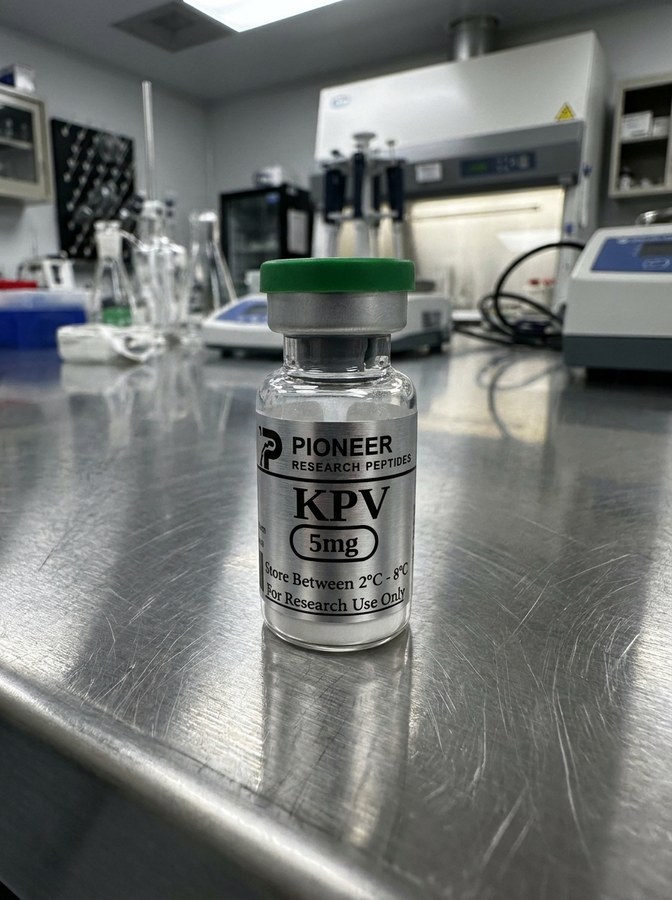
KPV
Batch documentation. Ask what exists for the batch we would ship before you order — email us ›
Tripeptide (Lys-Pro-Val)
A C-terminal tripeptide of α-MSH studied in research on inflammatory signalling (NF-κB) in gut and skin cell models.
Mechanism#
The active C-terminal tripeptide of the α-MSH hormone. It enters cells and dampens inflammatory signalling (such as NF-κB), which is why it is studied in models of gut and tissue inflammation.
Areas of research#
- Inflammatory-signalling research
- Melanocortin signalling
- Gut-inflammation models
- Immune-modulation studies

Sizes and pricing#
| Size | Price per vial | Availability |
|---|---|---|
| 5mg | £20 | Made to order — 1-2 weeks |
| 10mg | £30 | Made to order — 1-2 weeks |
Buying more than one? Mix and match any peptide vials: 3 vials 8%, 5 vials 12%, 10 or more 15% off the peptides in your basket. You get whichever is better, the bulk or the volume discount, never both — applied automatically at checkout. How it works.
Check your certificate#
- Molecular weight 342.4 for KPV free acid, C16H30N4O4 (monoisotopic 342.23). On a mass spectrum, expect the singly charged ion near 343.2.
- 341.5 is the amide, C16H31N5O3 (monoisotopic 341.24), the form found at the end of α-MSH; its singly charged ion sits near 342.2. The two are about one dalton apart, and the certificate should say which it describes.
- 344.4 is Lys-Pro-Thr, which includes KdPT, a different tripeptide based on interleukin-1β. D-residue versions of KPV have exactly the same mass as KPV; only a chiral method separates them.
- Purity, with the method named, measured on that batch rather than quoted as a minimum. A purity figure with no mass cannot say which of these is in the vial.
Ask about the documentation for the batch we would ship before you order. How to check a certificate yourself: verifying a COA.
What’s in the vial#
| Fill | 5mg or 10mg of peptide per vial |
|---|---|
| Appearance | Lyophilised powder |
| Purity and content | Purity is the share of what was detected that is this peptide. Net peptide content, how much of the powder’s weight is peptide rather than salt and water, is a separate number. How much is in the vial. |
Handling at a glance#
| Solvent | Bacteriostatic or sterile water. A very small, water-soluble peptide. |
|---|---|
| Sealed vial | 2–8°C, dry and dark. Let it reach room temperature before opening. |
| Once in solution | 2–8°C. Avoid thawing and refreezing the same volume. |
| Worth knowing | With two free amino groups, KPV is commonly made as an acetate or trifluoroacetate salt. The counter-ion adds weight that is not peptide. |
Working out a concentration: the reconstitution calculator. Technique: the reconstitution guide and the storage guide.
What the research covers#
KPV has a small, entirely preclinical literature: cell-culture work on intestinal epithelial, immune and skin cells measuring signalling pathways and cytokine release; rodent studies, mostly mouse colitis models; and delivery-system studies that use KPV as the cargo in nanoparticles and hydrogels, which describe the formulation in a mouse rather than the unformulated peptide. The papers on KPV itself number in the dozens, most from three groups in Dallas, Münster and Atlanta. We have found no published human clinical trial, and it is not a licensed medicine in the UK. Read the full guide, with sources: KPV: Three Residues of α-MSH, With or Without the Amide.
Published literature#
- Getting SJ, Schiöth HB, Perretti M (2003). J Pharmacol Exp Ther 306(2):631–7. Mouse study from the William Harvey Research Institute, London, comparing KPV with α-MSH and other melanocortin peptides. The authors concluded that KPV is unlikely to act through melanocortin receptors. PubMed 12750433
- Dalmasso G, Charrier-Hisamuddin L, Nguyen HT, et al. (2008). Gastroenterology 134(1):166–78. Cell and mouse study from Emory University, Atlanta, of KPV uptake through the PepT1 di- and tripeptide transporter in intestinal and immune cells, and of NF-κB and MAP kinase signalling. PubMed 18061177
- Kannengiesser K, Maaser C, Heidemann J, et al. (2008). Inflamm Bowel Dis 14(3):324–31. Mouse study from the University of Münster, Germany, including mice without a working MC1 receptor, to test whether the effects of KPV depend on that receptor. PubMed 18092346
- Xiao B, Xu Z, Viennois E, et al. (2017). Mol Ther 25(7):1628–1640. Formulation study from Southwest University, China: KPV loaded into hyaluronic acid-coated nanoparticles within a chitosan and alginate hydrogel, examined in cells and in mice. PubMed 28143741
Listed so the work can be read at source. A paper on this list is evidence of what was studied, not of what any product does.
Questions#
What is KPV?
The tripeptide Lys-Pro-Val, the last three residues (11-13) of alpha-melanocyte-stimulating hormone (α-MSH). The name can describe a free acid or an amide, which are different compounds.
What molecular weight should the certificate show?
342.4 for KPV free acid (monoisotopic 342.23, ion near 343.2) or 341.5 for the amide (monoisotopic 341.24, ion near 342.2). The certificate should say which form it describes. A mass near 344.4 is Lys-Pro-Thr, a different peptide.
How should it be stored?
Sealed vial at 2-8°C, dry and dark. Once reconstituted with bacteriostatic or sterile water, keep it at 2-8°C and avoid thawing and refreezing the same volume.
Is there a batch certificate?
Yes. The certificate for the current batch is available on request: email orders@pioneerpeptides.co.uk with the product and size.
Is it for human use?
No. It is supplied for laboratory research only, and we do not give guidance on human or animal use.
A batch-specific Certificate of Analysis is available on request. New to handling lyophilised material? See our reconstitution guide, storage guide and how to read a COA.