Cartalax
Short-chain peptide (Khavinson class)
A short synthetic 'bioregulator' peptide studied for its proposed role in cartilage and connective-tissue gene expression.
Mechanism#
Part of the Khavinson family of peptide bioregulators thought to bind specific DNA regions and influence tissue-specific gene expression — researched for cartilage and vascular tissue.
Areas of research#
- Peptide-bioregulator research
- Cartilage and connective tissue
- Gene-expression models
- Aging-research peptides

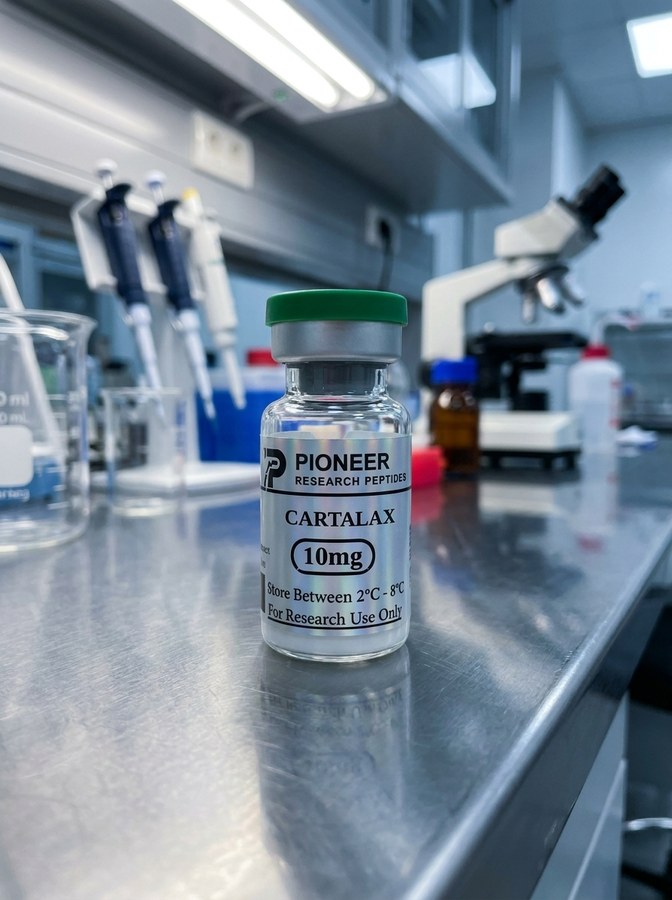
Identity and specification#
| Sequence | Ala-Glu-Asp (AED) |
|---|---|
| Length | 3 residues |
| Molecular formula | C12H19N3O8 |
| Molecular weight | 333.30 g/mol |
| CAS number | None verified — see below |
| Also known as | AED; T-31 |
| Class | Short synthetic peptide, Khavinson bioregulator series |
| Appearance | White lyophilised powder |
| Solubility | Bacteriostatic or sterile water |
| Storage | 2–8°C, both sealed and once in solution |
Why there is no CAS number here#
Most suppliers print one. We could not verify it. A single website carries a CAS number for Cartalax and no chemical database corroborates it; ChemicalBook's own entry for the compound leaves the CAS field blank and lists the molecular weight as zero. Rather than copy a number we cannot stand behind, we have left the field empty and said why.
The molecular weight is a separate matter and we are confident in it. Some pages state roughly 345 Da for Cartalax. That figure is wrong: alanine plus glutamate plus aspartate, less two molecules of water for the two peptide bonds, gives C12H19N3O8 and 333.30. You can check that arithmetic yourself, which is rather the point.
What it is#
Cartalax is the tripeptide alanine–glutamate–aspartate, from the Khavinson series of short peptide bioregulators developed at the St Petersburg Institute of Bioregulation and Gerontology. The series' founding proposal is that peptides of two to four residues are small enough to reach the nucleus and interact with specific DNA sequences, influencing tissue-specific gene expression rather than signalling through a surface receptor.
Note how close the family sits. Cartalax is AED; Cortagen is AEDP; Bronchogen AEDL; Cardiogen AEDR; Epithalon AEDG. Four of those are Cartalax plus one residue. Transcription errors between them are common in retail listings.
What the literature actually contains#
Very little, and we would rather say so. A search restricted to the name “Cartalax” across the main databases returns essentially one paper — and that one is physical chemistry, on oxidation of lipid micellar systems, rather than biology.
There is a somewhat larger body of work on the AED tripeptide as such: organotypic tissue culture of kidney and skin, stem-cell differentiation, gene expression in mesenchymal stromal cells. Every substantive study we could trace has Khavinson or a direct institute collaborator among the authors, and most use a tissue-culture model that is close to unique to that group. We found no independent replication and no human trials.
Cartilage and joint claims are common in retail copy for this compound. We could not find support for them, so we are not making them.
Handling and storage#
Supplied lyophilised. Keep the sealed vial at 2–8°C, protected from light and moisture, and let it warm to room temperature before opening. Reconstitute gently down the side of the vial. Store the solution at 2–8°C and avoid repeated freeze-thaw cycles. See our reconstitution guide and the bioregulator guide.
Sizes and pricing#
| Size | Price per vial | Availability |
|---|---|---|
| 10mg | £25 | Made to order — 1-2 weeks |
Buying more than one? Mix and match any peptide vials: 3 vials 8%, 5 vials 12%, 10 or more 15% off the peptides in your basket. You get whichever is better, the bulk or the volume discount, never both — applied automatically at checkout. How it works.
Check your certificate#
- Molecular weight 333.30 (monoisotopic 333.12), C12H19N3O8. On a mass spectrum, expect the singly charged ion near 334.1.
- About 345 is wrong. Some pages state roughly 345 for Cartalax. Alanine plus glutamate plus aspartate, less two waters for the two peptide bonds, gives 333.30.
- One residue from its neighbours. Epithalon (AEDG) is 390.35 and Cortagen (AEDP) is 430.41; both are Cartalax plus one residue, and transcription errors between them are common.
- No verified CAS number. We could not verify one in any chemical database, so a CAS number on a certificate is not something to check identity against. The mass is.
- Purity, with the method named, measured on that batch rather than quoted as a minimum.
Ask about the documentation for the batch we would ship before you order. How to check a certificate yourself: verifying a COA.
What’s in the vial#
| Fill | 10mg of peptide per vial |
|---|---|
| Appearance | White lyophilised powder |
| Purity and content | Purity is the share of what was detected that is this peptide. Net peptide content, how much of the powder’s weight is peptide rather than salt and water, is a separate number. How much is in the vial. |
Handling at a glance#
| Solvent | Bacteriostatic or sterile water |
|---|---|
| Sealed vial | 2–8°C, protected from light and moisture. Let it reach room temperature before opening. |
| Once in solution | 2–8°C. Avoid thawing and refreezing the same volume. |
| Worth knowing | Short peptides are not automatically more robust than long ones. Three residues still call for the standard handling. |
Working out a concentration: the reconstitution calculator. Technique: the reconstitution guide and the storage guide.
What the research covers#
Very little. A search restricted to the name Cartalax returns essentially one paper, and that is physical chemistry on the oxidation of lipid micellar systems rather than biology. Work on the AED tripeptide as such is somewhat larger: organotypic culture of kidney and skin tissue, stem-cell differentiation, and gene expression in mesenchymal stromal cells. Every substantive study we could trace has Khavinson or a direct institute collaborator among its authors. We found no independent replication and no human trials, and no support for the cartilage and joint claims common in retail copy. Read the full guide, with sources: Peptide Bioregulators Explained: Epithalon, Cortagen, Cartalax.
Published literature#
- Khavinson VK, Popovich IG, Linkova NS, et al. (2021). Molecules 26(22):7053. Systematic review by the St Petersburg group setting out their gene-regulation hypothesis for short peptides. PubMed 34834147
Listed so the work can be read at source. A paper on this list is evidence of what was studied, not of what any product does.
Questions#
What is Cartalax?
The tripeptide Ala-Glu-Asp (AED), also called T-31, from the Khavinson series of short peptide bioregulators developed at the St Petersburg Institute of Bioregulation and Gerontology.
What molecular weight should the certificate show?
333.30 (monoisotopic 333.12), usually seen as an ion near 334.1. A figure of about 345 is wrong for this sequence; 390.35 is Epithalon and 430.41 is Cortagen.
Why is there no CAS number?
We could not verify one. A single website carries a CAS number for Cartalax and no chemical database corroborates it, so we have left the field empty rather than copy it.
How should it be stored?
Sealed vial at 2-8°C, protected from light and moisture, brought to room temperature before opening. Once reconstituted with bacteriostatic or sterile water, keep it at 2-8°C and avoid thawing and refreezing the same volume.
Is it for human use?
No. It is supplied for laboratory research only, and we do not give guidance on human or animal use.
A batch-specific Certificate of Analysis is available on request. New to handling lyophilised material? See our reconstitution guide, storage guide and how to read a COA.