
Peptide Bioregulators Explained: Epithalon, Cortagen, Cartalax
For laboratory research use only. Not for human or veterinary use.
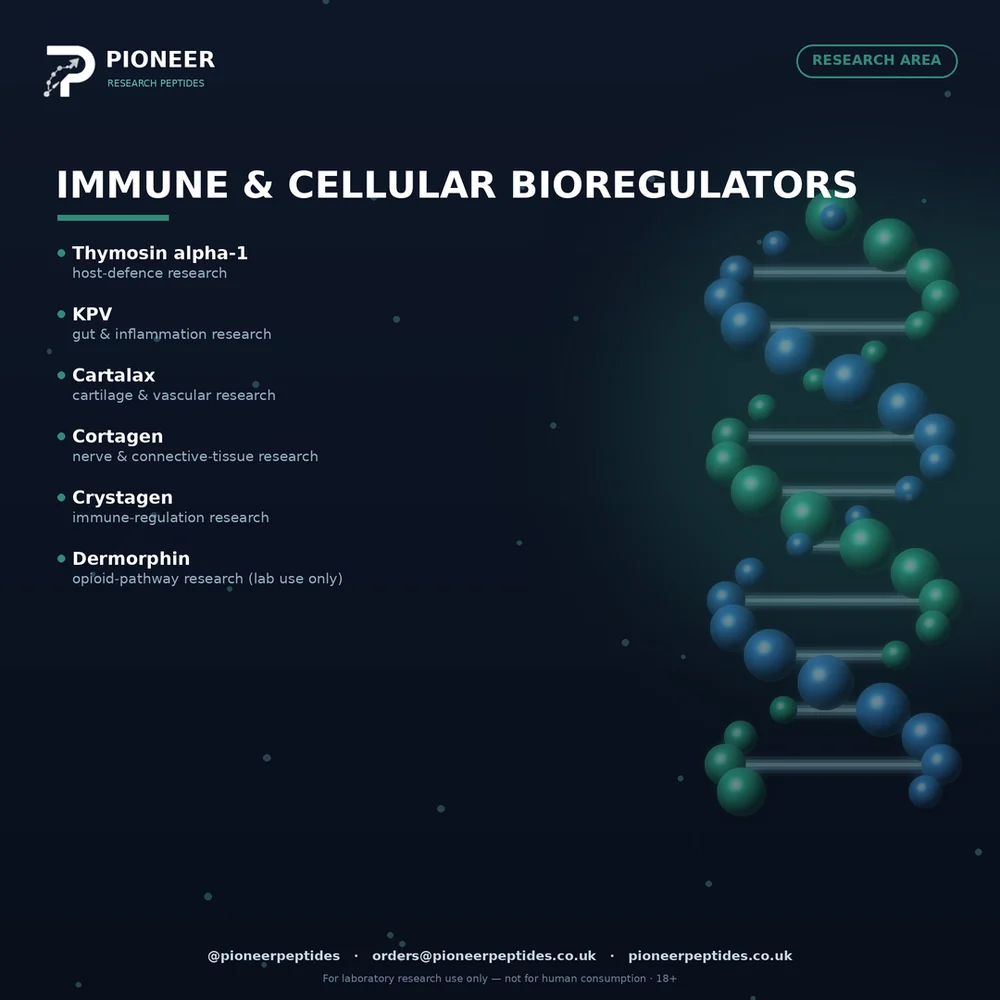
Bioregulators are a distinct and often misunderstood category of research peptide. They come from a specific scientific tradition, they're structurally unusual, and they're studied differently from the better-known signalling peptides.
Where they come from
Peptide bioregulators emerged from Soviet and later Russian research beginning in the 1970s, associated primarily with the St Petersburg Institute of Bioregulation and Gerontology. The research programme investigated short peptides isolated from animal tissues, and later synthesised versions of the same sequences.
Much of the foundational literature was published in Russian, which is part of why these compounds are less familiar in English-language research than peptides of Western origin. The body of work is substantial but unevenly translated.
What makes them structurally distinct
Most research peptides are moderately sized — often 15 to 40 amino acids. Bioregulators are strikingly short, typically two to four residues.
Epithalon, for instance, is a tetrapeptide: alanine-glutamate-aspartate-glycine. Four amino acids. That's small even by peptide standards.
The theoretical framework proposed for them is tissue-specific gene regulation — the hypothesis being that these very short sequences interact with DNA or chromatin-associated proteins to influence transcription in particular tissue types. Each bioregulator is associated in the literature with a specific tissue of origin.
It's worth being clear-eyed: this remains an area where the mechanistic evidence base is less developed than for well-characterised receptor-binding peptides, and much of the supporting work sits outside mainstream Western literature. That's a legitimate reason for research interest and equally a reason for methodological caution.
The main compounds
Epithalon — a tetrapeptide studied in relation to telomerase activity and circadian regulation. The most widely known of the group, and the one with the largest English-language literature.
Cortagen — associated in the literature with nerve and connective tissue, studied in peripheral nerve research models.
Crystagen — studied in immune-system research contexts.
Cartalax — associated with cartilage and connective tissue, appearing in joint and vascular research literature.
Thymosin alpha-1 — sometimes grouped here, though it sits somewhat apart: it's longer at 28 residues, has a substantially larger Western literature, and is studied extensively in immunological research.
Practical handling
Short peptides are not automatically more robust. Standard practice applies:
- Lyophilised material stored at 2–8°C, protected from light and moisture
- Reconstituted with bacteriostatic or sterile water — see the solvent guide
- Solvent run down the vial wall, never onto the powder; swirl, never shake
- Reconstituted material refrigerated and used within its stability window
One genuine advantage of very short sequences: fewer coupling steps during synthesis means fewer opportunities for truncation errors, which is one reason well-made bioregulators often show figures. That's a reason to expect a good number, not a reason to skip verifying it.
Verification matters more here, not less
Because the literature is fragmented and the market smaller, documentation discipline is particularly important with this group.
A four-residue peptide has a low molecular weight, which makes mass-spectrometry identity confirmation straightforward and unambiguous. There's no good reason for a supplier to omit it. Insist on seeing both purity and identity data — see how to read a COA and what a purity figure actually means.
In our catalogue
- Epithalon — telomerase and circadian research
- Cortagen — nerve and connective tissue research
- Crystagen — immune regulation research
- Cartalax — cartilage and vascular research
- Thymosin alpha-1 — immune research
- FOXO4-DRI — cellular senescence research
All independently batch tested, with a batch-specific certificate of analysis on request.
Pioneer Research Peptides — UK supplier of research peptides.
For laboratory research use only — not for human consumption. 18+.
Research-grade peptides, documented
Every Pioneer compound is Independently batch tested, with a batch-specific Certificate of Analysis available on request.