
Copper Peptides in Research: GHK-Cu and AHK-Cu
For laboratory research use only. Not for human or veterinary use.
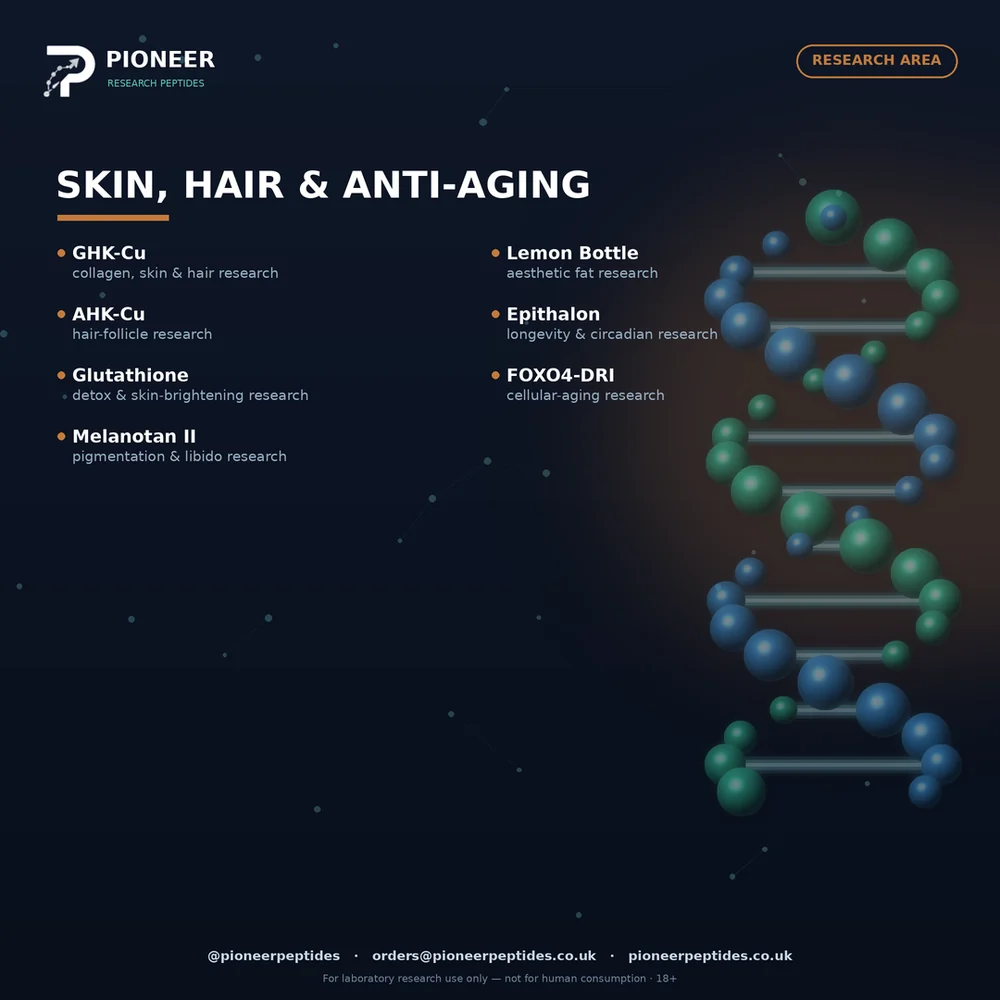
Copper peptides are among the most-studied compounds in dermatological and connective-tissue research literature. Here's what they are, why the copper matters, and how they differ from one another.
What makes a copper peptide
A copper peptide is a short amino acid sequence bound to a copper(II) ion. The peptide acts as a chelator — it holds the metal ion in a specific geometric arrangement rather than leaving it free in solution.
That distinction is the whole point. Free copper ions are reactive and can drive oxidative chemistry indiscriminately. Bound into a peptide complex, the copper is delivered in a controlled, stable form, and the complex behaves as a discrete molecule with its own binding characteristics.
The blue colour of a reconstituted copper peptide solution comes from the copper complex itself. It is expected, not a sign of contamination.
GHK-Cu
GHK is glycyl-L-histidyl-L-lysine — a tripeptide first isolated from human plasma in the 1970s. Bound to copper it becomes GHK-Cu.
Research literature focuses on its interaction with extracellular matrix components. Published work examines its relationship to collagen and elastin synthesis pathways, matrix metalloproteinase regulation, and gene-expression profiles in fibroblast models. It appears widely in studies of tissue remodelling and skin-science research.
GHK-Cu is the most extensively documented compound in this group, with a research literature spanning several decades.
AHK-Cu
AHK is alanyl-L-histidyl-L-lysine. Structurally similar to GHK — the glycine at position one is replaced by alanine — and likewise studied as a copper complex.
The research emphasis differs. AHK-Cu appears predominantly in hair-follicle literature, particularly work examining dermal papilla cell models and follicular growth-phase signalling. The two compounds are frequently studied side by side precisely because the single-residue difference produces different research profiles.
Handling copper peptides in the laboratory
Copper complexes have practical quirks worth knowing:
Light sensitivity. Copper peptide solutions degrade faster under light exposure than many other peptides. Amber vials and dark storage are standard practice.
Solvent choice matters. Bacteriostatic water is the usual choice for multi-draw work. Some protocols specify sterile water. See our solvent guide for the distinction.
Colour is diagnostic. A clear blue solution is normal. Cloudiness, particulates or a colour shift toward green or brown suggests degradation or contamination — discard rather than use.
Don't shake. As with all peptides, swirl gently. Agitation denatures peptide structure. Full technique in our reconstitution guide.
Cold storage. Lyophilised at 2–8°C protected from light; reconstituted material refrigerated and used within its stability window. See storage guidance.
Blends containing copper peptides
Copper peptides appear in several multi-compound research blends, combined with repair-focused compounds. Where a blend contains GHK-Cu, the same handling considerations apply to the whole preparation — light protection, gentle reconstitution, cold storage.
Sourcing considerations
Two points specific to this group:
Copper content should be specified. The complex has a defined stoichiometry. A certificate that reports peptide purity without addressing the copper component is incomplete for a metal complex.
Colour is not a purity indicator. A vivid blue solution tells you copper is present. It tells you nothing about the purity of the peptide or whether the sequence is correct. That still requires HPLC and mass spectrometry.
In our catalogue
- GHK-Cu — collagen and matrix research
- AHK-Cu — hair follicle research
- GLOW Blend — GHK-Cu with repair compounds
- KLOW Blend — four-compound research blend
All supplied Independently batch tested, with a batch-specific COA.
Pioneer Research Peptides — UK supplier of research peptides.
For laboratory research use only — not for human consumption. 18+.
Research-grade peptides, documented
Every Pioneer compound is Independently batch tested, with a batch-specific Certificate of Analysis available on request.