
What Are Research Peptides? Plain-English Introduction
For laboratory research use only. Not for human or veterinary use.
The word "peptide" gets used a lot and explained rarely. Here's what these compounds actually are, why laboratories study them, and what separates research-grade material from everything else.
The simple definition
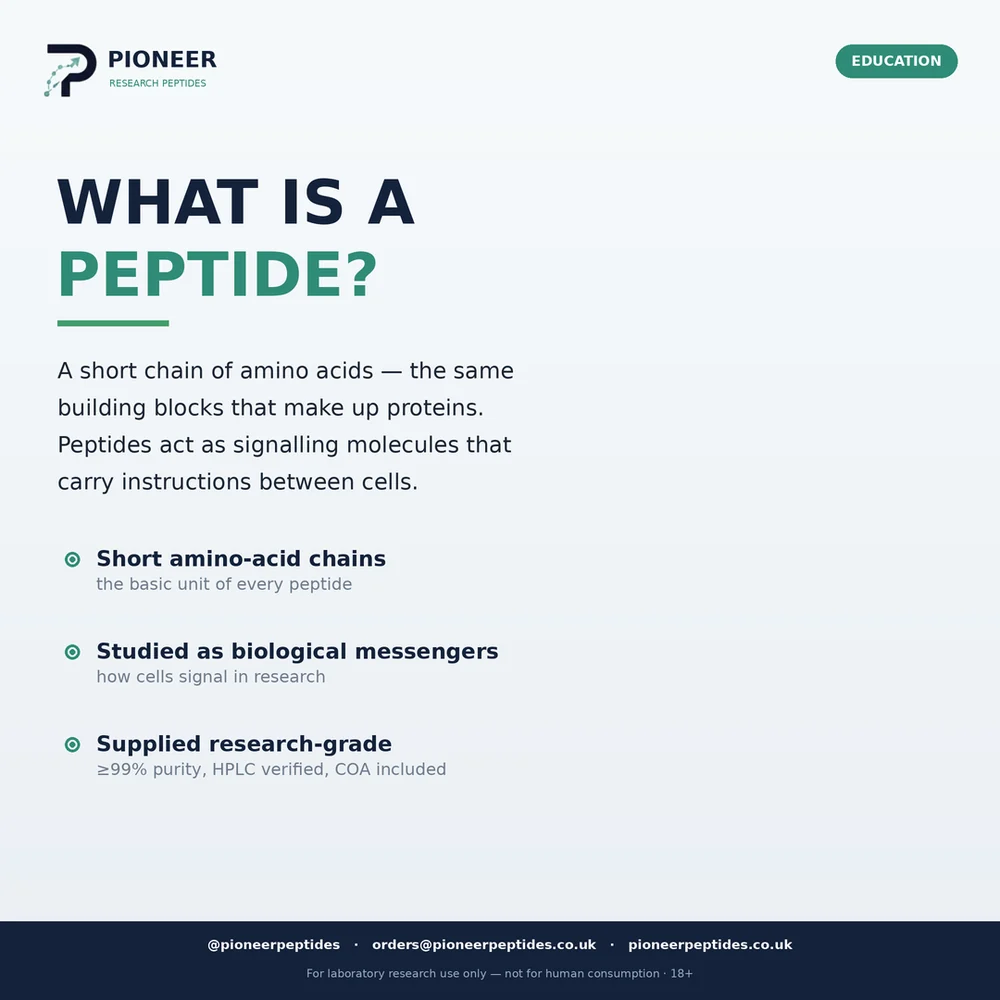
A peptide is a short chain of amino acids.
Amino acids are the building blocks of proteins. Link a few together — typically fewer than fifty — and you have a peptide. Link hundreds and you have a protein. That's the whole distinction: length.
Your body makes thousands of them. Insulin is a peptide. So is oxytocin. They are among the most common signalling molecules in biology.
What they do in the body
Peptides mostly work as messengers. A peptide binds to a receptor on a cell — the way a key fits a lock — and that binding tells the cell to do something. The specificity of that interaction is what makes peptides interesting scientifically: a given peptide binds particular receptors and not others, so its effects in a research model can be studied with precision.
This is why the descriptions of research compounds reference targets and pathways. GHK-Cu is studied in relation to collagen and elastin. BPC-157 appears in tissue-repair literature. Semax is studied in relation to BDNF pathways. The compound and its receptor target are the scientifically meaningful pair.
Why laboratories study them
Peptides sit in a useful middle ground. Small molecules are cheap but often blunt. Large proteins are precise but difficult to produce and handle. Peptides offer meaningful specificity while remaining synthesisable at scale — which is why peptide research has expanded so rapidly across metabolic, regenerative, cosmetic and neurological fields.
How research peptides are made
Modern research peptides are produced by solid-phase peptide synthesis: the chain is assembled one amino acid at a time on a solid support, then cleaved, purified and freeze-dried into the white lyophilised powder you receive in a vial.
That purification step is where quality is won or lost. Synthesis inevitably produces truncated sequences and by-products. Purification removes them. How well it removes them is exactly what a purity figure measures.
What "research grade" actually means
It means the material is manufactured, tested and supplied for laboratory research use only — not for human or veterinary use, not for diagnostic or therapeutic purposes.
Practically, a serious research supplier should provide:
- A purity figure determined by HPLC, reported as measured for your lot rather than stated as a blanket minimum
- Identity confirmation, ideally by mass spectrometry
- A batch-specific Certificate of Analysis — not a generic document
- Correct cold-chain handling and clear storage instructions
- Clear research-use-only labelling
Anything less and you don't know what's in the vial — which makes any result from it unreliable.
The questions worth asking any supplier
- What's the purity, and by what method?
- Can I see the COA for the batch you'd ship me?
- Does the batch number on the certificate match the vial?
- How is it stored and shipped?
Suppliers with proper documentation answer these immediately.
Where we stand
Every Pioneer compound is Independently batch tested, with a batch-specific Certificate of Analysis available on request and same-day UK dispatch. Documented, traceable, research-grade — that's the whole proposition.
Pioneer Research Peptides — UK supplier of research peptides for laboratory use. Independently tested by batch, certificates published with verification keys at the COA library.
For laboratory research use only — not for human consumption. 18+.
Research-grade peptides, documented
Every Pioneer compound is Independently batch tested, with a batch-specific Certificate of Analysis available on request.