GHK-Cu
Batch documentation. Ask what exists for the batch we would ship before you order — email us ›
Copper tripeptide-1
A naturally occurring copper-binding tripeptide studied in skin and extracellular-matrix research: copper binding, fibroblast gene expression, and collagen turnover in cell and wound models.
Mechanism#
A copper-carrying tripeptide naturally present in plasma. Published literature describes a role in tissue-remodelling signalling, including collagen and elastin synthesis, and it is widely used in skin-science and connective-tissue research.
Areas of research#
- Collagen and extracellular-matrix turnover
- Skin-remodelling and extracellular-matrix research
- Wound-closure models
- Antioxidant and matrix-remodelling pathways

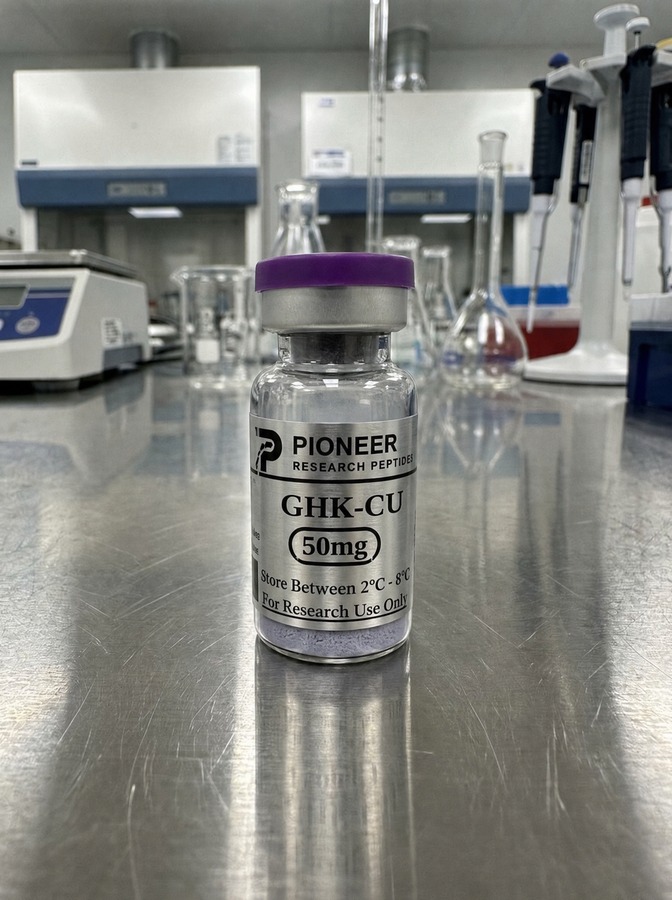
Identity and specification#
| Also known as | Copper tripeptide-1; glycyl-L-histidyl-L-lysine copper(II) |
|---|---|
| Sequence | Gly-His-Lys, complexed with Cu(II) |
| Molecular formula | C14H22CuN6O4 |
| Molecular weight | 401.91 g/mol |
| CAS number | 89030-95-5 (complex); 49557-75-7 is the free tripeptide GHK |
| Free peptide | GHK, C14H24N6O4, 340.38 g/mol |
| Supplied as | Acetate salt — C16H25CuN6O6, 460.96 g/mol. A stated milligram figure refers to the complex, not the salt. |
| Class | Copper(II) tripeptide complex |
| Appearance | Blue to blue-violet powder |
| Solubility | Water |
| Storage | Sealed at 2–8°C, protected from light and moisture |
Count the hydrogens. Free GHK is C14H24N6O4. The copper complex is C14H22CuN6O4 — two hydrogens fewer, not the same formula with a copper added. Those two protons are released when Cu(II) binds, because the copper coordinates through the deprotonated amide nitrogen of the glycine-histidine bond alongside the histidine imidazole and the glycine amino group. A formula written as C14H24CuN6O4 describes a molecule that cannot exist, and it is a common enough error in supplier listings to be worth checking for.
The arithmetic that follows. The complex is 401.91, not 403.93. Copper is 63.55 of that — 15.8% of the mass in the vial is metal, not peptide. And a certificate reporting 340.38 for material sold as GHK-Cu is reporting uncomplexed tripeptide: the peptide is there, the copper is not.
Here, colour is an identity check. Lyophilised peptides should be white, and a tint in one is a reason to ask questions. This is the exception. The blue comes from d-d electronic transitions in the coordinated Cu(II) ion, so the colour is the complex. Pale, patchy or off-white material is the thing to query — it suggests incomplete complexation.
Handling and storage#
Dissolves readily in water; no bacteriostatic solvent is needed to get it into solution, though one may be preferred for storage. Keep the sealed vial at 2–8°C and out of the light. The complex is stable but the coordination is pH-sensitive, so strongly acidic conditions will strip the copper and leave free GHK behind — which is the same failure the 340.38 mass above describes, arrived at by mishandling rather than by mislabelling.
For how GHK-Cu and AHK-Cu differ, and what the copper is doing, see our guide to copper peptides in research.
Sizes and pricing#
| Size | Price per vial | Availability |
|---|---|---|
| 50mg | £24 | In stock |
| 100mg | £39.95 | In stock |
Buying more than one? Mix and match any peptide vials: 3 vials 8%, 5 vials 12%, 10 or more 15% off the peptides in your basket. You get whichever is better, the bulk or the volume discount, never both — applied automatically at checkout. How it works.
Check your certificate#
- Molecular weight 401.91 for the copper complex, C14H22CuN6O4. A formula written with H24 and copper describes a molecule that cannot exist.
- 340.38 means free GHK: the tripeptide without its copper.
- The copper should be reported. It is about 15.8% of the complex’s weight. A certificate for a metal complex that only reports the peptide is incomplete.
- Colour is an identity check here. Blue to blue-violet is the complex. Pale, patchy or off-white material suggests incomplete complexation.
Ask about the documentation for the batch we would ship before you order. How to check a certificate yourself: verifying a COA.
What’s in the vial#
| Fill | 50mg or 100mg of the copper complex per vial |
|---|---|
| Appearance | Blue to blue-violet powder. The colour is the copper complex. |
| Salt form | Acetate. The stated milligrams refer to the complex, not the salt. |
| Copper | About 15.8% of the complex’s weight is copper, not peptide. |
Handling at a glance#
| Solvent | Dissolves readily in water. Bacteriostatic water is usual where a vial will be opened more than once. |
|---|---|
| Sealed vial | 2–8°C, protected from light and moisture |
| Once in solution | 2–8°C and dark. Copper peptide solutions degrade faster in light than most. |
| Worth knowing | Strongly acidic conditions strip the copper and leave free GHK. A clear blue solution is normal; cloudiness or a shift to green or brown is a reason to discard. |
Working out a concentration: the reconstitution calculator. Technique: the reconstitution guide and the storage guide.
What the research covers#
GHK-Cu has several decades of literature, mostly cell and animal studies and work on it as a cosmetic ingredient. A 2026 independent evidence-mapping review found the clinical evidence sparse, and that many studies do not define which copper complex they actually tested. It is widely used as a cosmetic ingredient and is not a licensed medicine. Read the full guide, with sources: Copper peptides in research: GHK-Cu and AHK-Cu.
Published literature#
- Pickart L, Thaler MM (1973). Nat New Biol 243(124):85–7. The 1973 report of a tripeptide from human serum, the starting point of the GHK literature. PubMed 4349963
- Maquart FX, Pickart L, Laurent M, et al. (1988). FEBS Lett 238(2):343–6. Faculty of Medicine, Reims, France, with the scientist who first described GHK. Fibroblast culture study of GHK-Cu and collagen synthesis. PubMed 3169264
- Mortazavi SM, Mohammadi Vadoud SA, Moghimi HR (2025). Bioimpacts 15:30071. Independent review of GHK and GHK-Cu as topical cosmetic ingredients, covering cell studies, skin permeability and formulation. Notes that GHK-Cu is widely used in cosmetic products. PubMed 39963574
- Hureau C, Eury H, Guillot R, et al. (2011). Chemistry 17(36):10151–60. CNRS, Toulouse, France. X-ray and solution structures of the copper(II) complexes of GHK and DAHK, with their redox behaviour measured. PubMed 21780203
- Li H, Low YS, Chong HP, et al. (2015). Pharm Res 32(8):2678–89. National University of Singapore. In vitro study of GHK-Cu permeation through skin models after microneedle pretreatment. PubMed 25690343
Listed so the work can be read at source. A paper on this list is evidence of what was studied, not of what any product does.
Questions#
Why is GHK-Cu blue?
The colour comes from the copper(II) ion held by the peptide. Blue to blue-violet is the complex itself; pale or off-white material suggests the copper is not fully bound.
What molecular weight should the certificate show?
401.91 for the copper complex, C14H22CuN6O4. A figure of 340.38 is free GHK, the peptide without its copper.
Does the 100mg on the label include the copper?
Yes. The stated milligrams refer to the copper complex, of which about 15.8% by weight is copper. They do not include the acetate salt.
How should it be stored?
Sealed vial at 2-8°C, protected from light and moisture. Once dissolved, keep it at 2-8°C in the dark, and avoid strongly acidic conditions, which strip the copper.
Is it for human use?
No. It is supplied for laboratory research only, and we do not give guidance on human or animal use.
A batch-specific Certificate of Analysis is available on request. New to handling lyophilised material? See our reconstitution guide, storage guide and how to read a COA.