Glutathione
Tripeptide (Glu-Cys-Gly)
The body's principal intracellular thiol tripeptide (GSH), studied in redox-balance, detoxification and skin-brightening research.
Mechanism#
Neutralises reactive oxygen species and recycles other antioxidants; it also inhibits tyrosinase (melanin synthesis), which underpins skin-brightening and redox research.
Areas of research#
- Antioxidant / redox research
- Detoxification-pathway models
- Skin-brightening (tyrosinase) studies
- Cellular-protection research
Why the 1500mg vial is harder to work with#
Most of the market sells glutathione in 1500mg vials, because per milligram it looks like the better buy. We stock 400mg, 600mg and 1500mg, and the difference between them is solubility.
Cayman Chemical’s data sheet puts the aqueous solubility of reduced glutathione at about 20 mg/ml. Reconstituted into the 2–3ml a vial of this size normally takes, that is not a small overshoot:
| Vial | In 3ml | vs. 20 mg/ml | Volume for a true solution |
|---|---|---|---|
| 400mg | 133 mg/ml | 6.7× | 20 ml |
| 600mg | 200 mg/ml | 10× | 30 ml |
| 1500mg | 500 mg/ml | 25× | 75 ml |
Every size on this market is reconstituted well past what the compound will genuinely dissolve, ours included — that is the nature of the material. But a 1500mg vial is far enough past it to be a practical nuisance: slow to go in, prone to leaving undissolved material, and producing a solution acidic enough to be worth knowing about, because glutathione carries two carboxyl groups and a free thiol and a heavily concentrated solution of it is not near neutral.
The 1500mg vial is the better price per milligram; the smaller vials are the easier ones to get into solution. All three are listed below, and we would rather you knew the trade-off before choosing than after.
Sizes and pricing#
| Size | Price per vial | Availability |
|---|---|---|
| 400mg | £20 | Made to order — 1-2 weeks |
| 600mg | £24 | In stock |
| 1500mg | £49.99 | In stock |
Buying more than one? Mix and match any peptide vials: 3 vials 8%, 5 vials 12%, 10 or more 15% off the peptides in your basket. You get whichever is better, the bulk or the volume discount, never both — applied automatically at checkout. How it works.

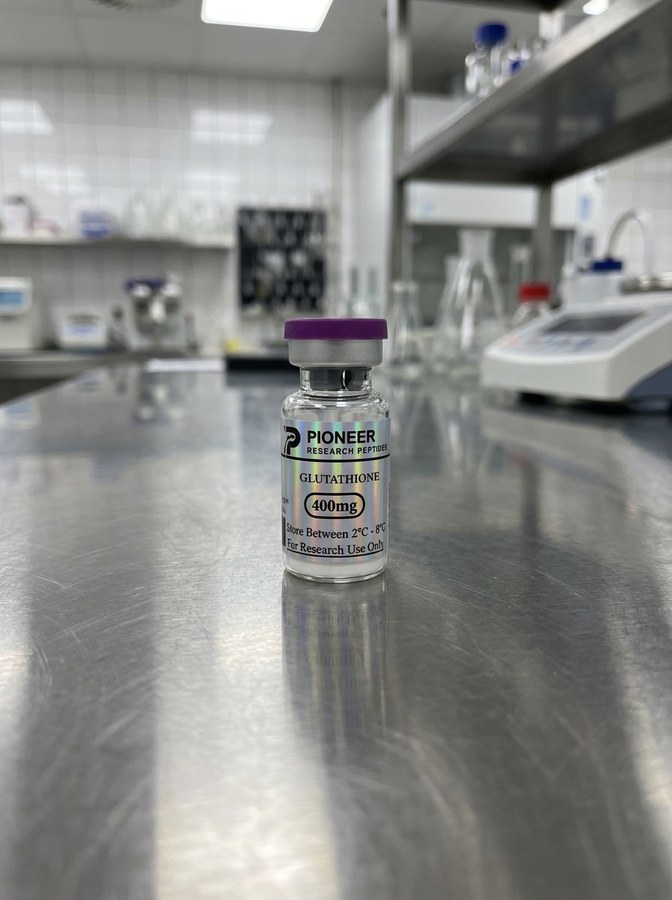
Technical specification#
| Molecular formula | C10H17N3O6S |
|---|---|
| Molecular weight | 307.32 |
| CAS number | 70-18-8 |
| Sequence | gamma-Glu-Cys-Gly |
Check your certificate#
- Molecular weight 307.32, C10H17N3O6S (monoisotopic 307.08). On a mass spectrum, expect the singly charged ion near 308.1.
- Sequence γ-Glu-Cys-Gly, CAS 70-18-8. That figure is reduced glutathione, the form with a free thiol.
- Purity, with the method named, measured on that batch rather than quoted as a minimum.
- Quantity is a separate result. Purity says nothing about how much is in the vial. A certificate that reports quantity found alongside purity is worth more than one that reports purity alone.
Ask about the documentation for the batch we would ship before you order. How to check a certificate yourself: verifying a COA.
What’s in the vial#
| Fill | 400mg, 600mg or 1500mg per vial. The 400mg vial is made to order. |
|---|---|
| Solubility | About 20 mg/ml in water, from the manufacturer’s data sheet our guide cites. Every vial size is normally reconstituted well past that. |
| Purity and content | Purity is the share of what was detected that is this peptide. How much of the powder’s weight is glutathione rather than salt and water is a separate number. How much is in the vial. |
Handling at a glance#
| Solvent | Water |
|---|---|
| Sealed vial | 2–8°C protected from light. Let it reach room temperature before opening. |
| Once in solution | 2–8°C, protected from light. Avoid thawing and refreezing the same volume. |
| Worth knowing | A concentrated solution is markedly acidic: glutathione carries two carboxyl groups and a free thiol. The further past its solubility, the slower it goes in and the more likely it is to leave undissolved material. |
Working out a concentration: the reconstitution calculator. Technique: the reconstitution guide and the storage guide.
What the research covers#
Glutathione is the body’s principal intracellular thiol tripeptide, and the research areas listed for it here are redox balance, detoxification pathways and tyrosinase (melanin synthesis) studies. The guide linked below is not a review of that literature: it covers solubility, salt and how much compound a vial really holds. We have not published an assessment of the research evidence, so we make no claim about its strength. Read the full guide, with sources: How much is actually in the vial.
Published literature#
- Meister A, Anderson ME (1983). Annu Rev Biochem 52:711–60. Review of the biochemistry of glutathione: its synthesis, breakdown, transport and functions in the cell. PubMed 6137189
- Aebi S, Assereto R, Lauterburg BH (1991). Eur J Clin Invest 21(1):103–10. University of Berne, Switzerland. Pharmacokinetics of intravenous reduced glutathione in 10 healthy volunteers, with glutathione and cysteine measured in plasma and urine. PubMed 1907548
- Richie JP, Nichenametla S, Neidig W, et al. (2015). Eur J Nutr 54(2):251–63. Penn State. Six-month randomised, double-blind, placebo-controlled trial of oral glutathione in healthy adults, measuring glutathione in blood and other compartments. Levels rose and returned to baseline after a one-month washout. PubMed 24791752
Listed so the work can be read at source. A paper on this list is evidence of what was studied, not of what any product does.
Questions#
What is glutathione?
A tripeptide, gamma-Glu-Cys-Gly, often written GSH: the principal intracellular thiol tripeptide. CAS 70-18-8.
What molecular weight should the certificate show?
307.32 (monoisotopic 307.08), C10H17N3O6S, usually seen as an ion near 308.1.
Why does it not fully dissolve?
Reduced glutathione dissolves in water to about 20 mg/ml, and vials of this size are normally reconstituted well past that, ours included. The further past it, the slower it goes in, the more undissolved material it can leave, and the more acidic the solution.
How should it be stored?
Sealed vial cold, dry and protected from light: 2-8°C. Once in solution, keep it at 2-8°C and protected from light.
Is it for human use?
No. It is supplied for laboratory research only, and we do not give guidance on human or animal use.
A batch-specific Certificate of Analysis is available on request. New to handling lyophilised material? See our reconstitution guide, storage guide and how to read a COA.