
How to Read a Peptide Certificate of Analysis (COA)
For laboratory research use only. Not for human or veterinary use.
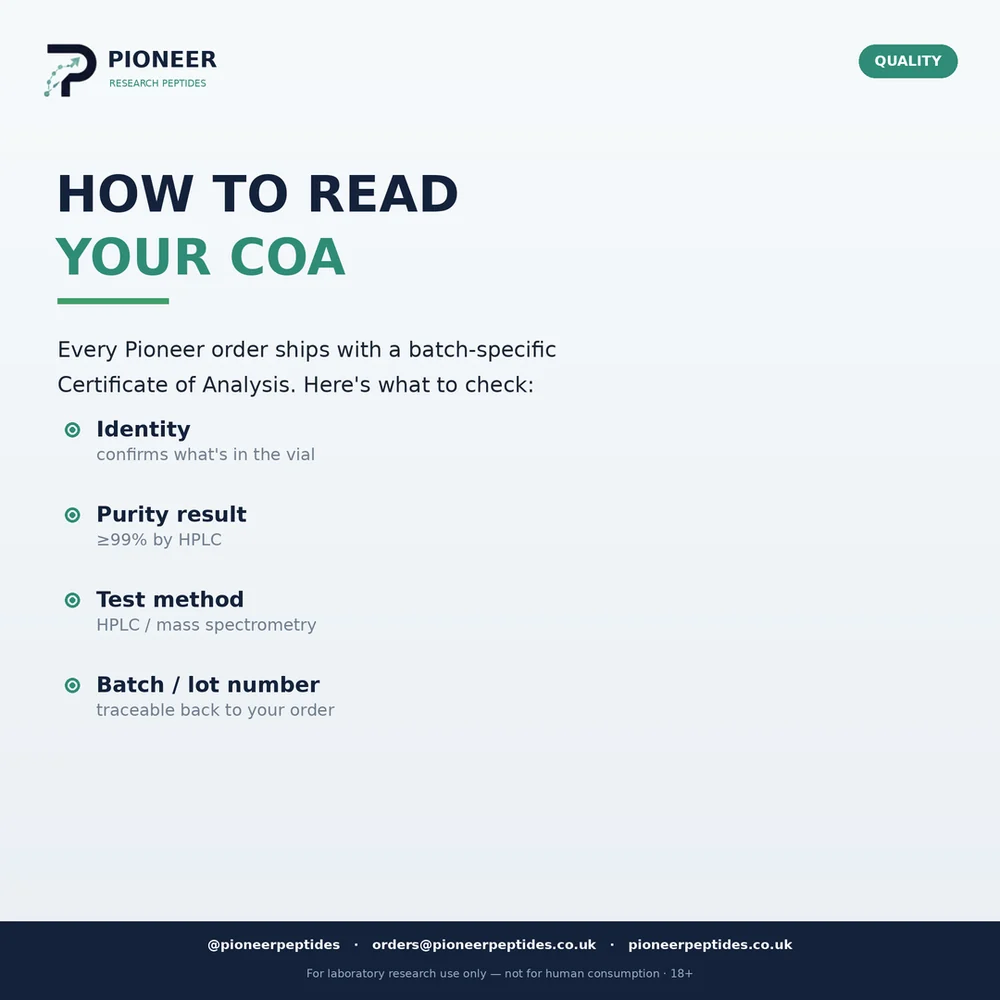
A Certificate of Analysis is the only objective evidence that a research peptide is what its label claims. Anyone can print "99% purity" on a vial. A COA is a laboratory document that either supports that claim or doesn't. Here's how to read one properly — and how to spot the ones that aren't worth the paper.
What a COA is
A COA is the analytical report produced when a batch of material is tested. It records what the compound is, how pure it is, what method was used to determine that, and which specific batch was tested. It is produced per batch — not per product.
The eight things to check
1. Batch or lot number. This is the most important field, and the one fake COAs get wrong. The batch number on the certificate must match the batch number printed on the vial in your hand. A COA that doesn't reference a specific batch is decoration, not documentation.
2. Product identity. The compound name and molecular formula should be stated. Cross-check the molecular weight against the published value for that peptide — mismatches indicate either an error or a different compound.
3. Purity figure. Usually expressed as a percentage. For research-grade peptides, 98–99%+ is the range to expect from a serious supplier.
4. The method used. This is what separates real data from marketing. Look for HPLC (High-Performance Liquid Chromatography) for purity, and ideally MS (Mass Spectrometry) for identity confirmation. A purity claim with no stated method is meaningless.
5. The chromatogram. A genuine HPLC report includes the trace itself — a graph with a dominant peak representing your compound. The area under that peak is where the purity percentage comes from. If a COA shows only a number and no chromatogram, ask why.
6. Test date. Recent testing matters. A certificate from years ago tells you about material that may no longer exist.
7. Who performed the analysis. The testing laboratory should be identified. Third-party testing carries more weight than self-reported figures.
8. The verification reference. Reputable laboratories issue each report with a unique key or reference that lets anyone retrieve that report from the lab directly. This is the field that makes the other seven checkable, because it is the only one you can confirm without the supplier’s involvement. A certificate with no verification reference asks you to take the supplier’s word for the document itself.
Step by step, with a worked example you can run against our own certificates: how to verify a peptide COA.
Warning signs
- No batch number, or a batch number that doesn't match your vial
- No method stated — just a percentage
- No chromatogram — the underlying data is missing
- Identical COAs issued for every batch (a real COA is unique to a batch)
- Different certificates sharing one verification reference. Harder to spot than a duplicated COA and more common: several documents with different compounds, batch numbers and dates, all carrying the same key. Each looks fine on its own. Compared side by side, at least one has been edited after issue. Check the reference is unique across every certificate a supplier shows you
- Purity claims above 99.9% for complex peptides — implausibly perfect figures are a red flag
- Suppliers who won't provide one — this tells you everything
Why identity matters as much as purity
Purity answers "how much of this vial is the compound?" Identity answers "is it the right compound at all?" A vial can be 99% pure and still be 99% of the wrong molecule. That's why mass spectrometry — which confirms molecular weight — belongs alongside HPLC on a complete certificate.
Chromatography alone cannot close the question. HPLC tells you the relative abundance of each peak; it does not tell you what each peak is. Two compounds can co-elute and appear as one peak, and a trace can look clean while the underlying material is wrong. Mass spectrometry measures mass-to-charge ratio, so it answers the identity question the chromatogram cannot. HPLC establishes purity, MS establishes identity, and a certificate quoting only one is answering half the question.
The simple test
Ask any supplier: "Can I see the COA for the batch you'd be shipping me?"
A supplier with proper documentation sends it without hesitation. A supplier who deflects, delays, or sends a generic document is telling you what you need to know.
Our standard
We publish the certificate for each tested batch in full, in the COA library, with the issuing laboratory’s verification key printed next to it — so you can run all eight checks above against us before you order, without asking us for anything. Testing is by Janoshik Analytical, independently of Pioneer.
Figures are published as measured. Where a batch was submitted for quantification rather than purity determination, the library says so rather than leaving the column blank. The certificate for your batch is also available on request.
Treat purity documentation as a filter rather than a bonus. A supplier who makes the evidence this easy to inspect has made your decision simpler, not harder.
Pioneer Research Peptides — UK supplier of research peptides for laboratory use. Independently tested by batch, certificates published with verification keys at the COA library.
For laboratory research use only — not for human consumption. 18+.
Research-grade peptides, documented
Every Pioneer compound is Independently batch tested, with a batch-specific Certificate of Analysis available on request.