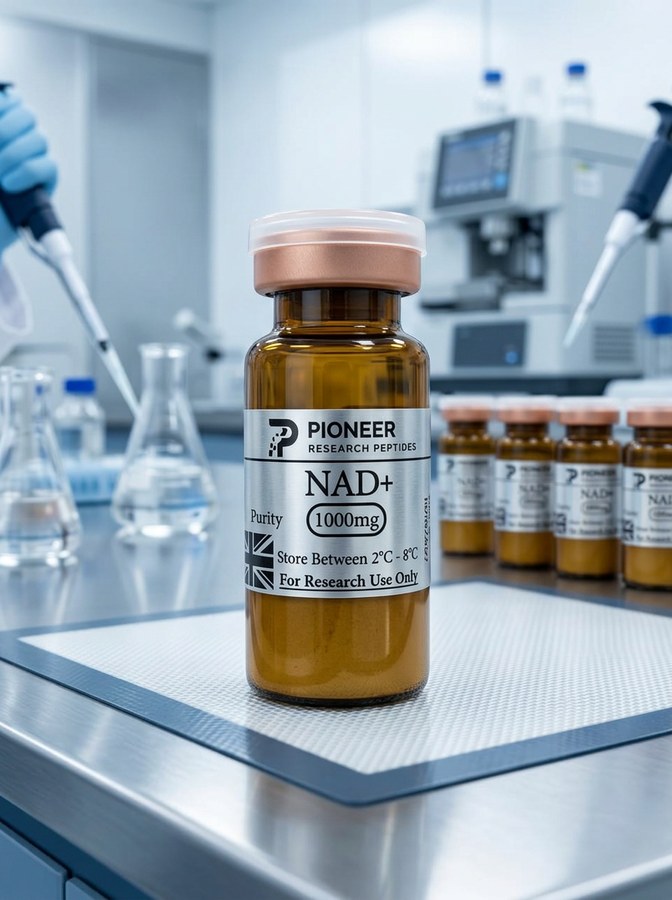
NAD+
Batch documentation. Ask what exists for the batch we would ship before you order — email us ›
Nicotinamide adenine dinucleotide
Nicotinamide adenine dinucleotide, a coenzyme central to cellular energy metabolism and a key focus of aging and redox research.
Mechanism#
A coenzyme every cell uses to turn nutrients into energy and to power sirtuins and DNA-repair enzymes. NAD+ levels fall with age, which makes it central to research on energy metabolism and longevity.
Areas of research#
- Cellular energy (NAD+/NADH) metabolism
- Sirtuin and DNA-repair pathways
- Mitochondrial function
- Aging and longevity research
Sizes and pricing#
| Size | Price per vial | Availability |
|---|---|---|
| 100mg | £22 | Made to order — 1-2 weeks |
| 500mg | £45 | In stock |
| 1000mg | £79.99 | In stock |
Buying more than one? Mix and match any peptide vials: 3 vials 8%, 5 vials 12%, 10 or more 15% off the peptides in your basket. You get whichever is better, the bulk or the volume discount, never both — applied automatically at checkout. How it works.

Technical specification#
| Molecular formula | C21H27N7O14P2 |
|---|---|
| Molecular weight | 663.43 |
| CAS number | 53-84-9 |
Check your certificate#
- Molecular weight 663.43, C21H27N7O14P2 (monoisotopic 663.11). On a mass spectrum, expect the singly charged ion near 664.1.
- NAD+, not NADH. The two are named together throughout the research, but they are different compounds. The certificate should name NAD+ and CAS 53-84-9.
- Quantity and purity are separate results. A quantity result confirms how much compound is in the vial; it does not report purity. Our latest batch was submitted for quantification only.
- Purity, with the method named, measured on that batch rather than quoted as a minimum, where purity has been tested.
Ask about the documentation for the batch we would ship before you order. How to check a certificate yourself: verifying a COA.
What’s in the vial#
| Fill | 100mg, 500mg or 1000mg per vial. The 100mg vial is made to order. |
|---|---|
| Compound | Nicotinamide adenine dinucleotide, CAS 53-84-9. A coenzyme, not a peptide. |
| Purity and content | Purity is the share of what was detected that is this compound. Quantity, how much NAD+ is actually in the vial, is a separate measurement. How much is in the vial. |
Handling at a glance#
| Sealed vial | 2–8°C protected from light. Keep it dry. |
|---|---|
| Before opening | Let a cold vial reach room temperature, so condensation forms on the glass rather than on the powder. |
| Once in solution | 2–8°C, protected from light. Avoid thawing and refreezing the same volume. |
Working out a concentration: the reconstitution calculator. Technique: the reconstitution guide and the storage guide.
What the research covers#
NAD+ is a coenzyme every cell uses, studied in energy metabolism, sirtuin and DNA-repair pathways and mitochondrial function. The guide linked below explains how to compare suppliers and certificates for metabolic research compounds; it is not a review of the NAD+ literature. We have not published an assessment of that evidence, so we make no claim about it. Read the full guide, with sources: UK metabolic research compound suppliers: how to compare them.
Published literature#
- Verdin E (2015). Science 350(6265):1208–13. Review from the Gladstone Institutes, San Francisco, of NAD+ as a coenzyme and as a substrate for sirtuins and PARPs, and of how cellular NAD+ levels change with age. PubMed 26785480
- Martens CR, Denman BA, Mazzo MR, et al. (2018). Nat Commun 9(1):1286. University of Colorado Boulder. Randomised, double-blind, placebo-controlled crossover trial of the precursor nicotinamide riboside, not NAD+ itself, in healthy middle-aged and older adults, measuring NAD+ metabolism. PubMed 29599478
- Covarrubias AJ, Perrone R, Grozio A, et al. (2021). Nat Rev Mol Cell Biol 22(2):119–141. Review from the Buck Institute for Research on Aging, California, of NAD+ metabolism and the enzymes that use it, including sirtuins, CD38 and PARPs, and of how NAD+ levels change with age. PubMed 33353981
- Rajman L, Chwalek K, Sinclair DA (2018). Cell Metab 27(3):529–547. Review from Harvard Medical School of the animal studies of NAD+ and the molecules that raise it. PubMed 29514064
Listed so the work can be read at source. A paper on this list is evidence of what was studied, not of what any product does.
Questions#
What is NAD+?
Nicotinamide adenine dinucleotide, a coenzyme central to redox reactions and cellular energy metabolism. It is a small molecule, not a peptide. CAS 53-84-9.
What molecular weight should the certificate show?
663.43 (monoisotopic 663.11), C21H27N7O14P2, usually seen as an ion near 664.1.
How should it be stored?
Sealed vial cold, dry and protected from light: 2-8°C, warmed to room temperature before opening. Once in solution, keep it at 2-8°C and protected from light.
Is there a batch certificate?
Yes. The certificate for the current batch is available on request: email orders@pioneerpeptides.co.uk with the product and size.
Is it for human use?
No. It is supplied for laboratory research only, and we do not give guidance on human or animal use.
A batch-specific Certificate of Analysis is available on request. New to handling lyophilised material? See our reconstitution guide, storage guide and how to read a COA.