5-Amino-1MQ
NNMT inhibitor
A small-molecule inhibitor of the enzyme NNMT, studied for effects on adipocyte metabolism and NAD+ salvage pathways.
Mechanism#
Blocks nicotinamide N-methyltransferase (NNMT), shifting cellular methylation and NAD+ balance — researched for fat-cell metabolism and metabolic flexibility.
Areas of research#
- NNMT-inhibition research
- Adipocyte-metabolism models
- NAD+ salvage pathway
- Metabolic-flexibility studies

Identity and specification#
| Full name | 5-amino-1-methylquinolinium iodide |
|---|---|
| Molecular formula | C10H11N2·I |
| Molecular weight | 286.11 g/mol (salt); 159.21 g/mol (cation) |
| CAS number | 42464-96-0 |
| Class | Small-molecule NNMT inhibitor; quaternary quinolinium salt |
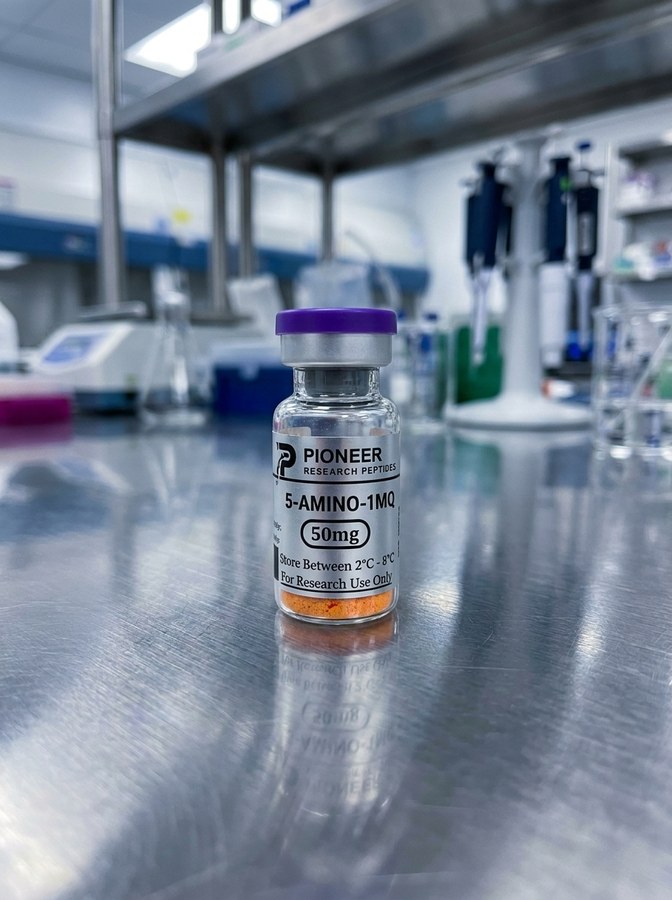
| Appearance | Brown to reddish-brown powder |
| Solubility | Water; DMSO |
| Storage | Sealed at 2–8°C, protected from light and moisture |
This is a salt, and that matters when you weigh it. The molecule that does the work is the 5-amino-1-methylquinolinium cation, which is 159.21 g/mol. The iodide counter-ion accounts for the remaining 126.90. So the cation is 55.6% of the mass in the vial: a 10mg vial holds about 5.6mg of it, and a 50mg vial about 27.8mg.
Papers reporting concentrations in molar terms are describing the cation, not the salt, so that conversion has to be made before a figure from the literature can be compared with what comes off the balance. Working from the salt mass alone overstates the amount of active material by nearly a factor of two.
The colour is not a fault. Lyophilised peptides should be white, and a tint in one is a reason to ask questions. This is not a peptide. Quinolinium salts are chromophoric, and brown to reddish-brown is the expected appearance of the material as supplied.
One further caution on sourcing: several chemical databases title this compound as the chloride while listing iodide data underneath, and the two are not interchangeable when you are converting masses. CAS 42464-96-0 is the iodide salt.
Handling and storage#
Hygroscopic and light-sensitive. Keep the vial sealed at 2–8°C, allow it to warm to room temperature before opening so that condensation forms on the glass rather than on the solid, and store solutions in amber or wrapped glass. Soluble in water and in DMSO; make solutions fresh where the work allows.
For the NNMT mechanism, the salt-mass conversion worked through, and what a certificate for this compound should show, see our guide to 5-Amino-1MQ explained.
Sizes and pricing#
| Size | Price per vial | Availability |
|---|---|---|
| 10mg | £29 | In stock |
| 50mg | £48.99 | Made to order — 1-2 weeks |
Buying more than one? Mix and match any peptide vials: 3 vials 8%, 5 vials 12%, 10 or more 15% off the peptides in your basket. You get whichever is better, the bulk or the volume discount, never both — applied automatically at checkout. How it works.
Check your certificate#
- Molecular weight 286.11 for the iodide salt, C10H11N2·I, CAS 42464-96-0. The 5-amino-1-methylquinolinium cation alone is 159.21 (monoisotopic 159.09), and it is the cation, near 159.1, that a mass spectrum shows.
- Which salt. 286.11 is the iodide. 194.66 is the chloride, a genuinely different product with more cation per milligram. A certificate reporting only 159.21 describes the cation and has not stated what was in the vial.
- Brown is the reference. Brown to reddish-brown is the expected appearance of this compound. Judge it against that, not against a white peptide.
- Purity, with the method named, measured on that batch rather than quoted as a minimum.
Ask about the documentation for the batch we would ship before you order. How to check a certificate yourself: verifying a COA.
What’s in the vial#
| Fill | 10mg or 50mg of the iodide salt per vial. The 50mg vial is made to order. |
|---|---|
| Appearance | Brown to reddish-brown powder. The colour is expected, not a fault. |
| Salt form | Iodide. The cation is 55.6% of the mass: about 5.6mg in a 10mg vial and 27.8mg in a 50mg vial. |
| Purity and content | Purity is the share of what was detected that is this compound. How much of the vial’s weight is the active cation rather than iodide, water or solvent is a separate question. How much is in the vial. |
Handling at a glance#
| Solvent | DMSO. Aqueous work usually starts from a DMSO stock, with attention to the final solvent fraction. |
|---|---|
| Sealed vial | 2–8°C, protected from light and moisture. Let it reach room temperature before opening. |
| Once in solution | Amber or wrapped glass. Make solutions fresh where the work allows. |
| Worth knowing | Hygroscopic and light-sensitive, but not a peptide: it cannot be denatured, and agitation does not damage it. |
Working out a concentration: the reconstitution calculator. Technique: the reconstitution guide and the storage guide.
What the research covers#
The research our guide cites is cell, mouse and rat work, much of it from one group: a 2017 structure–activity study that identified methylquinoliniums as NNMT inhibitors, cell and mouse studies of membrane permeability and selectivity, a study in aged mice, and a rat pharmacokinetic study. A 2026 review of NNMT inhibitor development notes the limited preclinical success of the earlier compounds. Read the full guide, with sources: 5-Amino-1MQ: what you are actually weighing.
Published literature#
- Neelakantan H, Wang HY, Vance V, et al. (2017). J Med Chem 60(12):5015–5028. Structure–activity study that identified methylquinoliniums as a scaffold for NNMT inhibitors. PubMed 28548833
- Neelakantan H, Vance V, Wetzel MD, et al. (2018). Biochem Pharmacol 147:141–152. Cell and mouse study of membrane permeability, selectivity, and effects on 1-methylnicotinamide, NAD+ and SAM. Reports that amine-substituted methylquinoliniums crossed membranes well, by passive and active transport. PubMed 29155147
- Neelakantan H, Brightwell CR, Graber TG, et al. (2019). Biochem Pharmacol 163:481–492. Mouse and cell study in aged animals of muscle stem-cell activity and muscle function after injury. PubMed 30753815
- Awosemo O, Neelakantan H, Watowich S, et al. (2021). J Pharm Biomed Anal 204:114255. Rat pharmacokinetic study, including oral bioavailability, with a validated assay for the compound in plasma and urine. PubMed 34304009
Listed so the work can be read at source. A paper on this list is evidence of what was studied, not of what any product does.
Questions#
What is 5-Amino-1MQ?
5-amino-1-methylquinolinium iodide: a small-molecule inhibitor of the enzyme nicotinamide N-methyltransferase (NNMT). It is a quaternary quinolinium salt, not a peptide.
What molecular weight should the certificate show?
286.11 for the iodide salt. The cation alone is 159.21 (monoisotopic 159.09), and that is what a mass spectrum shows. 194.66 would be the chloride, a different product.
Does the 10mg on the label include the iodide?
Yes. The stated milligrams are the iodide salt, of which about 55.6% by mass is the cation: about 5.6mg in a 10mg vial.
How should it be stored?
Sealed at 2-8°C, protected from light and moisture, and brought to room temperature before opening. Keep solutions in amber or wrapped glass and make them fresh where the work allows.
Is it for human use?
No. It is supplied for laboratory research only, and we do not give guidance on human or animal use.
A batch-specific Certificate of Analysis is available on request. New to handling lyophilised material? See our reconstitution guide, storage guide and how to read a COA.