SLU-PP-332
ERR agonist
A synthetic agonist of the estrogen-related receptors (ERRs) studied as an 'exercise-mimetic' for endurance and fat-metabolism pathways.
Mechanism#
Activates ERRα/β/γ, boosting mitochondrial and fatty-acid-oxidation gene programmes similar to those triggered by endurance exercise — a focus of metabolic research.
Areas of research#
- ERR-agonist research
- Exercise-mimetic pathways
- Mitochondrial / fat-oxidation models
- Endurance-metabolism studies

Identity and specification#
| Compound type | Small molecule — not a peptide |
|---|---|
| Chemical name | 4-Hydroxybenzoic acid 2-(2-naphthalenylmethylene)hydrazide |
| Molecular formula | C18H14N2O2 |
| Molecular weight | 290.32 g/mol |
| CAS number | 303760-60-3 |
| Class | Acylhydrazone; pan-agonist of the estrogen-related receptors |
| Supplied as | Free base — no salt form is in commerce |
| Appearance | Solid |
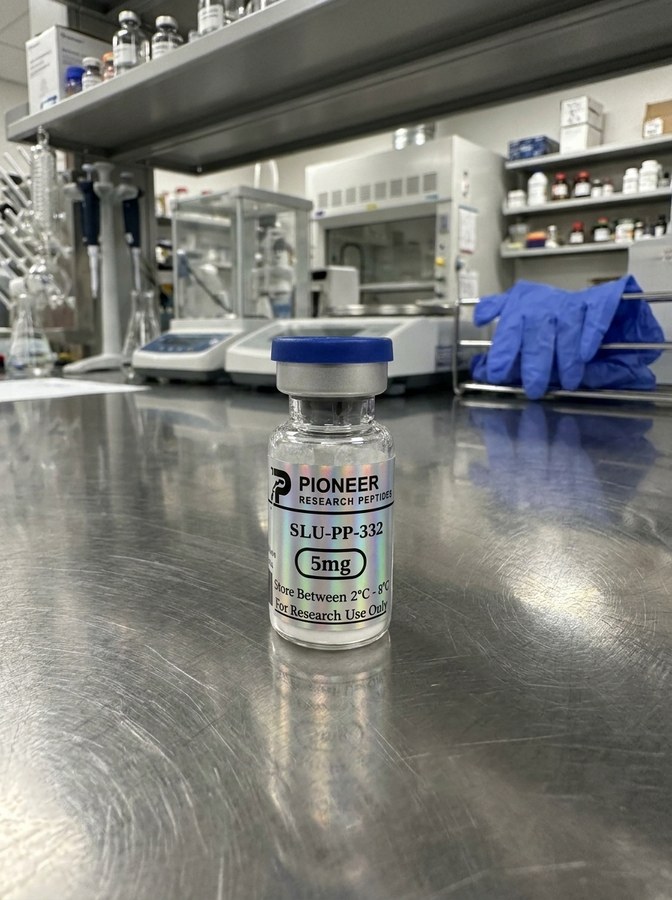
| Storage | Sealed at 2–8°C, protected from light and moisture |
Worth stating plainly on a peptide supplier's website: SLU-PP-332 is not a peptide. It has no amino acids and no sequence. It is a small synthetic molecule, and it is reconstituted and stored like one — typically in DMSO rather than bacteriostatic water.
What it does#
SLU-PP-332 is an agonist of the estrogen-related receptors, ERRα, ERRβ and ERRγ. Despite the name these are not the classical estrogen receptors; they are orphan nuclear receptors that regulate mitochondrial and oxidative-metabolism gene programmes, and they are constitutively active rather than switched on by a natural hormone. The compound binds their ligand-binding domain and enhances that existing activity.
It is genuinely non-selective across the three. Reported half-maximal effective concentrations are approximately 98 nM at ERRα, 230 nM at ERRβ and 430 nM at ERRγ — roughly four-fold between the extremes, which is not selectivity in any useful sense. Structurally it derives from an earlier ERR agonist, GSK4716, with a naphthalene in place of an isopropylphenyl group.
Where the “exercise mimetic” description comes from#
The phrase is not marketing invention; it traces to a specific paper. Billon and colleagues, writing in ACS Chemical Biology in 2023, reported that the compound induced an ERRα-dependent acute aerobic exercise gene response in mice and increased exercise capacity — treated animals ran substantially longer and further than controls. Follow-up work looked at mitochondrial biogenesis, oxidative-phosphorylation gene expression and a shift toward oxidative type IIa muscle fibres, and at metabolic-syndrome models.
What that does not include is any human data. We could find no clinical trial of SLU-PP-332 in people. Everything above is mouse and cell work, and the gap between “mice ran further” and anything else is the whole of drug development.
One specification we have deliberately left off#
Databases describe this molecule with a Z geometry at the hydrazone double bond; the supplier catalogues state no geometry at all, and acylhydrazones of this type are usually isolated as the E isomer. We could not establish from the primary literature which was actually characterised, so we state the constitution and omit the stereo-descriptor rather than print one that may be wrong.
Handling and storage#
Keep sealed at 2–8°C, dry and out of the light. As a small molecule rather than a lyophilised peptide it is usually taken up in DMSO; aqueous solubility is limited, and a stock in DMSO should be aliquoted rather than repeatedly frozen and thawed. Bring the vial to room temperature before opening.
Sizes and pricing#
| Size | Price per vial | Availability |
|---|---|---|
| 5mg | £45 | Made to order — 1-2 weeks |
| 10mg | £85 | Made to order — 1-2 weeks |
Buying more than one? Mix and match any peptide vials: 3 vials 8%, 5 vials 12%, 10 or more 15% off the peptides in your basket. You get whichever is better, the bulk or the volume discount, never both — applied automatically at checkout. How it works.
Check your certificate#
- Molecular weight 290.32, C18H14N2O2 (monoisotopic 290.11). On a mass spectrum, expect the singly charged ion near 291.1.
- A small molecule, not a peptide. There is no sequence to check. The identity is 4-hydroxybenzoic acid 2-(2-naphthalenylmethylene)hydrazide, CAS 303760-60-3.
- Free base, no salt. No salt form is in commerce, so there is no counter-ion weight to account for.
- Geometry is not settled. Databases give Z at the hydrazone double bond, supplier catalogues state none, and acylhydrazones of this type are usually isolated as E. We state the constitution and omit the descriptor rather than print one that may be wrong.
- Purity, with the method named, measured on that batch rather than quoted as a minimum.
Ask about the documentation for the batch we would ship before you order. How to check a certificate yourself: verifying a COA.
What’s in the vial#
| Fill | 5mg or 10mg per vial, both made to order |
|---|---|
| Appearance | Solid |
| Salt form | Free base. No salt form is in commerce. |
| Purity and content | Purity is the share of what was detected that is this compound. How much of the vial’s weight is the compound rather than water or residual solvent is a separate question. How much is in the vial. |
Handling at a glance#
| Solvent | Usually DMSO rather than bacteriostatic water. Aqueous solubility is limited. |
|---|---|
| Sealed vial | 2–8°C, dry and out of the light. Bring the vial to room temperature before opening. |
| Once in solution | Aliquot a DMSO stock rather than freezing and thawing it repeatedly. |
Working out a concentration: the reconstitution calculator. Technique: the reconstitution guide and the storage guide.
What the research covers#
The published work is in mice and cells. Billon and colleagues, in ACS Chemical Biology in 2023, reported an ERRα-dependent exercise gene response in mice and that treated animals ran longer and further than controls; follow-up work looked at mitochondrial biogenesis, muscle fibre type and metabolic-syndrome models. We could find no clinical trial of SLU-PP-332 in people. Read the full guide, with sources: UK metabolic research compound suppliers: how to compare them.
Published literature#
- Billon C, Sitaula S, Banerjee S, et al. (2023). ACS Chem Biol 18(4):756–771. Washington University School of Medicine and St. Louis College of Pharmacy, the group that designed SLU-PP-332. Cell and mouse study describing it as an agonist of all three ERRs, with muscle fibre type and running endurance measured in mice. PubMed 36988910
- Billon C, Schoepke E, Avdagic A, et al. (2024). J Pharmacol Exp Ther 388(2):232–240. The same group. Mouse study of energy expenditure, fatty acid oxidation and fat mass. PubMed 37739806
- Xu W, Billon C, Li H, et al. (2024). Circulation 149(3):227–250. Baylor College of Medicine, Houston, with the same group. Mouse study of SLU-PP-332 and a second agonist, SLU-PP-915, under cardiac pressure overload, with cardiac metabolism and mitochondrial function measured. PubMed 37961903
- Möller T, Krug O, Thevis M (2026). Rapid Commun Mass Spectrom 40(8):e70039. Center for Preventive Doping Research, German Sport University Cologne, independent of the developers. Mass spectrometric characterisation of SLU-PP-332 and SLU-PP-915 and identification of their in vitro metabolites, for sports drug testing. PubMed 41588687
Listed so the work can be read at source. A paper on this list is evidence of what was studied, not of what any product does.
Questions#
What is SLU-PP-332?
A small synthetic molecule, not a peptide: an acylhydrazone that acts as an agonist at all three estrogen-related receptors, ERR alpha, beta and gamma. These are orphan nuclear receptors, not the classical estrogen receptors.
What molecular weight should the certificate show?
290.32 (monoisotopic 290.11), C18H14N2O2, usually seen as an ion near 291.1. It is supplied as the free base, so there is no salt weight to account for.
Why is no E or Z isomer stated?
Databases give a Z geometry at the hydrazone double bond, supplier catalogues state none, and compounds of this type are usually isolated as E. We could not establish from the primary literature which was characterised, so we leave the descriptor off rather than print one that may be wrong.
How should it be stored?
Sealed at 2-8°C, dry and out of the light, brought to room temperature before opening. It is usually taken up in DMSO, and a DMSO stock should be aliquoted rather than repeatedly frozen and thawed.
Is it for human use?
No. It is supplied for laboratory research only, and we do not give guidance on human or animal use.
A batch-specific Certificate of Analysis is available on request. New to handling lyophilised material? See our reconstitution guide, storage guide and how to read a COA.