
Bacteriostatic vs Sterile Water: Which to Use
For laboratory research use only. Not for human or veterinary use.
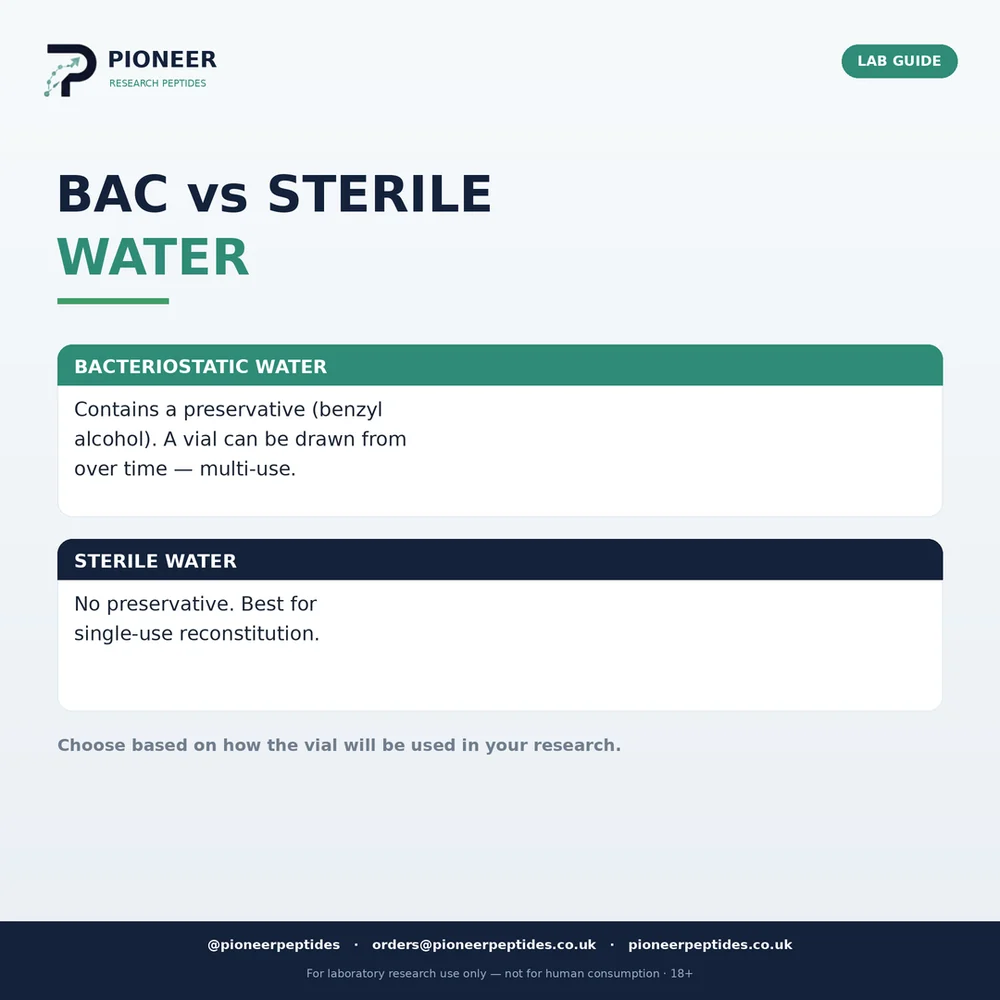
Choosing the wrong solvent is one of the quickest ways to waste a vial of research material. The difference between bacteriostatic and sterile water is small in chemistry but significant in practice.
Sterile water
Sterile water is purified water that has been sterilised to remove microorganisms. It contains no preservative.
That matters: the moment the stopper is pierced and the vial is exposed to air, there is nothing preventing microbial growth in the solution. Sterile water is therefore treated as single-use — reconstitute, use, discard.
Use it when: the reconstituted material will be used immediately, or when a preservative-free solution is specifically required by the protocol.
Bacteriostatic water
Bacteriostatic water is sterile water containing 0.9% benzyl alcohol, a preservative that inhibits bacterial growth (bacteriostatic = stops bacteria multiplying, as opposed to bactericidal = kills them).
Because of that preservative, a bacteriostatic water vial can be entered multiple times over a period of time without the solution immediately becoming a growth medium. This is why it's the default solvent for most lyophilised research peptides.
Use it when: the reconstituted peptide will be drawn from more than once — which covers most research use.
Side by side
| Sterile Water | Bacteriostatic Water | |
|---|---|---|
| Preservative | None | 0.9% benzyl alcohol |
| Multiple draws | No — single use | Yes |
| Typical use | Immediate, one-off | Standard peptide reconstitution |
| Storage after opening | Discard | Refrigerated, limited window |
Acetic acid water
A third solvent worth knowing. Some peptides are poorly soluble in plain water and require a mildly acidic solution to dissolve fully. Dilute acetic acid water is used for these compounds. If a peptide won't go into solution in bacteriostatic water and remains cloudy or particulate, solubility — not quality — may be the issue.
Practical points
- Match the solvent to the workflow. Single draw, sterile water is fine. Multiple draws over days, you want bacteriostatic.
- Store solvents properly. Both should be kept clean, capped, and within date.
- Swab every time. The preservative in bacteriostatic water reduces risk; it doesn't replace sterile technique.
- Record what you used. Solvent type and volume both belong in your notes — the volume determines your concentration.
The bit people forget
The solvent choice only matters if the peptide itself is what it claims to be. Reconstituting an unverified powder perfectly is still reconstituting an unknown. Purity data and a batch COA come first; solvent technique second.
We supply bacteriostatic water, sterile water and acetic acid water alongside the full research range, so the solvent and the compound come from the same documented source.
Pioneer Research Peptides — UK supplier of research peptides and laboratory solvents.
For laboratory research use only — not for human consumption. 18+.
Research-grade peptides, documented
Every Pioneer compound is Independently batch tested, with a batch-specific Certificate of Analysis available on request.