
Why Research Peptides Are Freeze-Dried (Lyophilisation)
For laboratory research use only. Not for human or veterinary use.
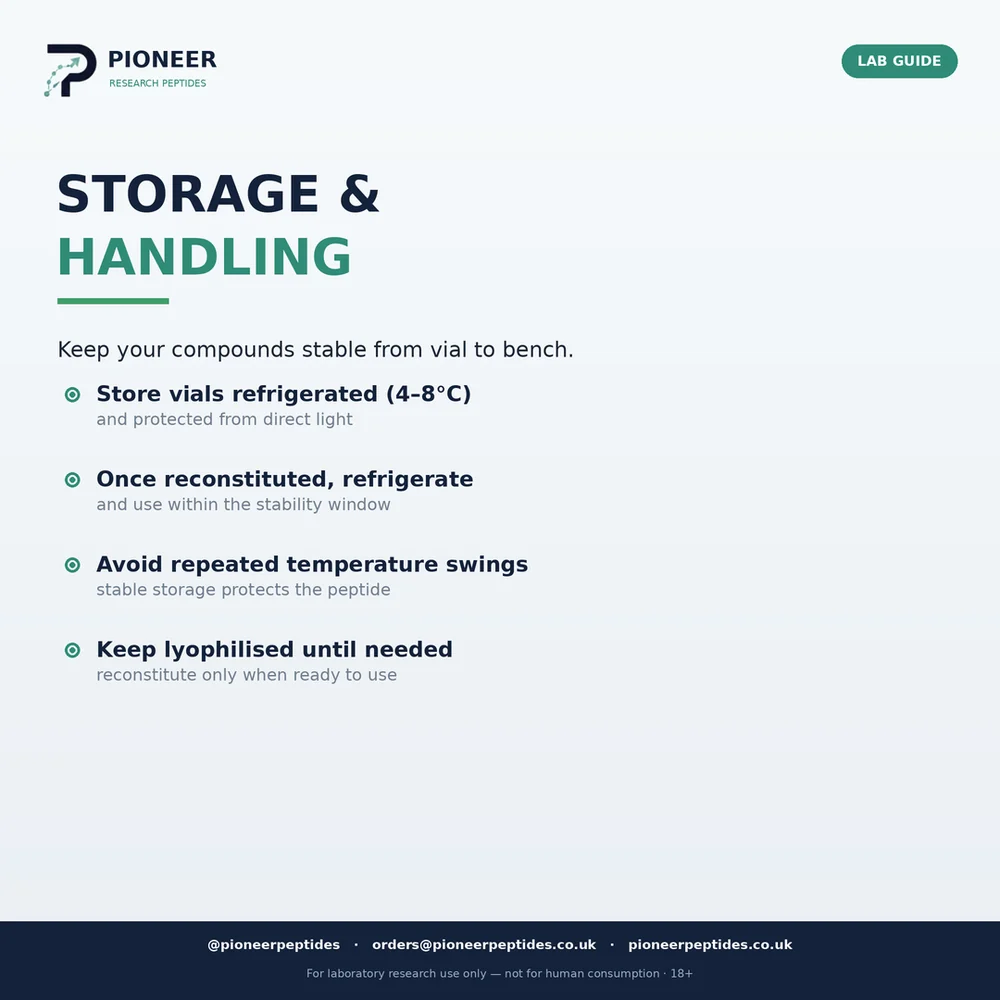
Peptides arrive as a dry powder rather than a ready-made solution, and there's a substantive reason for it. Understanding the reason explains most of the handling rules that follow from it.
Water is the problem
Peptides in solution degrade. The main routes are:
- Hydrolysis — water molecules attacking peptide bonds and cleaving the chain
- Oxidation — particularly at methionine, cysteine and tryptophan residues
- Deamidation — asparagine and glutamine residues chemically altering over time
- Aggregation — molecules clumping, which is often irreversible
- Microbial growth — any aqueous solution is a potential culture medium
Every one of these needs water to proceed. Remove the water and you remove the mechanism. A lyophilised peptide stored correctly remains stable for a long period; the same peptide in solution is measured in weeks.
What lyophilisation actually does
Freeze-drying isn't simply drying. It's a three-stage process:
Freezing. The peptide solution is cooled below its freezing point, converting the water to ice while leaving the peptide dispersed in the frozen matrix.
Primary drying. Pressure is dropped to a deep vacuum and gentle heat applied. The ice sublimes — passing directly from solid to vapour without ever becoming liquid. This is the key step: at no point does the peptide sit in a concentrating liquid, which is what would damage it.
Secondary drying. Temperature is raised slightly to drive off residual bound water that didn't sublime, taking moisture content down to very low levels.
The result is the porous, light cake or film you see in the vial — the peptide left behind in the shape the ice used to occupy.
Why not just dry it with heat?
Heat denatures peptides. Structure is held together by hydrogen bonds and other weak interactions, and thermal energy disrupts them. Evaporative drying would also concentrate the solution progressively as water left, exposing the peptide to increasing salt concentration and pH shifts.
Sublimation under vacuum avoids both. The peptide never experiences high temperature and never sits in a concentrating solution.
What this means for your handling
Several practical rules follow directly:
The cake is fragile. Lyophilised material is a delicate porous structure. Firing solvent directly at it destroys that structure and causes foaming. Run solvent down the wall instead — see the reconstitution guide.
Moisture is the enemy, before and after. A vial that has absorbed atmospheric moisture has already begun the degradation clock. Keep vials sealed, cold and dry until you reconstitute.
Let it warm before opening. Opening a cold vial in a warm room condenses water onto the cold powder. Allow it to reach room temperature sealed first.
The stability clock starts at reconstitution. Lyophilised material is stable for a long period. The same peptide in solution is not. See the storage guide.
An apparently empty vial is usually normal. A few milligrams of freeze-dried peptide can be nearly invisible — a thin film rather than a visible cake. Covered in troubleshooting.
Why it also matters commercially
Lyophilised material can be shipped and stored without a continuous cold chain in the way a solution would demand, and it can be accurately weighed and filled by mass before drying. That's why research peptides are supplied this way essentially universally — a supplier shipping pre-mixed solutions would be making your material less stable, not more convenient.
What good looks like in the vial
A well-lyophilised peptide shows a white or off-white cake or film, uniform in appearance, with no discolouration, no shrunken glassy collapse, and no visible moisture. Yellowing or a melted, collapsed appearance suggests the material has been through a temperature excursion.
Pioneer Research Peptides — UK supplier of research peptides for laboratory use. Independently tested by batch, certificates published with verification keys at the COA library.
For laboratory research use only — not for human consumption. 18+.
Research-grade peptides, documented
Every Pioneer compound is Independently batch tested, with a batch-specific Certificate of Analysis available on request.