
How to Store Research Peptides Correctly
For laboratory research use only. Not for human or veterinary use.
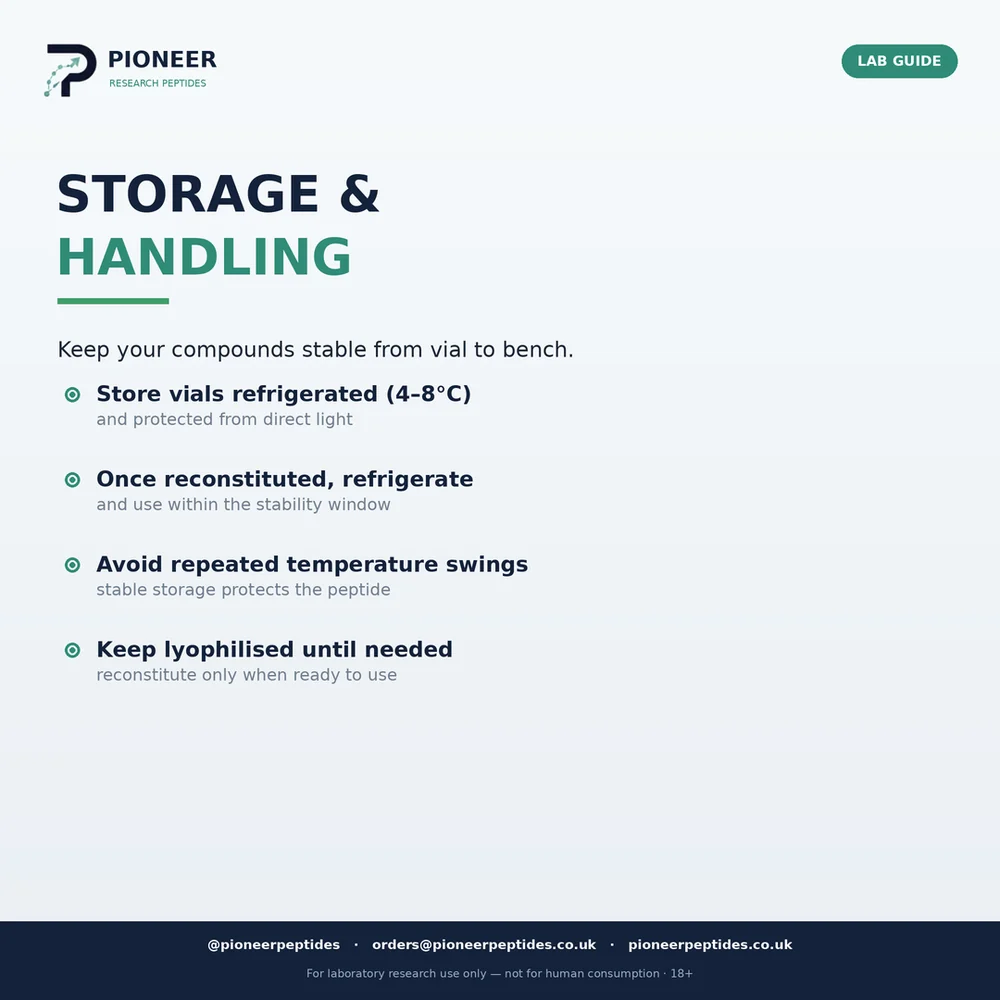
Peptides are fragile molecules. Temperature, light, moisture and repeated handling all degrade them — and degraded material produces unreliable results long before it looks any different in the vial. Here's how storage actually works.
Lyophilised (powder) storage
Freeze-dried peptides are relatively stable, which is why they ship that way.
Standard storage: 2–8°C, protected from light. Refrigeration at this range is appropriate for the great majority of research peptides in powder form. Keep the vial in its original packaging or a dark container — UV exposure degrades peptide bonds.
Long-term storage: for extended periods, freezing at −20°C or lower is used. Two cautions come with that: avoid repeated freeze–thaw cycles, and always allow a frozen vial to reach room temperature before opening, or condensation will form inside the vial and introduce moisture.
Keep it dry. Moisture is the enemy of lyophilised material. Vials are sealed for a reason.
Reconstituted (in solution) storage
Once a peptide is in solution it becomes markedly less stable.
- Store at 2–8°C — refrigerated, not frozen (freezing a reconstituted peptide can cause aggregation)
- Protect from light at all times
- Use within a limited window — solutions do not keep indefinitely
- Bacteriostatic water (with its 0.9% benzyl alcohol) allows multiple draws; sterile water does not
- Don't shake. Agitation denatures peptides in solution just as it does during reconstitution
The four things that degrade peptides
1. Heat. The single biggest factor. Leaving vials at room temperature for extended periods measurably reduces integrity. This is why cold-chain shipping matters.
2. Light. UV exposure breaks peptide bonds. Original packaging, dark storage.
3. Moisture. Affects lyophilised powder in particular — hence sealed vials and room-temperature equalisation before opening.
4. Repeated temperature cycling. Every freeze–thaw or fridge–bench–fridge cycle costs you a little material integrity. Plan your handling to minimise cycles.
Practical habits
- Label reconstituted vials with the date and concentration — memory is not a record
- Keep peptides in a dedicated area of the fridge, not the door (where temperature swings most)
- Bring vials to room temperature before opening, every time
- First in, first out — use older stock first
- Note the batch number in your records alongside your results, so any anomaly can be traced back
Storage doesn't fix a bad starting point
Perfect storage preserves whatever you started with. If the material arrived impure, or arrived warm after sitting in a delivery network for a week, correct storage from that point cannot undo it. That's why cold-chain dispatch and batch documentation matter as much as your fridge does.
Pioneer orders placed before 2pm on a working day are dispatched the same day in appropriate packaging, and every vial carries its storage requirements printed on the label: Store Between 2°C – 8°C. The certificate for your batch is published in the COA library, and is also available on request.
Pioneer Research Peptides — UK supplier of research peptides for laboratory use. Independently tested by batch, certificates published with verification keys at the COA library.
For laboratory research use only — not for human consumption. 18+.
Research-grade peptides, documented
Every Pioneer compound is Independently batch tested, with a batch-specific Certificate of Analysis available on request.