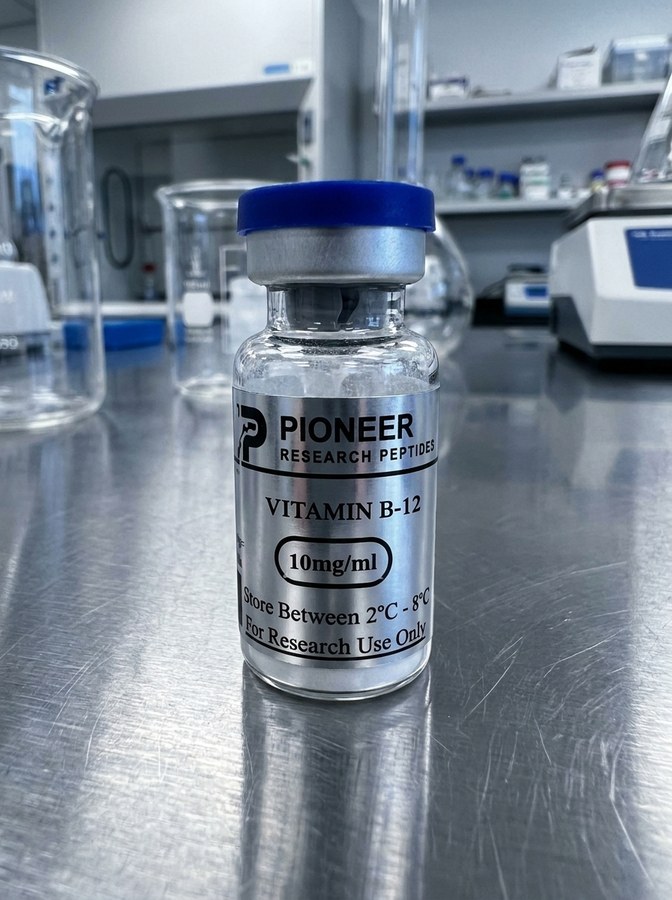
Vitamin B-12
Methylcobalamin solution
Methylcobalamin, the active form of vitamin B-12, central to research on energy metabolism, red-cell formation and methylation.
Mechanism#
Acts as a cofactor for methionine synthase and methylmalonyl-CoA mutase, supporting DNA synthesis and the methylation pathway — used in metabolic and haematology research.
Areas of research#
- Methylation-pathway research
- Energy-metabolism models
- Haematology (red-cell) studies
- Neurological-research cofactor
Sizes and pricing#
| Size | Price per vial | Availability |
|---|---|---|
| 10mg/ml | £15 | Made to order — 1-2 weeks |
Buying more than one? Mix and match any peptide vials: 3 vials 8%, 5 vials 12%, 10 or more 15% off the peptides in your basket. You get whichever is better, the bulk or the volume discount, never both — applied automatically at checkout. How it works.

Technical specification#
| Molecular formula | C63H91CoN13O14P |
|---|---|
| Molecular weight | 1344.38 |
| CAS number | 13422-55-4 |
| Form | Sterile solution (10 mg/ml) |
Check your certificate#
- Molecular weight 1344.38 for methylcobalamin, C63H91CoN13O14P (monoisotopic 1343.59). On a mass spectrum, expect ions near 1344.6 (singly charged) and 672.8 (doubly charged).
- Methylcobalamin specifically. The certificate should name methylcobalamin and CAS 13422-55-4, not just “vitamin B-12”.
- A solution, so concentration matters. It is supplied at 10 mg/ml, and a measured concentration tells you what a purity figure cannot.
- Purity, with the method named, measured on that batch rather than quoted as a minimum.
Ask about the documentation for the batch we would ship before you order. How to check a certificate yourself: verifying a COA.
What’s in the vial#
| Fill | Sterile solution, 10 mg/ml. Made to order. |
|---|---|
| Form | A solution, not a lyophilised powder. |
| Purity and content | Purity is the share of what was detected that is methylcobalamin. Concentration, how much is in each millilitre, is a separate number. How much is in the vial. |
Handling at a glance#
| Solvent | None needed. It is supplied in solution. |
|---|---|
| Storage | 2–8°C, protected from light. Refrigerated, not frozen. |
| Once opened | Every stopper pierced is a contamination opportunity, so keep handling steps few. |
Working out a concentration: the reconstitution calculator. Technique: the reconstitution guide and the storage guide.
What the research covers#
Methylcobalamin is a form of vitamin B-12 and a cofactor for methionine synthase and methylmalonyl-CoA mutase; the research areas listed for it here are the methylation pathway, energy metabolism and haematology. The guide linked below explains how to compare suppliers and certificates for metabolic research compounds; it is not a review of this literature. We have not published an assessment of that evidence, so we make no claim about it. Read the full guide, with sources: UK metabolic research compound suppliers: how to compare them.
Published literature#
- Green R, Allen LH, Bjørke-Monsen AL, et al. (2017). Nat Rev Dis Primers 3:17040. Review of vitamin B12: its role in cell metabolism, how B12 status is measured, and the continuing debate over where cut-offs should sit. PubMed 28660890
- Hotta K, Mano Y (2024). J Pharmacol Toxicol Methods 129:107552. Eisai, Japan. Methylcobalamin specifically: an LC-MS/MS method for measuring it in small volumes of rat plasma, applied to pharmacokinetic studies in rats. PubMed 39245417
- Banerjee R, Ragsdale SW (2003). Annu Rev Biochem 72:209–47. Review from the University of Nebraska of the enzymes that use vitamin B12, including the methylcobalamin-dependent methyltransferases, and how the cofactor works in each. PubMed 14527323
- Nielsen MJ, Rasmussen MR, Andersen CB, et al. (2012). Nat Rev Gastroenterol Hepatol 9(6):345–54. Review from Aarhus University, Denmark, of the multistep pathway that carries vitamin B12 from food to the body’s cells, and the proteins involved. PubMed 22547309
- Okada K, Tanaka H, Temporin K, et al. (2010). Exp Neurol 222(2):191–203. Osaka University, Japan. Methylcobalamin specifically: cultured neuron and rat study of the methylation cycle and Erk1/2 and Akt signalling, with nerve regeneration measured in rats. PubMed 20045411
Listed so the work can be read at source. A paper on this list is evidence of what was studied, not of what any product does.
Questions#
What is it?
Methylcobalamin, a form of vitamin B-12 that acts as a cofactor for methionine synthase and methylmalonyl-CoA mutase. CAS 13422-55-4. It is supplied as a sterile solution at 10 mg/ml.
What molecular weight should the certificate show?
1344.38 for methylcobalamin (monoisotopic 1343.59), C63H91CoN13O14P, usually seen as ions near 1344.6 and 672.8.
Does it need reconstituting?
No. It is supplied as a solution rather than as a lyophilised powder.
How should it be stored?
At 2-8°C, protected from light, refrigerated rather than frozen.
Is it for human use?
No. It is supplied for laboratory research only, and we do not give guidance on human or animal use.
A batch-specific Certificate of Analysis is available on request. New to handling lyophilised material? See our reconstitution guide, storage guide and how to read a COA.