AICAR
AMPK activator
Acadesine, usually sold under the abbreviation AICAR: a purine nucleoside analogue studied as an activator of AMP-activated protein kinase. It reached phase 3 trials under its own name, and it has been prohibited in sport since 2009.
Mechanism#
An activator of AMP-activated protein kinase, the enzyme that reads a cell’s AMP-to-ATP ratio. Acadesine is not itself the active species: it is phosphorylated inside the cell to ZMP, which resembles AMP closely enough to be read at the kinase’s regulatory site. Work using it sits in AMPK signalling, mitochondrial biogenesis and glucose-uptake models.
Areas of research#
- AMPK energy-sensing pathway
- Mitochondrial biogenesis
- Endurance and exercise-mimetic research
- Glucose-uptake models

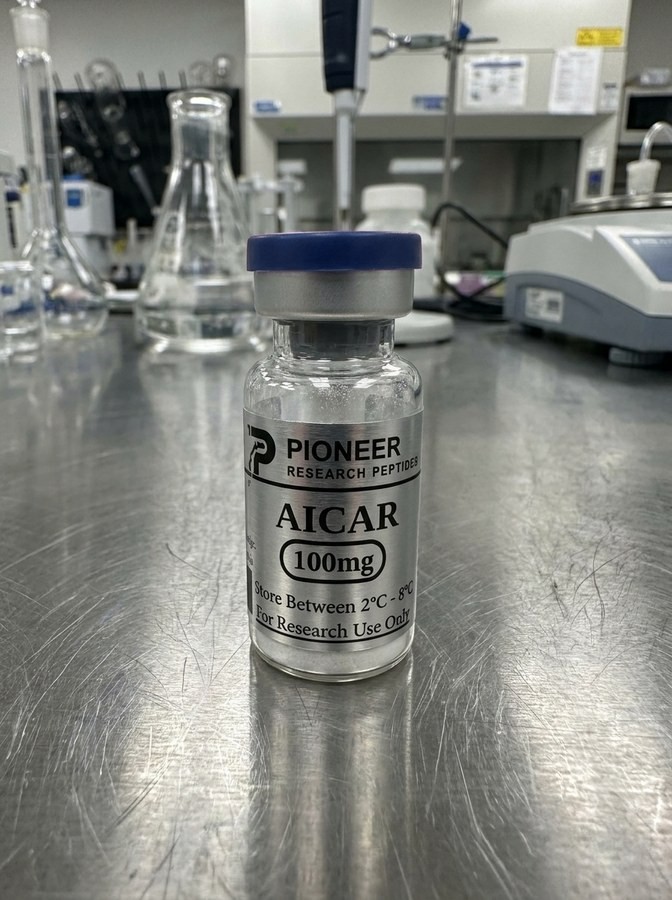
Identity and specification#
| Compound supplied | Acadesine (AICA riboside) |
|---|---|
| Molecular formula | C9H14N4O5 |
| Molecular weight | 258.23 g/mol |
| CAS number | 2627-69-2 |
| Class | Purine nucleoside analogue; AMPK activator |
| Active intracellular form | AICA ribonucleotide (ZMP), C9H15N4O8P, 338.21 g/mol, CAS 3031-94-5 |
| Appearance | White to off-white powder |
| Solubility | Water; DMSO |
| Storage | Sealed at 2–8°C, protected from moisture |
There is a naming trap here that catches a lot of people, and it is worth being precise about because two different molecules answer to the same abbreviation.
What is sold as AICAR is the nucleoside, acadesine: C9H14N4O5, 258.23 g/mol. The molecule that actually activates AMPK is its phosphorylated form, AICA ribonucleotide — ZMP — which the cell makes from acadesine using adenosine kinase. ZMP mimics AMP closely enough to be read by the enzyme's regulatory site, and that is the whole mechanism. The difference between the two molecules is a single phosphate group: eighty atomic mass units, 258.23 against 338.21.
The practical consequence is a check worth running on any certificate. A certificate quoting 338.21, or CAS 3031-94-5, for material labelled AICAR is describing the monophosphate, not the nucleoside that is normally supplied. Neither figure is wrong in itself; they describe different things, and the label has to match the one in the vial.
Where “exercise mimetic” came from#
The phrase attached to this compound everywhere has one source, and it is worth reading rather than repeating. In 2008 Narkar and colleagues published a paper in Cell titled “AMPK and PPARδ agonists are exercise mimetics”. Sedentary mice given acadesine ran further than untreated controls, without training. The title did the rest.
Three things about that result are routinely dropped when it is quoted. It was a mouse study. The comparison was against untrained animals rather than against training, so it does not say the compound substitutes for exercise. And the second half of the paper is about a different molecule entirely, a PPARδ agonist, which did nothing on its own without exercise — a finding that complicates the headline considerably.
None of which makes the work poor. It is a serious paper in a serious journal and it opened a real line of enquiry. But a single rodent result published eighteen years ago is a hypothesis rather than a conclusion, and the phrase it generated has travelled a great deal further than the evidence behind it.
What happened when it was tested in people#
Unusually for a compound in this catalogue, that question has an answer. Acadesine did not stall at the preclinical stage; it went the whole way.
It was investigated from the 1980s as a cardioprotective agent, licensed by PeriCor Therapeutics to Schering-Plough in 2007, and taken into RED-CABG — a phase 3 trial in patients undergoing coronary artery bypass grafting. In late 2010 the trial was terminated early. An interim analysis found a low probability that it would meet its primary efficacy endpoint, and continuing could not be justified.
That is what a completed evidence base looks like, and the important part is that the answer was no. Acadesine had a plausible mechanism, decades of preclinical support and a major pharmaceutical sponsor behind it, and it still did not survive a properly powered trial in its own indication. Compounds that never reach that stage have no record of failure — not because they would have succeeded, but because nobody ran the test that could have shown otherwise.
Worth separating clearly: the trial that failed was in cardiac surgery, not in metabolism or exercise physiology. It says nothing either way about the AMPK work. It does say that this compound has been through the machinery that most research compounds never reach, which makes its literature more informative than most, not less.
Status in sport#
AICAR is named on the World Anti-Doping Agency’s Prohibited List under metabolic modulators, in the entry for activators of AMP-activated protein kinase, alongside SR9009. That class is prohibited at all times, in and out of competition, rather than in competition only. It has been on the list since 2009, the year after the Cell paper.
Handling and storage#
Acadesine is a small nucleoside rather than a peptide, so it is more forgiving than most of this catalogue — but it is hygroscopic, and that is what spoils it. Keep the vial sealed and at 2–8°C, let it reach room temperature before opening so that condensation forms on the outside of the glass rather than on the powder, and make solutions fresh where the work allows. Soluble in water and in DMSO.
For the acadesine-versus-ZMP distinction in full, the AMPK mechanism, and the regulatory history, see our guide to AICAR explained.
What a certificate for acadesine should show#
Most of this catalogue is peptides, and the analytical questions for a small nucleoside are not the same ones. Three differences matter.
- Identity is easier, and should still be stated. A 258-dalton molecule with a known formula is unambiguous on a mass spectrometer, and NMR settles the structure outright. Identity and purity remain separate measurements reported separately — chromatography separates, it does not identify — but neither is the hard part here.
- Water is the hard part. Acadesine is hygroscopic. An HPLC purity figure is an area percentage of UV-absorbing material, so absorbed water is invisible to it: a batch can read high on purity and still be meaningfully water by mass. Karl Fischer titration is the measurement that answers it, and it is a separate line on a certificate rather than something the purity figure covers.
- Residual solvent is the other omission. Also invisible to a purity percentage, and also its own assay.
The general rule holds in both directions: a purity percentage describes the composition of what the detector saw, not the composition of the vial. For a hygroscopic compound that gap is wider than usual, which makes it the one worth asking about here. Our guide to reading a certificate of analysis works through a real one line by line.
Sources#
- AMPK and PPARδ agonists are exercise mimetics — Narkar et al., Cell, 2008
- Acadesine — development history, the RED-CABG termination in late 2010, and the 2009 addition to the Prohibited List
- AICA ribonucleotide — the nucleotide ZMP, C9H15N4O8P, CAS 3031-94-5, and its relationship to the riboside
- WADA Prohibited List — metabolic modulators; AMPK activators prohibited at all times
Sizes and pricing#
| Size | Price per vial | Availability |
|---|---|---|
| 50mg | £28 | In stock |
| 100mg | £55 | In stock |
Buying more than one? Mix and match any peptide vials: 3 vials 8%, 5 vials 12%, 10 or more 15% off the peptides in your basket. You get whichever is better, the bulk or the volume discount, never both — applied automatically at checkout. How it works.
Check your certificate#
- Molecular weight 258.23 for acadesine, C9H14N4O5, CAS 2627-69-2 (monoisotopic 258.10). On a mass spectrum, expect the singly charged ion near 259.1.
- 338.21 is the other AICAR. That is ZMP, the monophosphate (C9H15N4O8P, CAS 3031-94-5). A certificate quoting it for material labelled AICAR is describing a different molecule from the nucleoside normally supplied.
- Water content, by Karl Fischer titration. Acadesine is hygroscopic, and absorbed water is invisible to an HPLC purity figure, so it needs its own line. Residual solvent is the same: its own assay.
- Purity, with the method named, measured on that batch rather than quoted as a minimum. Identity and purity are separate measurements, reported separately.
Ask about the documentation for the batch we would ship before you order. How to check a certificate yourself: verifying a COA.
What’s in the vial#
| Fill | 50mg or 100mg of acadesine per vial |
|---|---|
| Appearance | White to off-white powder |
| Purity and content | Purity is the share of what was detected that is this compound. It cannot see water, and acadesine is hygroscopic, so water content is a separate number. How much is in the vial. |
Handling at a glance#
| Solvent | Water or DMSO |
|---|---|
| Sealed vial | 2–8°C, protected from moisture. Let it reach room temperature before opening, so condensation forms on the glass rather than on the powder. |
| Once in solution | Make solutions fresh where the work allows. |
| Worth knowing | A small nucleoside, not a peptide: agitation does not damage it, but it is hygroscopic, and moisture is what spoils it. |
Working out a concentration: the reconstitution calculator. Technique: the reconstitution guide and the storage guide.
What the research covers#
Acadesine has an unusually complete record. It was investigated from the 1980s for cardiac protection during surgery and taken into RED-CABG, a phase 3 trial in heart-bypass surgery that was stopped in late 2010 when a futility analysis found no difference in the primary outcome. The “exercise mimetic” label traces to a single 2008 mouse study that compared treated animals with untrained ones, not with training. It has never been approved for clinical use anywhere, and it has been on the World Anti-Doping Agency’s Prohibited List since 2009. Read the full guide, with sources: AICAR explained: what it is and what the name actually refers to.
Published literature#
- Corton JM, Gillespie JG, Hawley SA, et al. (1995). Eur J Biochem 229(2):558–65. The Dundee study showing that cells convert AICAR to ZMP, which activates AMPK without changing the cell’s ATP, ADP or AMP. PubMed 7744080
- Narkar VA, Downes M, Yu RT, et al. (2008). Cell 134(3):405–15. The Salk Institute mouse study of AMPK and PPARδ agonists and treadmill endurance that drew attention to AICAR outside the laboratory. PubMed 18674809
- Pokrywka A, Cholbinski P, Kaliszewski P, et al. (2014). J Physiol Pharmacol 65(4):469–76. Anti-doping review: why AICAR was added to the WADA Prohibited List in 2009, and how laboratories detect it. PubMed 25179079
- Mangano DT (1997). JAMA 277(4):325–32. Meta-analysis of the five earlier randomised trials in heart-bypass surgery (4,043 patients). It met its primary outcome, and its result led to the RED-CABG trial. PubMed 9002496
Listed so the work can be read at source. A paper on this list is evidence of what was studied, not of what any product does.
Questions#
What is AICAR?
Acadesine, also called AICA riboside: a purine nucleoside analogue studied as an activator of AMP-activated protein kinase (AMPK). Inside the cell it is phosphorylated to ZMP, the form that acts on the enzyme.
What molecular weight should the certificate show?
258.23 for acadesine (monoisotopic 258.10), usually seen as an ion near 259.1. A certificate quoting 338.21, or CAS 3031-94-5, is describing ZMP, the monophosphate.
How should it be stored?
Sealed at 2-8°C, protected from moisture, and brought to room temperature before opening. It dissolves in water and in DMSO; make solutions fresh where the work allows.
Is it prohibited in sport?
Yes. It is on the World Anti-Doping Agency's Prohibited List under metabolic modulators, prohibited at all times, and has been since 2009.
Is it for human use?
No. It is supplied for laboratory research only, and we do not give guidance on human or animal use.
A batch-specific Certificate of Analysis is available on request. New to handling lyophilised material? See our reconstitution guide, storage guide and how to read a COA.