MOTS-c
Batch documentation. Ask what exists for the batch we would ship before you order — email us ›
Mitochondrial-derived peptide
A mitochondrial-derived peptide investigated for roles in metabolic homeostasis, insulin sensitivity and exercise physiology.
Mechanism#
Encoded within mitochondrial DNA, it behaves like an 'exercise-mimetic' signal — research links it to AMPK activation, improved insulin sensitivity and greater metabolic flexibility.
Areas of research#
- Mitochondrial metabolism
- Insulin-sensitivity models
- Exercise and energy-metabolism research
- Cellular stress responses

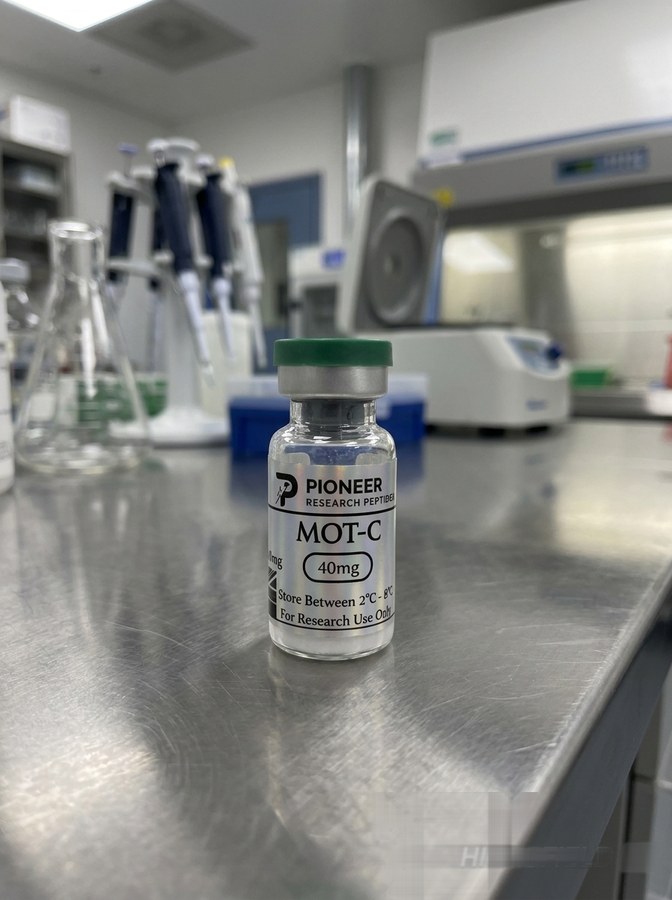
Identity and specification#
| Also known as | Mitochondrial ORF of the 12S rRNA type-c |
|---|---|
| Sequence | Met-Arg-Trp-Gln-Glu-Met-Gly-Tyr-Ile-Phe-Tyr-Pro-Arg-Lys-Leu-Arg (MRWQEMGYIFYPRKLR) |
| Length | 16 residues |
| Molecular formula | C101H152N28O22S2 |
| Molecular weight | 2174.62 g/mol |
| CAS number | 1627580-64-6 |
| Encoded by | MT-RNR1 — a mitochondrial gene, not a nuclear one |
| Appearance | White lyophilised powder |
| Solubility | Bacteriostatic or sterile water |
| Storage | 2–8°C, both sealed and once in solution |
This peptide is not encoded where peptides are normally encoded. Almost everything in a cell is transcribed from nuclear DNA. MOTS-c comes from MT-RNR1, a gene on the mitochondrion’s own small circular genome — the 12S ribosomal RNA gene, which was assumed to code for nothing at all. The name is the finding: mitochondrial open reading frame of the 12S rRNA, type c. That origin is the whole reason it is studied as a metabolic signal, because a message written by the mitochondrion is a message from the part of the cell that actually knows the energy state.
Two methionines, and why that matters on a certificate. Look at the formula: S2. Those two sulphurs are Met1 and Met6, and methionine is the residue most readily oxidised in storage. Each oxidation adds a single oxygen — sixteen mass units. So a mass spectrum landing at 2190 or 2206 rather than 2174.62 is not a different peptide; it is this peptide with one or both methionines oxidised. That is a storage result, and it is worth knowing how to read rather than dismiss.
The tryptophan at position 3 and the two tyrosines at 8 and 11 give this peptide a strong chromophore, so unlike several others in this catalogue it can be quantified at 280 nm. The same residues make it worth keeping out of the light.
Handling and storage#
Supplied as a lyophilised cake. Add solvent slowly down the vial wall and swirl rather than shake. Keep the sealed vial at 2–8°C; once in solution, refrigerate at 2–8°C, store in amber or wrapped glass, and avoid repeated freeze-thaw cycles. Given the two methionines, air exposure is the thing to minimise: keep headspace small and the cap on.
For how MOTS-c compares with the other metabolic compounds here, see our guide to UK metabolic research compounds.
Sizes and pricing#
| Size | Price per vial | Availability |
|---|---|---|
| 10mg | £25 | Made to order — 1-2 weeks |
| 20mg | £45 | In stock |
| 40mg | £68 | In stock |
Buying more than one? Mix and match any peptide vials: 3 vials 8%, 5 vials 12%, 10 or more 15% off the peptides in your basket. You get whichever is better, the bulk or the volume discount, never both — applied automatically at checkout. How it works.
Check your certificate#
- Molecular weight 2174.62 (monoisotopic 2173.11). On a mass spectrum, expect charged ions near 1087.6 (doubly charged), 725.4 (triply) and 544.3 (quadruply).
- Two methionines, and each can oxidise. Each oxidation adds 16, so peaks near 2190.6 or 2206.6 are this peptide with one or both methionines oxidised: a storage result, not a different peptide.
- Counter-ions carry real weight. With five basic residues plus the free amino end, MOTS-c can carry up to six. As a trifluoroacetate salt that can be roughly a quarter of the weight in the vial, so net peptide content is a separate number from purity.
- Purity, with the method named, measured on that batch rather than quoted as a minimum.
Ask about the documentation for the batch we would ship before you order. How to check a certificate yourself: verifying a COA.
What’s in the vial#
| Fill | 10mg, 20mg or 40mg per vial. The 10mg vial is made to order. |
|---|---|
| Appearance | White lyophilised powder |
| Purity and content | Purity is the share of what was detected that is this peptide. Net peptide content, how much of the powder’s weight is peptide rather than salt and water, is a separate number. How much is in the vial. |
Handling at a glance#
| Solvent | Bacteriostatic or sterile water |
|---|---|
| Sealed vial | 2–8°C, dry and dark. Let it reach room temperature before opening. |
| Once in solution | 2–8°C, in amber or wrapped glass. Avoid thawing and refreezing the same volume. |
| Worth knowing | The two methionines make air the thing to minimise: keep headspace small and the cap on. The tryptophan and two tyrosines are a further reason to keep it out of the light. |
Working out a concentration: the reconstitution calculator. Technique: the reconstitution guide and the storage guide.
What the research covers#
MOTS-c was first described in 2015, and the published work since is mostly in mice and cells. Most of it comes from the group that discovered it and its collaborators, whose papers declare a commercial interest; an unconnected Copenhagen group published mouse muscle work in 2026. We have found no published controlled trial of MOTS-c given to people: the human studies measure the body’s own MOTS-c, including a 30-person exercise study in which it showed only a trend to rise. It is not a licensed medicine anywhere. Read the full guide, with sources: MOTS-c: the peptide written in mitochondrial DNA.
Published literature#
- Lee C, Zeng J, Drew BG, et al. (2015). Cell Metab 21(3):443–54. The first description of MOTS-c: where it is encoded, its action on the folate cycle and AMPK, and studies in mice with age and on a high-fat diet. PubMed 25738459
- Kim KH, Son JM, Benayoun BA, et al. (2018). Cell Metab 28(3):516–524.e7. Movement of MOTS-c into the cell nucleus under metabolic stress, and the nuclear genes it affected there. PubMed 29983246
- Reynolds JC, Lai RW, Woodhead JST, et al. (2021). Nat Commun 12(1):470. Physical capacity in young, middle-aged and old mice given MOTS-c, and MOTS-c levels in human muscle and blood after exercise. PubMed 33473109
- Kumagai H, Kim SJ, Miller B, et al. (2024). iScience 27(11):111212. Identification of the enzyme CK2 as a direct target of MOTS-c in muscle and fat, including the variant peptide’s reduced binding. PubMed 39559755
- Gudiksen A, Hansen CC, van der Stede T, et al. (2026). Free Radic Biol Med 246:682–96. Independent laboratory study of MOTS-c and muscle mitochondrial function in two transgenic mouse strains, testing the roles of PGC-1α and AMPK. PubMed 41520850
Listed so the work can be read at source. A paper on this list is evidence of what was studied, not of what any product does.
Questions#
What is MOTS-c?
A 16-residue peptide, Met-Arg-Trp-Gln-Glu-Met-Gly-Tyr-Ile-Phe-Tyr-Pro-Arg-Lys-Leu-Arg, encoded in the 12S rRNA gene of mitochondrial DNA rather than in the cell nucleus. It was first described in 2015.
What molecular weight should the certificate show?
2174.62 (monoisotopic 2173.11), usually seen as ions near 1087.6, 725.4 and 544.3. Peaks near 2190.6 or 2206.6 mean one or both of its two methionines have oxidised.
How should it be stored?
Sealed vial at 2-8°C, dry and dark. Once reconstituted with bacteriostatic or sterile water, keep it at 2-8°C in amber or wrapped glass, keep air exposure low, and avoid thawing and refreezing the same volume.
Is there a batch certificate?
Yes. The certificate for the current batch is available on request: email orders@pioneerpeptides.co.uk with the product and size.
Is it for human use?
No. It is supplied for laboratory research only, and we do not give guidance on human or animal use.
A batch-specific Certificate of Analysis is available on request. New to handling lyophilised material? See our reconstitution guide, storage guide and how to read a COA.