BPC-157
Body Protection Compound
A synthetic peptide derived from a gastric protein ('body protection compound'), widely studied in research for tissue-repair and angiogenic pathways.
Mechanism#
A stable fragment of a protein found in gastric juice. Research indicates it promotes angiogenesis (new blood-vessel growth) and up-regulates growth-factor pathways, supporting repair of tendon, muscle and gut tissue in models.
Areas of research#
- Tendon, ligament and muscle-repair models
- Gastrointestinal-protection research
- Angiogenesis and blood-vessel formation
- Cytoprotection pathways

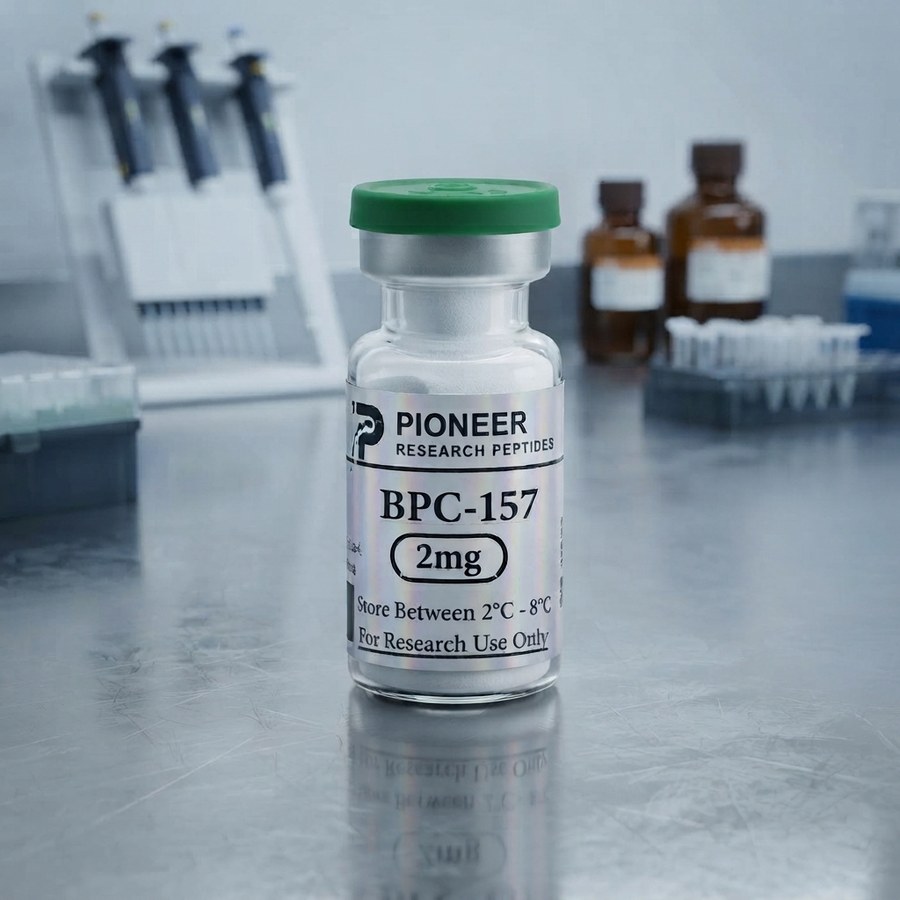
Identity and specification#
| Also known as | Body Protection Compound-157; PL 14736 |
|---|---|
| Sequence | Gly-Glu-Pro-Pro-Pro-Gly-Lys-Pro-Ala-Asp-Asp-Ala-Gly-Leu-Val |
| Length | 15 residues (pentadecapeptide), free acid C-terminus |
| Molecular formula | C62H98N16O22 |
| Molecular weight | 1419.55 g/mol (free peptide) |
| Supplied as | Acetate salt. With two basic sites (the free amino end and lysine 7) it carries at most two acetate counter-ions: C62H98N16O22 · 2C2H4O2, 1539.65 g/mol as the diacetate. A stated milligram figure refers to the peptide, not the salt. |
| CAS number | 137525-51-0 |
| Class | Synthetic peptide fragment of human gastric juice protein BPC |
| Appearance | White lyophilised powder (acetate salt) |
| Solubility | Bacteriostatic or sterile water |
| Storage | 2–8°C, both sealed and once in solution |
Read the sequence and one feature stands out immediately: Gly-Glu-Pro-Pro-Pro. Three consecutive prolines at positions 3 to 5, and a fourth at position 8. Proline is the one amino acid whose side chain loops back and bonds to its own backbone nitrogen, which locks the local geometry and leaves proteases very little to grip. That run of prolines is the structural reason BPC-157 is unusually robust — it is reported to survive in human gastric juice intact for more than 24 hours, where most 15-residue peptides would not last minutes.
It is worth being precise about what BPC-157 is. It is not a naturally occurring molecule in its own right; it is a synthetic fragment corresponding to part of a larger protein found in gastric juice, and it has never been isolated as a free peptide in the body. Sources describing it as “a peptide found in the stomach” are compressing that into something inaccurate.
A note on salt form. The 1419.55 figure is the free base. Peptides of this kind are commonly supplied as acetate salts, and each acetate carried adds about 60 to the mass. That is why a mass-spectrometry result and a gravimetric figure on the same certificate need not agree exactly, and why the certificate is worth reading rather than skimming.
Handling and storage#
Supplied as a lyophilised cake. Add solvent slowly down the inside wall of the vial rather than onto the powder, and swirl rather than shake. Keep the sealed vial at 2–8°C; once in solution, refrigerate at 2–8°C and avoid repeated freeze-thaw cycles. The proline-rich backbone makes this one of the more forgiving peptides in the catalogue, but that is a reason to store it properly rather than a licence not to.
For the solvent choice, the volumes and the mistakes that cost material, see our guide to reconstituting research peptides.
Sizes and pricing#
| Size | Price per vial | Availability |
|---|---|---|
| 2mg | £9 | Made to order — 1-2 weeks |
| 5mg | £17 | Made to order — 1-2 weeks |
| 10mg | £29.95 | In stock |
Buying more than one? Mix and match any peptide vials: 3 vials 8%, 5 vials 12%, 10 or more 15% off the peptides in your basket. You get whichever is better, the bulk or the volume discount, never both — applied automatically at checkout. How it works.
Check your certificate#
- Molecular weight 1419.55 for the peptide (monoisotopic 1418.70). On a mass spectrum, expect ions near 1419.7 (singly charged) and 710.4 (doubly charged).
- The salt is not in that figure. BPC-157 is supplied as the acetate salt, but a mass spectrum shows the peptide on its own.
- A free acid. BPC-157 ends in a free carboxylic acid, not an amide. The formula should read C62H98N16O22.
- Purity, with the method named, measured on that batch rather than quoted as a minimum.
Ask about the documentation for the batch we would ship before you order. How to check a certificate yourself: verifying a COA.
What’s in the vial#
| Fill | 2mg, 5mg or 10mg per vial. The stated milligrams refer to the peptide, not the salt. |
|---|---|
| Appearance | White lyophilised powder |
| Salt form | Acetate. With two basic sites, it carries at most two acetate counter-ions (1539.65 as the diacetate). |
| Purity and content | Purity is the share of what was detected that is this peptide. Net peptide content, how much of the powder’s weight is peptide rather than salt and water, is a separate number. How much is in the vial. |
Handling at a glance#
| Solvent | Bacteriostatic or sterile water |
|---|---|
| Sealed vial | 2–8°C, dry and dark. Let it reach room temperature before opening. |
| Once in solution | 2–8°C. Avoid thawing and refreezing the same volume. |
| Worth knowing | Its run of prolines makes it one of the more robust peptides in the catalogue. That is a reason to store it properly, not a reason not to. |
Working out a concentration: the reconstitution calculator. Technique: the reconstitution guide and the storage guide.
What the research covers#
The published work is overwhelmingly in rodents, and much of it comes from one research group. A 2026 systematic review of the human evidence found three small studies with 30 participants in total, none of them controlled, all judged poor quality. It is not a licensed medicine in the UK. Read the full guide, with sources: BPC-157: what it is, and what the evidence says.
Published literature#
- Sikirić P, Petek M, Rucman R, et al. (1993). J Physiol Paris 87(5):313–27. The Zagreb group’s early overview, introducing the 15-residue fragment and summarising their animal studies. PubMed 8298609
- Chang CH, Tsai WC, Lin MS, et al. (2011). J Appl Physiol (1985) 110(3):774–80. Independent study from Chang Gung University, Taiwan, of rat tendon fibroblasts with BPC-157: outgrowth from tendon explants, cell survival under oxidative stress, and migration. PubMed 21030672
- He L, Feng D, Guo H, et al. (2022). Front Pharmacol 13:1026182. Pharmacokinetic study in rats and dogs by a group in Xi’an, independent of Zagreb: a half-life under 30 minutes, with the peptide broken down into small fragments and amino acids. PubMed 36588717
Listed so the work can be read at source. A paper on this list is evidence of what was studied, not of what any product does.
Questions#
What is BPC-157?
A synthetic 15-residue peptide, Gly-Glu-Pro-Pro-Pro-Gly-Lys-Pro-Ala-Asp-Asp-Ala-Gly-Leu-Val, corresponding to part of a larger protein found in gastric juice. It has never been isolated as a free peptide in the body.
What molecular weight should the certificate show?
1419.55 for the peptide (monoisotopic 1418.70), usually seen as ions near 1419.7 and 710.4. It is supplied as the acetate salt, but the mass spectrum shows the peptide alone.
Does the 10mg on the label include the salt?
No. The stated milligrams refer to the peptide, not the acetate salt it is supplied as.
How should it be stored?
Sealed vial at 2-8°C, dry and dark. Once reconstituted with bacteriostatic or sterile water, keep it at 2-8°C and avoid thawing and refreezing the same volume.
Is it for human use?
No. It is supplied for laboratory research only, and we do not give guidance on human or animal use.
A batch-specific Certificate of Analysis is available on request. New to handling lyophilised material? See our reconstitution guide, storage guide and how to read a COA.