FOXO4-DRI
D-retro-inverso peptide
A D-retro-inverso peptide that disrupts the FOXO4–p53 interaction, widely studied in senescence and longevity research for selectively clearing senescent cells.
Mechanism#
Competes with p53 binding to FOXO4 in senescent cells, releasing p53 to trigger their apoptosis — a widely used tool in senescence research.
Areas of research#
- Senescence research
- FOXO4–p53 pathway
- Longevity and aging models
- Cellular-apoptosis studies

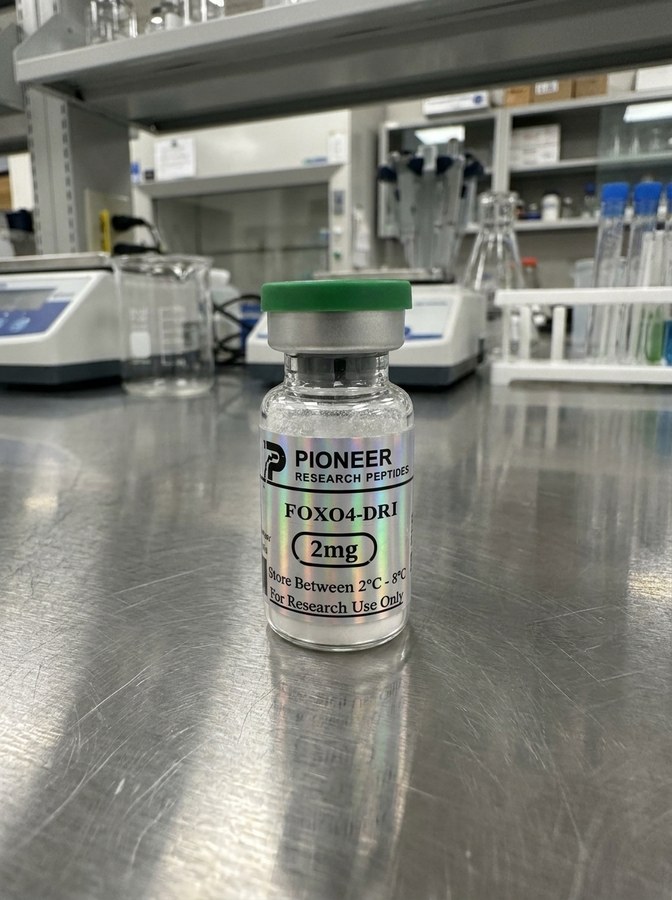
Identity and specification#
| Length | 46 residues |
|---|---|
| Chirality | All-D enantiomer (the four glycines are achiral) |
| Termini | Free N-terminal amine; free C-terminal acid — not amidated |
| Molecular formula | C228H388N86O64 (free base) |
| Molecular weight | 5358.1 g/mol (free base) |
| CAS number | 2460055-10-9 |
| Also known as | FOXO4 D-retro-inverso peptide; FOXO4–p53 interfering peptide |
| Appearance | White lyophilised powder |
| Storage | 2–8°C, both sealed and once in solution |
What “D-retro-inverso” actually means#
Two changes at once, and they cancel out. The sequence is reversed, and every chiral residue is switched from L to D. Reversing the order while inverting the handedness leaves the side chains arranged in approximately the same three-dimensional pattern as the original peptide — so the molecule still fits its target — while making it largely invisible to the proteases that would otherwise degrade an ordinary peptide in minutes.
There is a consequence worth noticing. The parent peptide carries the HIV TAT cell-penetrating sequence at its N-terminus. Because the DRI form is written in reverse, that TAT-derived block sits at the C-terminal end instead. A sequence that looks upside-down compared with the published parent is correct, not a transcription error.
What it does#
FOXO4-DRI blocks a protein–protein interaction rather than a receptor. In senescent cells the transcription factor FOXO4 is elevated and binds p53, holding it in nuclear foci and keeping the senescent cell alive. The peptide competes with endogenous FOXO4 for that binding site, disrupting the foci and releasing active p53, which drives apoptosis — selectively in senescent cells, and not in their healthy neighbours. That selectivity is why the compound is described as a senolytic.
The work is Baar and colleagues, Cell, 2017. Later work has refined the target to the disordered transactivation domain of p53. Research areas since have included chemotoxicity models, renal function and fitness measures in aged mice. As with everything on this page, it is animal and cell work: we could find no human trials.
A note on molecular weight, because suppliers differ#
You will see figures around 5367 quoted. That is a salt weight. With twelve arginines and three lysines this peptide is supplied as an acetate or trifluoroacetate salt, and the counter-ion content is measured per batch rather than fixed — one supplier's lot-specific figure is not a property of the molecule. We quote the free base, 5358.1, and note that the salt adds a lot-dependent one to ten per cent. Gross weight in the vial is not the same as net peptide.
Handling and storage#
A 46-residue peptide is more fragile than the short ones. Keep the sealed vial at 2–8°C, dry and dark, and warm it to room temperature before opening. Reconstitute gently down the side of the vial rather than onto the cake, and do not vortex. Store the solution at 2–8°C, split it into aliquots where it will be drawn from more than a few times, and avoid repeated freeze-thaw cycles. Our reconstitution guide covers the mechanics.
Sizes and pricing#
| Size | Price per vial | Availability |
|---|---|---|
| 2mg | £35 | Made to order — 1-2 weeks |
| 5mg | £65 | Made to order — 1-2 weeks |
Buying more than one? Mix and match any peptide vials: 3 vials 8%, 5 vials 12%, 10 or more 15% off the peptides in your basket. You get whichever is better, the bulk or the volume discount, never both — applied automatically at checkout. How it works.
Check your certificate#
- Molecular weight 5358.1 for the free base, C228H388N86O64 (monoisotopic 5354.98). A peptide this size shows on a mass spectrum as several multiply charged ions, for example near 1339.8 (four charges), 1072.0 (five) and 893.5 (six).
- Figures around 5367 are a salt weight, not a different peptide. With twelve arginines and three lysines it is supplied as an acetate or trifluoroacetate salt, and the counter-ion adds a lot-dependent one to ten per cent.
- Reversed, and all-D. The sequence runs in reverse of the parent peptide, so the TAT-derived block sits at the C-terminal end. A sequence that looks upside-down against the published parent is correct. Mass alone cannot confirm the D-configuration, because mirror-image forms weigh the same.
- Free amine and free acid at the ends, not amidated.
- Purity, with the method named, measured on that batch rather than quoted as a minimum.
Ask about the documentation for the batch we would ship before you order. How to check a certificate yourself: verifying a COA.
What’s in the vial#
| Fill | 2mg or 5mg per vial, both made to order |
|---|---|
| Appearance | White lyophilised powder |
| Salt form | Acetate or trifluoroacetate. The counter-ion content is measured per batch, so gross weight in the vial is not the same as net peptide. |
| Purity and content | Purity is the share of what was detected that is this peptide. Net peptide content, how much of the powder’s weight is peptide rather than salt and water, is a separate number. How much is in the vial. |
Handling at a glance#
| Reconstitution | Gently, down the side of the vial rather than onto the cake. Do not vortex. |
|---|---|
| Sealed vial | 2–8°C, dry and dark. Let it reach room temperature before opening. |
| Once in solution | 2–8°C. Split it into aliquots where it will be drawn from more than a few times, and avoid repeated freeze-thaw cycles. |
| Worth knowing | At 46 residues it is more fragile than the short peptides in the catalogue. |
Working out a concentration: the reconstitution calculator. Technique: the reconstitution guide and the storage guide.
What the research covers#
The research is animal and cell work. It starts with Baar and colleagues in Cell in 2017, who reported that the peptide disrupts the FOXO4–p53 interaction and leads to apoptosis selectively in senescent cells in their models. Later work refined the target to the transactivation domain of p53, and has looked at chemotoxicity models, renal function and fitness measures in aged mice. We could find no human trials. Read the full guide, with sources: How to read a peptide certificate of analysis (COA).
Published literature#
- Baar MP, Brandt RMC, Putavet DA, et al. (2017). Cell 169(1):132–147.e16. Erasmus University Medical Center, Rotterdam: the paper that designed FOXO4-DRI. Cell and mouse study of a peptide that disrupts the FOXO4–p53 interaction in senescent cells, including fast-ageing and naturally aged mice. PubMed 28340339
- Zhang C, Xie Y, Chen H, et al. (2020). Aging (Albany NY) 12(2):1272–1284. Sun Yat-sen University, Guangzhou. Senescent mouse Leydig cells in culture and naturally aged mice, with testosterone secretion measured. PubMed 31959736
- Bourgeois B, Spreitzer E, Platero-Rochart D, et al. (2025). Nat Commun 16(1):5672. Medical University of Graz, with authors of the original paper. Solution NMR structures of the p53 transactivation domain bound to FOXO4 and to FOXO4-DRI. PubMed 40593617
Listed so the work can be read at source. A paper on this list is evidence of what was studied, not of what any product does.
Questions#
What is FOXO4-DRI?
A 46-residue D-retro-inverso peptide: a FOXO4-derived peptide with its sequence reversed and every chiral residue switched to the D form. It is studied in senescence research as a disruptor of the FOXO4-p53 interaction.
What molecular weight should the certificate show?
5358.1 for the free base (monoisotopic 5354.98), seen as several multiply charged ions such as 1339.8, 1072.0 and 893.5. Figures around 5367 are a salt weight, not a different peptide.
Why does the sequence look reversed?
Because it is. A D-retro-inverso peptide is written in reverse with its residues switched from L to D, so the TAT-derived block at the N-terminus of the parent peptide appears at the C-terminal end. That is correct, not a transcription error.
How should it be stored?
Sealed vial at 2-8°C, dry and dark, warmed to room temperature before opening. Once reconstituted, keep it at 2-8°C, split it into aliquots if it will be drawn from more than a few times, and avoid repeated freeze-thaw cycles.
Is it for human use?
No. It is supplied for laboratory research only, and we do not give guidance on human or animal use.
A batch-specific Certificate of Analysis is available on request. New to handling lyophilised material? See our reconstitution guide, storage guide and how to read a COA.