Crystagen
Short-chain peptide (Khavinson class)
A peptide bioregulator studied for immune-system modulation and thymic function in research models.
Mechanism#
A short Khavinson-family peptide proposed to influence immune-cell gene expression, investigated for immune-regulation research.
Areas of research#
- Immune-bioregulator research
- Thymic-function models
- Immune-cell gene expression
- Aging-research peptides

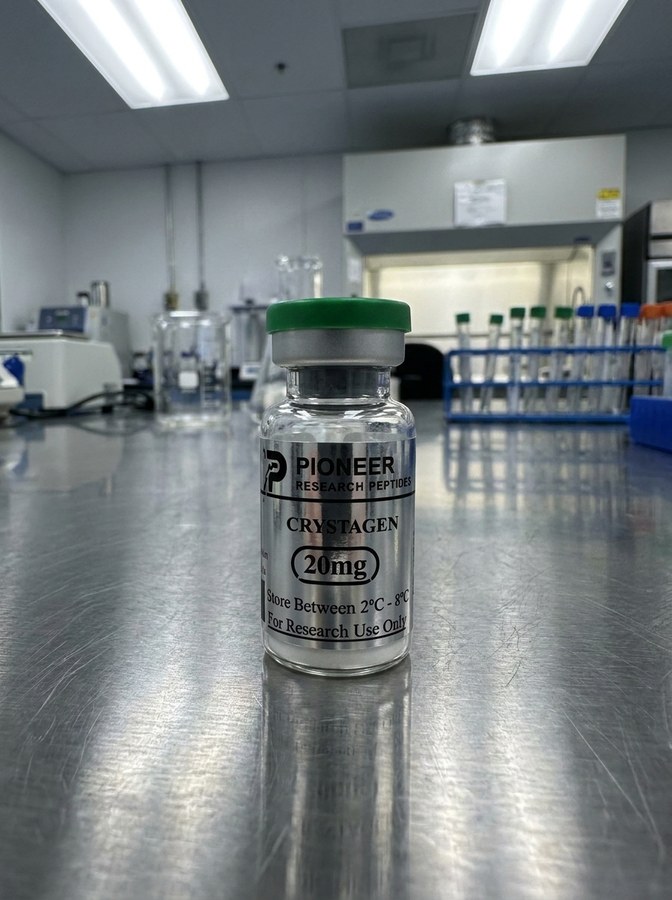
Identity and specification#
| Sequence | Glu-Asp-Pro (EDP) |
|---|---|
| Length | 3 residues |
| Molecular formula | C14H21N3O8 |
| Molecular weight | 359.34 g/mol |
| CAS number | None assigned that we could find |
| Also spelled | Cristagen (the transliteration used in the primary literature) |
| Class | Short synthetic peptide, Khavinson bioregulator series |
| Appearance | White lyophilised powder |
| Solubility | Bacteriostatic or sterile water |
| Storage | 2–8°C, both sealed and once in solution |
What it is#
Crystagen is the tripeptide glutamate–aspartate–proline, one of the short peptides from the Khavinson series developed at the St Petersburg Institute of Bioregulation and Gerontology. The series proposes that peptides of this size act in the nucleus, interacting with specific DNA sequences to influence tissue-specific gene expression.
Two things are worth knowing before you order it anywhere.
The spelling matters when you go looking. Khavinson's own papers render it Cristagen, with an i. Searching the literature for “Crystagen” finds retail pages; searching for “Cristagen” finds the two papers that exist.
The name covers two different things. Crystagen is also sold in Russia as a capsule supplement whose declared active is a peptide complex designated AS-6 — a preparation containing proline, glutamic acid and aspartic acid. The synthetic research peptide sold under the same name is the defined EDP tripeptide. Same word on the label, not necessarily the same material in the container.
We should also note a disagreement we could not settle: most sources, including the primary one, describe Crystagen as a tripeptide, while at least one describes it as a tetrapeptide. We have gone with the tripeptide, EDP, because that is what Khavinson's own table states.
What the literature actually contains#
This is the thinnest evidence base of the three bioregulators we stock, and it would be dishonest to present it otherwise. A name-restricted search of the main databases returns two items, both concerning immunomodulating activity of short peptides in the spleen with age, and both from Khavinson's own group. We found no study of this compound by any unaffiliated laboratory, in any language, and no human trials.
One further caution. Some listings cite studies with titles like “Crystagen in Elderly Patients with Impaired Immunity” and give a journal and year. We could not locate either those papers or any authors or DOI for them in any database. We are not repeating citations we cannot find, and we would suggest treating them sceptically wherever you see them.
Handling and storage#
Supplied lyophilised. Keep the sealed vial at 2–8°C, protected from light and moisture, and allow it to reach room temperature before opening. Reconstitute gently down the side of the vial. Store the solution at 2–8°C and avoid repeated freeze-thaw cycles. See our reconstitution guide and the bioregulator guide.
Sizes and pricing#
| Size | Price per vial | Availability |
|---|---|---|
| 20mg | £55 | Made to order — 1-2 weeks |
Buying more than one? Mix and match any peptide vials: 3 vials 8%, 5 vials 12%, 10 or more 15% off the peptides in your basket. You get whichever is better, the bulk or the volume discount, never both — applied automatically at checkout. How it works.
Check your certificate#
- Molecular weight 359.34 (monoisotopic 359.13), C14H21N3O8. On a mass spectrum, expect the singly charged ion near 360.1.
- Not Cortagen. Cortagen (AEDP, 430.41) is the same three residues with an alanine in front. Check the sequence reads Glu-Asp-Pro.
- Same name, different material. Crystagen is also sold in Russia as a capsule supplement whose declared active is a peptide complex, AS-6. A certificate for the research peptide should describe the defined EDP tripeptide.
- Purity, with the method named, measured on that batch rather than quoted as a minimum.
Ask about the documentation for the batch we would ship before you order. How to check a certificate yourself: verifying a COA.
What’s in the vial#
| Fill | 20mg of peptide per vial |
|---|---|
| Appearance | White lyophilised powder |
| Purity and content | Purity is the share of what was detected that is this peptide. Net peptide content, how much of the powder’s weight is peptide rather than salt and water, is a separate number. How much is in the vial. |
Handling at a glance#
| Solvent | Bacteriostatic or sterile water |
|---|---|
| Sealed vial | 2–8°C, protected from light and moisture. Let it reach room temperature before opening. |
| Once in solution | 2–8°C. Avoid thawing and refreezing the same volume. |
| Worth knowing | Short peptides are not automatically more robust than long ones. Three residues still call for the standard handling. |
Working out a concentration: the reconstitution calculator. Technique: the reconstitution guide and the storage guide.
What the research covers#
This is the thinnest evidence base of the bioregulators we stock. A name-restricted search, using Cristagen, the spelling in the primary literature, returns two items, both on the immunomodulating activity of short peptides in the spleen with age, and both from Khavinson’s own group. We found no study by an unaffiliated laboratory and no human trials. Some listings cite studies in elderly patients that we could not locate in any database. Read the full guide, with sources: Peptide Bioregulators Explained: Epithalon, Cortagen, Cartalax.
Published literature#
- Khavinson VK, Popovich IG, Linkova NS, et al. (2021). Molecules 26(22):7053. Systematic review by the St Petersburg group setting out their gene-regulation hypothesis for short peptides. PubMed 34834147
Listed so the work can be read at source. A paper on this list is evidence of what was studied, not of what any product does.
Questions#
What is Crystagen?
The tripeptide Glu-Asp-Pro (EDP), from the Khavinson series of short peptide bioregulators. The primary literature spells it Cristagen. Most sources, including the primary one, describe it as a tripeptide, though at least one calls it a tetrapeptide.
What molecular weight should the certificate show?
359.34 (monoisotopic 359.13), usually seen as an ion near 360.1. Cortagen, the same residues with an alanine in front, is 430.41.
How should it be stored?
Sealed vial at 2-8°C, protected from light and moisture, brought to room temperature before opening. Once reconstituted with bacteriostatic or sterile water, keep it at 2-8°C and avoid thawing and refreezing the same volume.
Is it the same as the Crystagen capsules sold in Russia?
Not necessarily. Those capsules declare a peptide complex designated AS-6. The research peptide is the defined EDP tripeptide.
Is it for human use?
No. It is supplied for laboratory research only, and we do not give guidance on human or animal use.
A batch-specific Certificate of Analysis is available on request. New to handling lyophilised material? See our reconstitution guide, storage guide and how to read a COA.