GHRP-6
GH-releasing peptide-6
An early growth-hormone-releasing peptide and strong ghrelin-receptor agonist, studied for GH release and pronounced appetite stimulation.
Mechanism#
Binds the ghrelin receptor to drive GH secretion and a marked increase in hunger signalling; widely used as a reference secretagogue in GH-axis research.
Areas of research#
- GH-secretagogue research
- Ghrelin-receptor signalling
- Appetite and food-intake models
- Gut-motility research

Identity and specification#
| Also known as | GH-releasing peptide-6; His-D-Trp-Ala-Trp-D-Phe-Lys-NH2 |
|---|---|
| Sequence | His-D-Trp-Ala-Trp-D-Phe-Lys-NH2 |
| Length | 6 residues, C-terminally amidated |
| Molecular formula | C46H56N12O6 |
| Molecular weight | 873.03 g/mol |
| CAS number | 87616-84-0 |
| Class | Synthetic hexapeptide; ghrelin receptor (GHS-R1a) agonist |
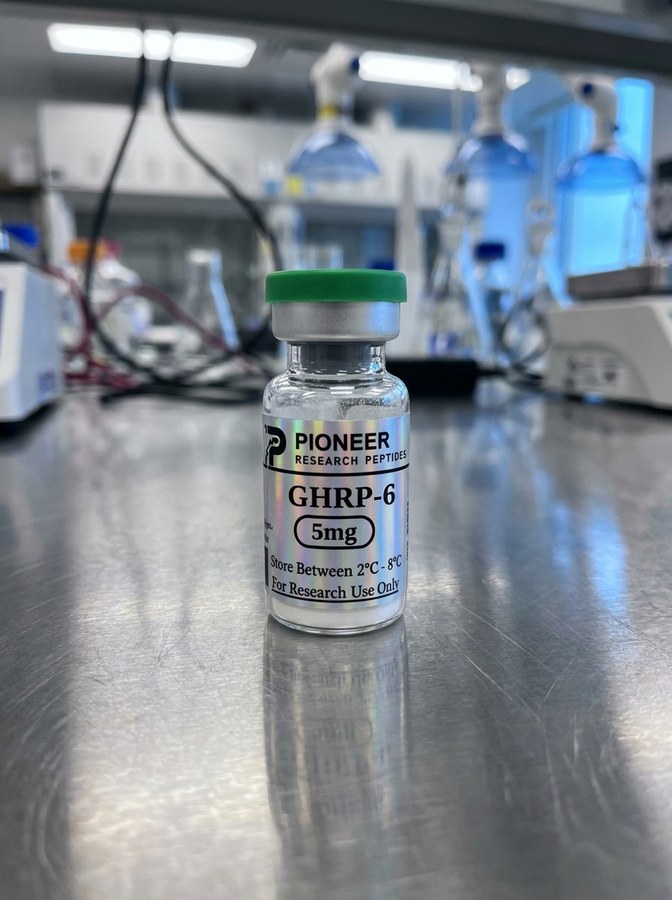
| Appearance | White lyophilised powder |
| Solubility | Bacteriostatic or sterile water |
| Storage | 2–8°C, both sealed and once in solution |
GHRP-6 and GHRP-2 are both hexapeptides at the same receptor, and they are separated by 55 mass units — 873.03 against 817.99. That gap is large enough to tell them apart on a mass spectrum without ambiguity, which is worth knowing if you are checking a certificate against a label.
The two tryptophans are the practical difference in the laboratory. Tryptophan absorbs strongly at 280 nm, so GHRP-6 can be quantified by A280 where many short peptides carry no chromophore and cannot. The same residue is why the material is worth keeping out of the light: tryptophan photo-degrades, and a solution left on a sunlit bench loses signal before it loses appearance.
Handling and storage#
Supplied as a lyophilised cake under vacuum. Add solvent slowly down the inside wall of the vial rather than onto the powder, and swirl rather than shake. Keep the sealed vial at 2–8°C; once in solution, refrigerate at 2–8°C, store in amber or wrapped glass given the tryptophan content, and avoid repeated freeze-thaw cycles.
For receptor selectivity, the mass difference between the two, and what each one looks like on a certificate, see our guide to GHRP-2 and GHRP-6 compared.
Sizes and pricing#
| Size | Price per vial | Availability |
|---|---|---|
| 5mg | £8.50 | Made to order — 1-2 weeks |
| 10mg | £14 | In stock |
Buying more than one? Mix and match any peptide vials: 3 vials 8%, 5 vials 12%, 10 or more 15% off the peptides in your basket. You get whichever is better, the bulk or the volume discount, never both — applied automatically at checkout. How it works.
Batch documentation. Ask about the documentation for the batch we would ship before you order.
Check your certificate#
- Molecular weight 873.03 is the average mass (monoisotopic 872.44). On a mass spectrum, expect ions near 873.5 (singly charged) and 437.2 (doubly charged).
- Not GHRP-2. GHRP-2 is 817.99, 55 lighter, and ipamorelin is 711.86. The gap is large enough to tell them apart without ambiguity.
- An amide at the C-terminus. GHRP-6 ends in Lys-NH2. The formula should read C46H56N12O6.
- Purity, with the method named, measured on that batch rather than quoted as a minimum.
Ask about the documentation for the batch we would ship before you order. How to check a certificate yourself: verifying a COA.
What’s in the vial#
| Fill | 5mg or 10mg of peptide per vial |
|---|---|
| Appearance | White lyophilised powder |
| Purity and content | Purity is the share of what was detected that is this peptide. Net peptide content, how much of the powder’s weight is peptide rather than salt and water, is a separate number. How much is in the vial. |
Handling at a glance#
| Solvent | Bacteriostatic or sterile water |
|---|---|
| Sealed vial | 2–8°C, dry and dark. Let it reach room temperature before opening. |
| Once in solution | 2–8°C, in amber or wrapped glass. Avoid thawing and refreezing the same volume. |
| Worth knowing | Its two tryptophans absorb strongly at 280 nm, so it can be quantified by A280. They also photo-degrade: a solution left in the light loses signal before it loses appearance. |
Working out a concentration: the reconstitution calculator. Technique: the reconstitution guide and the storage guide.
What the research covers#
GHRP-6 was first reported in 1984, as growth hormone release in pituitary preparations and in several animal species, before its receptor was cloned in 1996 or the receptor’s natural ligand, ghrelin, was identified in 1999. It is widely described as having a stronger effect on appetite than GHRP-2, but we have not found a published study comparing the two directly. Read the full guide, with sources: GHRP-2 and GHRP-6 Compared.
Published literature#
- Bowers CY, Momany FA, Reynolds GA, et al. (1984). Endocrinology 114(5):1537–45. The first report of GHRP-6 ([His1,Lys6]-GHRP): growth hormone release in pituitary preparations and in several animal species. PubMed 6714155
- Howard AD, Feighner SD, Cully DF, et al. (1996). Science 273(5277):974–7. Cloning of the receptor these compounds act on, the growth hormone secretagogue receptor, now usually called the ghrelin receptor. PubMed 8688086
- Kojima M, Hosoda H, Date Y, et al. (1999). Nature 402(6762):656–60. Identification of ghrelin, the receptor’s natural ligand, from the stomach. PubMed 10604470
- Bowers CY (2012). Methods Enzymol 514:3–32. The originator’s own history of the field, from the first synthetic GHRPs in the 1970s to the discovery of ghrelin. PubMed 22975043
Listed so the work can be read at source. A paper on this list is evidence of what was studied, not of what any product does.
Questions#
What is GHRP-6?
A synthetic hexapeptide, His-D-Trp-Ala-Trp-D-Phe-Lys-NH2, that acts at the ghrelin receptor (GHS-R1a). It was first reported in 1984, before the receptor or ghrelin itself had been identified.
What molecular weight should the certificate show?
873.03 is the average mass (monoisotopic 872.44), usually seen as ions near 873.5 or 437.2. 817.99 is GHRP-2, 55 lighter.
How should it be stored?
Sealed vial at 2-8°C, dry and dark. Once reconstituted with bacteriostatic or sterile water, keep it at 2-8°C in amber or wrapped glass, and avoid thawing and refreezing the same volume.
Is there a batch certificate?
Yes. The certificate for the current batch is available on request: email orders@pioneerpeptides.co.uk with the product and size.
Is it for human use?
No. It is supplied for laboratory research only, and we do not give guidance on human or animal use.
A batch-specific Certificate of Analysis is available on request. New to handling lyophilised material? See our reconstitution guide, storage guide and how to read a COA.