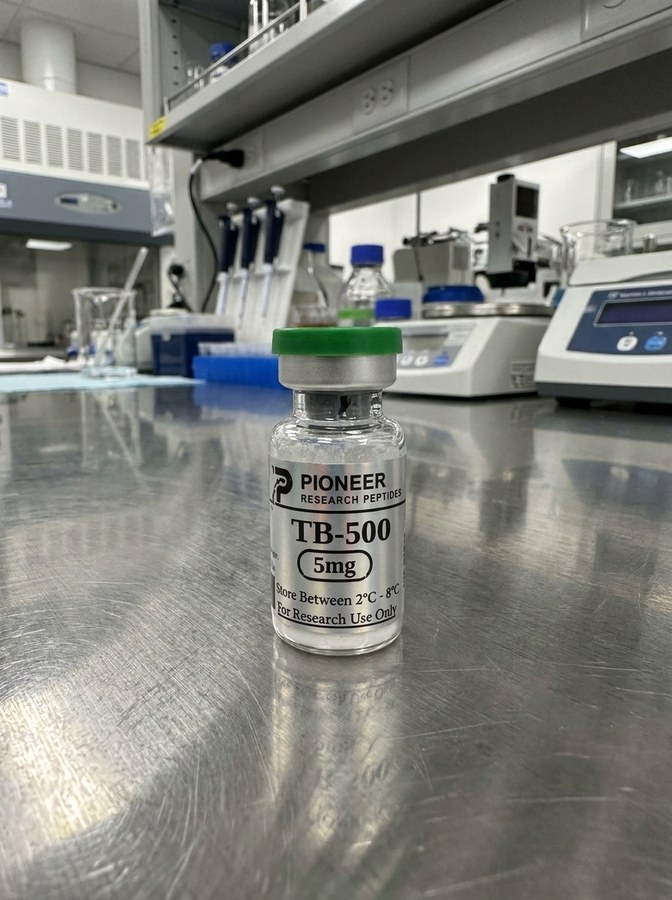
TB-500
Thymosin β4 acetate
A synthetic version of the active region of Thymosin β4, studied for actin regulation, cell migration and wound-closure models.
Mechanism#
The active region of Thymosin β4. It regulates actin, the protein that lets cells move, so research focuses on cell migration to wound sites, new blood-vessel formation and tissue recovery.
Areas of research#
- Cell migration and actin regulation
- Wound-closure models
- Angiogenesis research
- Inflammation-modulation studies
Sizes and pricing#
| Size | Price per vial | Availability |
|---|---|---|
| 5mg | £22 | In stock |
| 10mg | £36 | Made to order — 1-2 weeks |
Buying more than one? Mix and match any peptide vials: 3 vials 8%, 5 vials 12%, 10 or more 15% off the peptides in your basket. You get whichever is better, the bulk or the volume discount, never both — applied automatically at checkout. How it works.

Technical specification#
| Molecular formula | C212H350N56O78S |
|---|---|
| Molecular weight | 4963.44 |
| CAS number | 77591-33-4 |
Check your certificate#
- Molecular weight 4963.44 for full-length thymosin β4, C212H350N56O78S (monoisotopic 4960.49). A protein this size shows as several charged ions, for example near 1241.1 (four charges), 993.1 (five) and 827.8 (six).
- 889.01 is the fragment. Ac-LKKTETQ, seven residues, is sold under the same name. It is a different substance, five and a half times lighter.
- About 847 is the fragment without its acetyl group, a third substance again.
- No mass, no identity. A purity figure on its own cannot say which of these is in the vial.
- Purity, with the method named, measured on that batch rather than quoted as a minimum.
Ask about the documentation for the batch we would ship before you order. How to check a certificate yourself: verifying a COA.
What’s in the vial#
| Fill | 5mg or 10mg per vial |
|---|---|
| Appearance | White lyophilised powder |
| Salt form | Acetate. A mass spectrum measures the peptide itself, so it should read 4963 whatever the salt. |
| Purity and content | Purity is the share of what was detected that is this peptide. Net peptide content, how much of the powder’s weight is peptide rather than salt and water, is a separate number. How much is in the vial. |
Handling at a glance#
| Solvent | Bacteriostatic or sterile water |
|---|---|
| Sealed vial | 2–8°C, dry and dark. Let it reach room temperature before opening. |
| Once in solution | 2–8°C. Avoid thawing and refreezing the same volume. |
| Worth knowing | A 43-residue protein has structure to lose, so foaming is denaturation rather than a cosmetic problem. Run the water down the vial wall and swirl rather than shake. |
Working out a concentration: the reconstitution calculator. Technique: the reconstitution guide and the storage guide.
What the research covers#
Thymosin β4 is the subject of a research literature that is overwhelmingly preclinical, and the fragment’s literature more so. Much of the later interest traces back to a 2004 mouse and cell study on heart-muscle cell migration and survival. Published human work on the full-length protein includes a phase 1 placebo-controlled study in 40 healthy volunteers that recorded adverse events and pharmacokinetics. Neither the protein nor the fragment is a licensed medicine in the UK. Read the full guide, with sources: TB-500: Two Different Substances, One Name.
Published literature#
- Low TL, Hu SK, Goldstein AL (1981). Proc Natl Acad Sci U S A 78(2):1162–6. The first complete sequence of thymosin β4: 43 residues, with an acetylated N-terminus. PubMed 6940133
- Vancompernolle K, Goethals M, Huet C, et al. (1992). EMBO J 11(13):4739–46. Locates the actin-binding site of thymosin β4, including the LKKTET motif that the TB-500 fragment carries. PubMed 1464307
- Bock-Marquette I, Saxena A, White MD, et al. (2004). Nature 432(7016):466–72. Mouse and cell study linking thymosin β4 to integrin-linked kinase signalling and to heart-muscle cell migration and survival. Much of the later research interest in thymosin β4 traces back to it. PubMed 15565145
- Esposito S, Deventer K, Goeman J, et al. (2012). Drug Test Anal 4(9):733–8. An anti-doping laboratory in Ghent identifies the acetylated 17–23 fragment, Ac-LKKTETQ, in a product sold as TB-500, and synthesises it as a reference standard. PubMed 22962027
- Ruff D, Crockford D, Girardi G, et al. (2010). Ann N Y Acad Sci 1194:223–9. Phase 1 placebo-controlled study of synthetic full-length thymosin β4 in 40 healthy volunteers, recording adverse events and pharmacokinetics. PubMed 20536472
- Xing Y, Ye Y, Zuo H, et al. (2021). Front Endocrinol (Lausanne) 12:767785. Review of thymosin β4 research, covering the animal work and the clinical trials run so far. PubMed 34992578
Listed so the work can be read at source. A paper on this list is evidence of what was studied, not of what any product does.
Questions#
What is TB-500?
The name is used for two different substances. Ours is full-length thymosin β4 acetate: 43 residues, N-terminally acetylated, 4963.44 g/mol. The other is the seven-residue fragment Ac-LKKTETQ, 889.01, the actin-binding region of the protein.
What molecular weight should the certificate show?
4963.44 for full-length thymosin β4 (monoisotopic 4960.49). A mass near 889 is the acetylated fragment, and near 847 the fragment without its acetyl group.
How should it be stored?
Sealed vial at 2-8°C, dry and dark. Once reconstituted with bacteriostatic or sterile water, keep it at 2-8°C and avoid thawing and refreezing the same volume. Swirl rather than shake: foaming denatures the protein.
Is there a batch certificate?
Yes. The certificate for the current batch is available on request: email orders@pioneerpeptides.co.uk with the product and size.
Is it for human use?
No. It is supplied for laboratory research only, and we do not give guidance on human or animal use.
A batch-specific Certificate of Analysis is available on request. New to handling lyophilised material? See our reconstitution guide, storage guide and how to read a COA.