CJC-1295 (without DAC)
Batch documentation. Ask what exists for the batch we would ship before you order — email us ›
GHRH analogue (no DAC)
A GHRH analogue without the Drug Affinity Complex, giving a short, pulsatile stimulation of growth-hormone release — often studied alongside a GH secretagogue.
Mechanism#
Binds GHRH receptors on the pituitary to trigger a brief, natural GH pulse; without the albumin-binding complex its half-life is short, so it is frequently studied alongside a ghrelin-receptor agonist.
Areas of research#
- Growth-hormone pulse research
- GH/IGF-1 axis studies
- GHRH-receptor pharmacology
- Secretagogue-pairing models

Identity and specification#
| Also known as | Modified GRF(1-29); Mod GRF 1-29; CJC-1295 DAC-less |
|---|---|
| Sequence | GRF(1-29) with four substitutions: D-Ala2, Gln8, Ala15, Leu27; C-terminally amidated |
| Length | 29 residues |
| Molecular formula | C152H252N44O42 |
| Molecular weight | 3367.90 g/mol (free base) |
| CAS number | 863288-34-0 (free base); 446036-97-1 is the acetate salt |
| Class | GHRH analogue, tetrasubstituted, no albumin-binding complex |
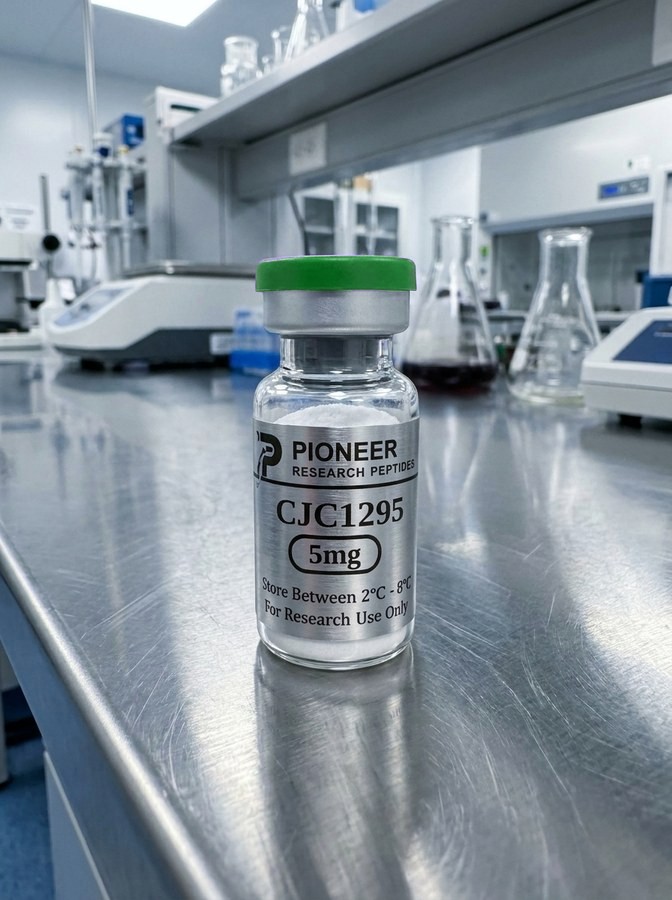
| Appearance | White lyophilised powder |
| Solubility | Bacteriostatic or sterile water |
| Storage | 2–8°C, both sealed and once in solution |
The name is a misnomer, and it is worth knowing why. CJC-1295 was the DAC-bearing molecule; that is what the code designated. This compound is properly modified GRF(1-29), and calling it “CJC-1295 without DAC” describes it by subtracting a feature from a different molecule. The trade has settled on the name, so we use it, but the two are separate compounds and the literature does sometimes conflate them.
What the four substitutions are for. The parent is the first 29 residues of growth-hormone-releasing hormone — the fragment that retains full receptor activity. Four residues are then swapped. D-Ala at position 2 is the important one: position 2 is where dipeptidyl peptidase-4 cuts GHRH, and inverting the stereochemistry there blocks the enzyme outright. Gln8 replaces an asparagine, which is prone to deamidation in storage. Leu27 replaces a methionine, which oxidises easily, so the finished peptide contains no methionine at all. Ala15 replaces a flexible glycine in the middle of the peptide’s helical region.
Against the DAC-bearing form at 3647.25, this molecule is 279.3 lighter. That difference is the single most reliable way to tell the two apart on a certificate.
Handling and storage#
Supplied as a lyophilised cake. Add solvent slowly down the vial wall and swirl rather than shake. Keep the sealed vial at 2–8°C; once in solution, refrigerate at 2–8°C and avoid repeated freeze-thaw cycles. A mass-spectrometry result on a certificate measures the peptide itself, not the acetate it may be supplied with, so it should match 3367.9 (monoisotopic 3365.9) whatever the salt form. The acetate shows up instead in the net peptide content: the share of the powder’s weight that is actually peptide.
For what the mass column is telling you and how to separate the two CJC-1295 forms, see our guide to reading a certificate of analysis.
Sizes and pricing#
| Size | Price per vial | Availability |
|---|---|---|
| 2mg | £12.95 | Made to order — 1-2 weeks |
| 5mg | £26 | In stock |
| 10mg | £39.99 | In stock |
Buying more than one? Mix and match any peptide vials: 3 vials 8%, 5 vials 12%, 10 or more 15% off the peptides in your basket. You get whichever is better, the bulk or the volume discount, never both — applied automatically at checkout. How it works.
Batch documentation. Ask what exists for the batch we would ship before you order — email us ›
Check your certificate#
- Molecular weight 3367.9 (monoisotopic 3365.89). On a mass spectrum, expect charged ions near 1123.0, 842.5 and 674.2.
- Not the DAC version. CJC-1295 with DAC is 3647.2, 279 heavier. A certificate near 3647 is describing the other compound.
- Not sermorelin. Plain GRF(1-29) is 3357.9, only 10 lighter. A mass rounded to “about 3360” cannot separate the two.
- Purity, with the method named, measured on that batch rather than quoted as a minimum.
Ask about the documentation for the batch we would ship before you order. How to check a certificate yourself: verifying a COA.
What’s in the vial#
| Fill | 2mg, 5mg or 10mg of peptide per vial |
|---|---|
| Appearance | White lyophilised powder |
| Salt form | Acetate. A mass spectrum measures the peptide itself, so it should read 3367.9 whatever the salt. |
| Purity and content | Purity is the share of what was detected that is this peptide. Net peptide content, how much of the powder’s weight is peptide rather than salt and water, is a separate number. How much is in the vial. |
Handling at a glance#
| Solvent | Bacteriostatic or sterile water |
|---|---|
| Sealed vial | 2–8°C, dry and dark. Let it reach room temperature before opening. |
| Once in solution | 2–8°C. Avoid thawing and refreezing the same volume. |
| Worth knowing | Methionine 27 was replaced with leucine, so this form has no methionine to oxidise. |
Working out a concentration: the reconstitution calculator. Technique: the reconstitution guide and the storage guide.
What the research covers#
Almost all published research on CJC-1295 is on the DAC version. For this form, the published work is mostly anti-doping detection chemistry rather than studies of what it does. It is not a licensed medicine anywhere. Read the full guide, with sources: CJC-1295 with and without DAC.
Published literature#
- Frohman LA, Downs TR, Williams TC, et al. (1986). J Clin Invest 78(4):906–13. Breakdown of natural GHRH in human plasma and in volunteers: removal of the first two residues by a plasma enzyme, and the activity of the shortened product. PubMed 3093533
- Jetté L, Léger R, Thibaudeau K, et al. (2005). Endocrinology 146(7):3052–8. The developer's description of three albumin-binding GRF(1-29) derivatives, and the selection of CJC-1295 from them, in rat pituitary cells and rats. PubMed 15817669
- Knoop A, Thomas A, Fichant E, et al. (2016). Anal Bioanal Chem 408(12):3145–53. A validated anti-doping method for detecting several GHRH analogues in plasma, including sermorelin and its shortened form GHRH(3-29). PubMed 26879649
Listed so the work can be read at source. A paper on this list is evidence of what was studied, not of what any product does.
Questions#
What is CJC-1295 without DAC?
Modified GRF(1-29): the first 29 residues of growth hormone-releasing hormone with four substitutions (D-Ala2, Gln8, Ala15, Leu27). Unlike CJC-1295 with DAC, it has no albumin-binding group.
What molecular weight should the certificate show?
3367.9 (monoisotopic 3365.89), usually seen as ions near 1123.0, 842.5 and 674.2. 3647.2 is the DAC version and 3357.9 is sermorelin.
How should it be stored?
Sealed vial at 2-8°C, dry and dark. Once reconstituted with bacteriostatic or sterile water, keep it at 2-8°C and avoid thawing and refreezing the same volume.
Is there a batch certificate?
Yes. The certificate for the current batch is available on request: email orders@pioneerpeptides.co.uk with the product and size.
Is it for human use?
No. It is supplied for laboratory research only, and we do not give guidance on human or animal use.
A batch-specific Certificate of Analysis is available on request. New to handling lyophilised material? See our reconstitution guide, storage guide and how to read a COA.