Semax
Batch documentation. Ask what exists for the batch we would ship before you order — email us ›
Heptapeptide, ACTH fragment analogue
A synthetic ACTH(4–10) analogue investigated in research on cognition, neuroprotection and BDNF expression.
Mechanism#
A fragment of ACTH with the hormonal activity removed. Research focuses on its ability to raise BDNF and protect neurons, supporting studies of cognition and neuroprotection.
Areas of research#
- Cognition and memory models
- Neuroprotection research
- BDNF / neurotrophic signalling
- Stress-resilience studies

Identity and specification#
| Sequence | Met-Glu-His-Phe-Pro-Gly-Pro (MEHFPGP) |
|---|---|
| Length | 7 residues (heptapeptide) |
| Molecular formula | C37H51N9O10S |
| Molecular weight | 813.93 g/mol |
| CAS number | 80714-61-0 |
| Relation to ACTH | The ACTH(4-7) fragment Met-Glu-His-Phe, extended with Pro-Gly-Pro; described in the literature as an ACTH(4-10) analogue |
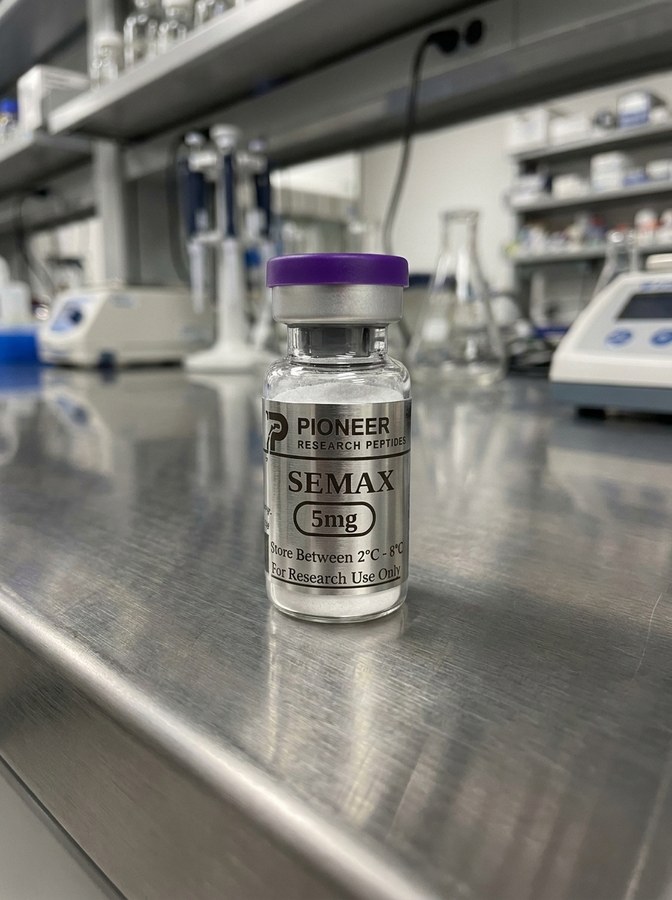
| Appearance | White lyophilised powder |
| Solubility | Bacteriostatic or sterile water |
| Storage | 2–8°C, both sealed and once in solution |
On the naming. You will see Semax called an ACTH(4-7) analogue in one place and an ACTH(4-10) analogue in another, and both are defensible, which is why the disagreement persists. The precise statement is this: the first four residues — Met-Glu-His-Phe — are ACTH(4-7) exactly. The native hormone continues Arg-Trp-Gly to complete ACTH(4-10). Semax replaces those three with Pro-Gly-Pro. It is therefore the 4-7 fragment by composition and a 4-10 analogue by length and intent.
What the Pro-Gly-Pro tail is doing. Two prolines in three residues. Proline is the amino acid whose side chain bonds back to its own backbone nitrogen, which stiffens the local geometry and gives peptidases very little to grip — the same trick that makes BPC-157 durable. Swapping the readily cleaved Arg-Trp-Gly tail for Pro-Gly-Pro is a stability change, and it is the difference between a fragment that disappears and one that can be worked with.
The single sulphur is a storage tell. That lone S in the formula is Met1. Oxidise it and the mass goes from 813.93 to 829.93 — sixteen units, one oxygen. A certificate showing a shoulder sixteen above the main peak is describing oxidation, not contamination.
Note also what is absent: no tryptophan and no tyrosine. Phenylalanine absorbs only weakly and well below 280 nm, so an A280 reading is not a sound way to quantify this peptide.
Handling and storage#
Supplied as a lyophilised cake. Add solvent slowly down the vial wall and swirl rather than shake. Keep the sealed vial at 2–8°C; once in solution, refrigerate at 2–8°C and avoid repeated freeze-thaw cycles. The methionine makes air the enemy here more than light: keep the vial closed and make solutions in the volume you will actually use.
For why oxidation and freeze-thaw damage cost more than most people expect, see our guide to storing research peptides.
Sizes and pricing#
| Size | Price per vial | Availability |
|---|---|---|
| 5mg | £17 | Made to order — 1-2 weeks |
| 10mg | £29 | In stock |
Buying more than one? Mix and match any peptide vials: 3 vials 8%, 5 vials 12%, 10 or more 15% off the peptides in your basket. You get whichever is better, the bulk or the volume discount, never both — applied automatically at checkout. How it works.
Semax 10mg and Selank 10mg together: £48 for the pair instead of £58, applied automatically in the basket.
Add both for £48 (save £10)
Check your certificate#
- Molecular weight 813.93 (monoisotopic 813.35). On a mass spectrum, expect ions near 814.4 (singly charged) and 407.7 (doubly charged).
- Sixteen heavier means oxidation. The single sulphur is methionine 1. With one oxygen added the mass reads 829.93, so a shoulder sixteen above the main peak describes oxidised material, not contamination.
- Not Selank. Selank carries the same Pro-Gly-Pro tail but weighs 751.87. At this size a mass spectrum separates the two without difficulty.
- Purity, with the method named, measured on that batch rather than quoted as a minimum.
Ask about the documentation for the batch we would ship before you order. How to check a certificate yourself: verifying a COA.
What’s in the vial#
| Fill | 5mg or 10mg of peptide per vial |
|---|---|
| Appearance | White lyophilised powder |
| Purity and content | Purity is the share of what was detected that is this peptide. Net peptide content, how much of the powder’s weight is peptide rather than salt and water, is a separate number. How much is in the vial. |
Handling at a glance#
| Solvent | Bacteriostatic or sterile water |
|---|---|
| Sealed vial | 2–8°C, dry and dark. Let it reach room temperature before opening. |
| Once in solution | 2–8°C. Avoid thawing and refreezing the same volume. |
| Worth knowing | The methionine makes air a bigger risk than light. Keep the vial closed and limit how long a solution spends warm or exposed to air; oxidation is the most likely route to a sample that no longer matches its certificate. |
Working out a concentration: the reconstitution calculator. Technique: the reconstitution guide and the storage guide.
What the research covers#
Most of the published work on Semax is in Russian, much of it predates modern reporting standards, and the English-language peer-reviewed literature is thin and heavily preclinical. The animal work largely measures neurotrophic factor expression, such as BDNF and trkB levels in the rat hippocampus. The clinical work cited in our guide includes a Russian study of 110 patients in rehabilitation that compared blood BDNF levels with and without Semax. Our guide notes that it is used clinically in Russia, where it was developed. Read the full guide, with sources: Semax and Selank Compared.
Published literature#
- Asmarin IP, Nezavibat’ko VN, Miasoedov NF, et al. (1997). Zh Vyssh Nerv Deiat Im I P Pavlova 47(2):420–30. Overview by the Moscow group that designed Semax, covering fifteen years of work that took it from the laboratory into clinical use. PubMed 9173745
- Dolotov OV, Karpenko EA, Inozemtseva LS, et al. (2006). Brain Res 1117(1):54–60. Rat study measuring BDNF and trkB levels in the hippocampus after a single exposure to Semax. PubMed 16996037
- Gusev EI, Martynov MY, Kostenko EV, et al. (2018). Zh Nevrol Psikhiatr Im S S Korsakova 118(3 Vyp 2):61–68. Clinical study in 110 patients in rehabilitation, comparing blood BDNF levels and recovery scores with and without Semax. PubMed 29798983
Listed so the work can be read at source. A paper on this list is evidence of what was studied, not of what any product does.
Questions#
What is Semax?
A synthetic seven-residue peptide, Met-Glu-His-Phe-Pro-Gly-Pro. The first four residues are ACTH(4-7); the last three, Pro-Gly-Pro, replace the rest of the ACTH(4-10) fragment, which is why it is described as an ACTH(4-10) analogue.
What molecular weight should the certificate show?
813.93 (monoisotopic 813.35), usually seen as ions near 814.4 and 407.7. A peak near 829.93 is the methionine-oxidised form, and 751.87 is Selank.
How should it be stored?
Sealed vial at 2-8°C, dry and dark. Once reconstituted with bacteriostatic or sterile water, keep it at 2-8°C, keep the vial closed, and avoid thawing and refreezing the same volume.
Is there a batch certificate?
Yes. The certificate for the current batch is available on request: email orders@pioneerpeptides.co.uk with the product and size.
Is it for human use?
No. It is supplied for laboratory research only, and we do not give guidance on human or animal use.
A batch-specific Certificate of Analysis is available on request. New to handling lyophilised material? See our reconstitution guide, storage guide and how to read a COA.