GLOW Blend
BPC-157 + GHK-Cu + TB-500
A research blend of BPC-157, GHK-Cu and TB-500 covering cell-migration and skin-matrix research.
Mechanism#
Combines BPC-157 and TB-500 (cell-migration research) with GHK-Cu (skin-matrix research). Studied as a multi-target blend covering cell-migration and skin-matrix pathways.
Areas of research#
- Cell-migration research
- Collagen and skin-remodeling models
- Angiogenesis pathways
- Combined-peptide research

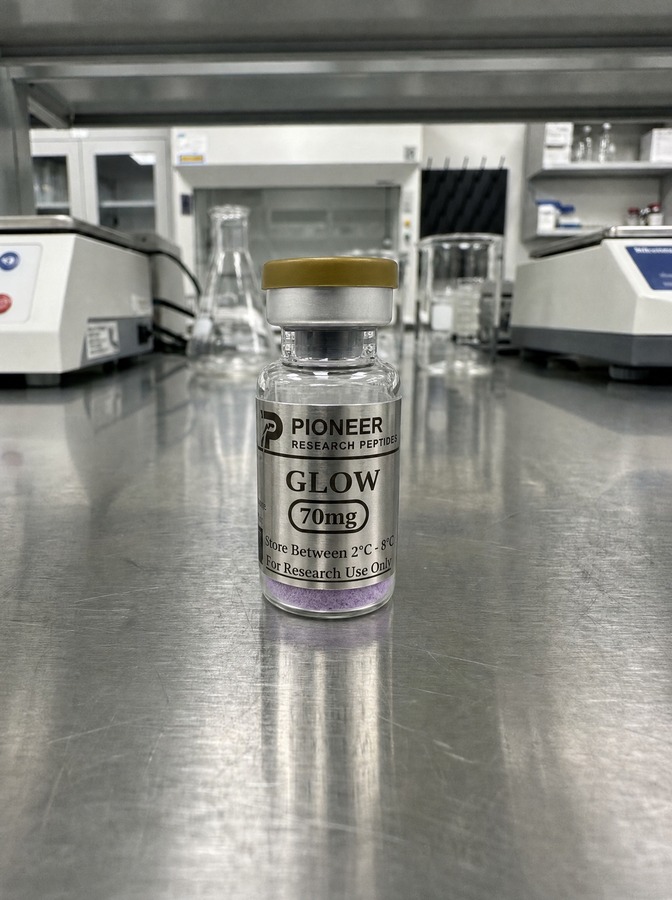
Sizes and pricing#
| Size | Price per vial | Availability |
|---|---|---|
| 70mg | £65 | In stock |
Buying more than one? Mix and match any peptide vials: 3 vials 8%, 5 vials 12%, 10 or more 15% off the peptides in your basket. You get whichever is better, the bulk or the volume discount, never both — applied automatically at checkout. How it works.
Check your certificate#
- BPC-157: 1419.55 (monoisotopic 1418.70), seen as ions near 1419.7 and 710.4.
- GHK-Cu: 401.91 for the copper complex, C14H22CuN6O4. 340.38 is free GHK, the tripeptide without its copper, so the copper should be reported too.
- TB-500: 4963.44 for full-length thymosin β4. A mass near 889 is the seven-residue fragment sold under the same name, a different substance.
- Each component on its own line. A blend certificate should identify and quantify every component separately; one overall figure hides the ratio. Our blend certificates report quantity rather than mass, so the TB-500’s identity rests on the manufacturer’s certificate for the source material.
- Purity, if reported, with the method named and given for each component rather than as one overall figure.
Ask about the documentation for the batch we would ship before you order. How to check a certificate yourself: verifying a COA.
What’s in the vial#
| Fill | 70mg vial |
|---|---|
| Components | BPC-157, GHK-Cu and TB-500 (full-length thymosin β4), pre-mixed in one vial |
| Copper | About 15.8% of GHK-Cu’s weight is copper, not peptide. |
| Purity and content | Purity is the share of what was detected that is each named peptide. Net peptide content, how much of the powder’s weight is peptide rather than salt and water, is a separate number. How much is in the vial. |
Handling at a glance#
| Solvent | Bacteriostatic or sterile water |
|---|---|
| Sealed vial | 2–8°C, protected from light and moisture. Let it reach room temperature before opening. |
| Once in solution | 2–8°C and dark. Avoid thawing and refreezing the same volume. |
| Worth knowing | Where a blend contains GHK-Cu, the copper peptide’s handling applies to the whole preparation: light protection, gentle reconstitution, cold storage. Strongly acidic conditions strip the copper and leave free GHK. |
Working out a concentration: the reconstitution calculator. Technique: the reconstitution guide and the storage guide.
What the research covers#
The guide linked here covers how a blend should be checked, not a study of the combination. For the components: published work on BPC-157 is overwhelmingly in rodents, and a 2026 systematic review of the human evidence found three small uncontrolled studies with 30 participants in total. GHK-Cu has several decades of literature, mostly cell and animal studies and work on it as a cosmetic ingredient. The thymosin β4 literature is overwhelmingly preclinical. None of the three is a licensed medicine in the UK. Read the full guide, with sources: How Peptide Blend Research Kits Should Be Checked.
Published literature#
- Esposito S, Deventer K, Goeman J, et al. (2012). Drug Test Anal 4(9):733–8. An anti-doping laboratory in Ghent identifies the acetylated 17–23 fragment, Ac-LKKTETQ, in a product sold as TB-500, and synthesises it as a reference standard. PubMed 22962027
- Sikirić P, Petek M, Rucman R, et al. (1993). J Physiol Paris 87(5):313–27. The Zagreb group’s early overview, introducing the 15-residue fragment and summarising their animal studies. PubMed 8298609
- Chang CH, Tsai WC, Lin MS, et al. (2011). J Appl Physiol (1985) 110(3):774–80. Independent study from Chang Gung University, Taiwan, of rat tendon fibroblasts with BPC-157: outgrowth from tendon explants, cell survival under oxidative stress, and migration. PubMed 21030672
- Mortazavi SM, Mohammadi Vadoud SA, Moghimi HR (2025). Bioimpacts 15:30071. Independent review of GHK and GHK-Cu as topical cosmetic ingredients, covering cell studies, skin permeability and formulation. Notes that GHK-Cu is widely used in cosmetic products. PubMed 39963574
Listed so the work can be read at source. A paper on this list is evidence of what was studied, not of what any product does.
Questions#
What is in the vial?
Three peptides pre-mixed in one 70mg vial: BPC-157, GHK-Cu (the copper complex of the tripeptide GHK) and TB-500 (full-length thymosin β4).
What molecular weight should the certificate show?
One figure for each component: 1419.55 for BPC-157, 401.91 for the GHK-Cu copper complex (340.38 would be free GHK without its copper) and 4963.44 for TB-500 as full-length thymosin β4. A blend certificate should identify and quantify each one separately.
How should it be stored?
Sealed vial at 2-8°C, protected from light and moisture. Once reconstituted with bacteriostatic or sterile water, keep it at 2-8°C in the dark, avoid thawing and refreezing the same volume, and avoid strongly acidic conditions, which strip the copper from GHK-Cu.
Is there a batch certificate?
Yes. The certificate for the current batch is available on request: email orders@pioneerpeptides.co.uk with the product and size.
Is it for human use?
No. It is supplied for laboratory research only, and we do not give guidance on human or animal use.
A batch-specific Certificate of Analysis is available on request. New to handling lyophilised material? See our reconstitution guide, storage guide and how to read a COA.