AHK-Cu
Copper tripeptide
A copper-binding peptide investigated in research on hair-follicle biology and angiogenesis.
Mechanism#
A copper peptide studied mainly in hair-science research, where it is linked to dermal-papilla activity and the growth of new blood vessels around the hair follicle.
Areas of research#
- Hair-follicle and dermal-papilla research
- Angiogenesis around follicles
- Tissue-repair pathways
- Cosmetic-science research

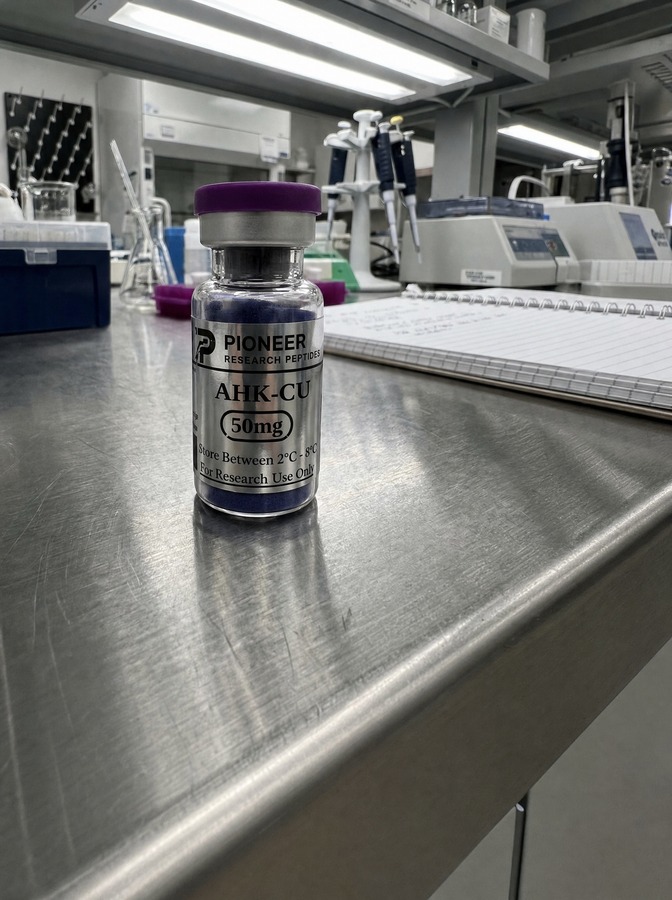
Sizes and pricing#
| Size | Price per vial | Availability |
|---|---|---|
| 50mg | £26 | In stock |
| 100mg | £44 | In stock |
Buying more than one? Mix and match any peptide vials: 3 vials 8%, 5 vials 12%, 10 or more 15% off the peptides in your basket. You get whichever is better, the bulk or the volume discount, never both — applied automatically at checkout. How it works.
Check your certificate#
- AHK-Cu, not GHK-Cu. AHK is alanyl-L-histidyl-L-lysine bound to copper(II), one residue away from GHK: alanine in place of glycine at position one. A certificate should name the AHK sequence. A mass of 401.91 describes GHK-Cu.
- The copper should be reported. The complex has a defined stoichiometry. A certificate for a metal complex that only reports the peptide is incomplete.
- Colour confirms copper, not purity. Blue is the complex itself. It says nothing about the purity of the peptide or whether the sequence is correct; that still takes HPLC and mass spectrometry.
- Purity, with the method named, measured on that batch rather than quoted as a minimum.
Ask about the documentation for the batch we would ship before you order. How to check a certificate yourself: verifying a COA.
What’s in the vial#
| Fill | 50mg or 100mg per vial |
|---|---|
| Appearance | The copper complex is blue. A clear blue solution is normal. |
| Purity and content | Purity is the share of what was detected that is this peptide complex. How much of the powder’s weight is the complex rather than salt and water is a separate number. How much is in the vial. |
Handling at a glance#
| Solvent | Bacteriostatic water is the usual choice where a vial will be opened more than once; sterile water is the alternative. |
|---|---|
| Sealed vial | 2–8°C protected from light. Let it reach room temperature before opening. |
| Once in solution | 2–8°C and dark. Copper peptide solutions degrade faster in light than many other peptides. |
| Worth knowing | Cloudiness, particulates or a shift toward green or brown suggests degradation or contamination. Discard rather than use. |
Working out a concentration: the reconstitution calculator. Technique: the reconstitution guide and the storage guide.
What the research covers#
AHK-Cu is far less documented than GHK-Cu. It appears mainly in hair-follicle literature, particularly laboratory work on dermal papilla cells and follicular growth-phase signalling; the study our guide cites is a 2007 laboratory study on human hair follicles kept in culture and on dermal papilla cells. It is often studied side by side with GHK-Cu because of the single-residue difference. Read the full guide, with sources: Copper peptides in research: GHK-Cu and AHK-Cu.
Published literature#
- Pyo HK, Yoo HG, Won CH, et al. (2007). Arch Pharm Res 30(7):834–9. Laboratory study of AHK-Cu on human hair follicles kept in culture and on dermal papilla cells. PubMed 17703734
- Jung JI, Park KY, Lee Y, et al. (2018). Differentiation 101:1–7. Eulji University, Korea. Cell culture study of a vitamin C-linked form of the Ala-His-Lys tripeptide, without copper, and osteoblast differentiation markers. PubMed 29567599
Listed so the work can be read at source. A paper on this list is evidence of what was studied, not of what any product does.
Questions#
What is AHK-Cu?
Alanyl-L-histidyl-L-lysine bound to a copper(II) ion. It differs from GHK-Cu by one residue, alanine in place of glycine at position one, and appears mainly in hair-follicle research.
What should the certificate show?
The AHK sequence with a mass that matches it, the copper content, and purity with the method named, measured on that batch. A mass of 401.91 is GHK-Cu, a different compound.
Why is it blue?
The colour comes from the copper complex itself and is expected. It confirms copper is present, but it says nothing about the purity of the peptide.
How should it be stored?
Sealed vial cold, dry and protected from light: 2-8°C. Once dissolved, keep it at 2-8°C in the dark, and discard a solution that turns cloudy, green or brown.
Is it for human use?
No. It is supplied for laboratory research only, and we do not give guidance on human or animal use.
A batch-specific Certificate of Analysis is available on request. New to handling lyophilised material? See our reconstitution guide, storage guide and how to read a COA.