Kisspeptin-10
Reproductive signalling peptide
A key reproductive signalling peptide investigated in research on GnRH release and the hypothalamic–pituitary–gonadal axis.
Mechanism#
Sits at the top of the reproductive axis — it stimulates GnRH neurons, which in turn drive LH and FSH release. Research uses it to probe puberty, fertility and the HPG axis.
Areas of research#
- GnRH-release and HPG-axis research
- Puberty and reproductive-timing models
- Neuroendocrine signalling
- Fertility research

Identity and specification#
| Sequence | H-Tyr-Asn-Trp-Asn-Ser-Phe-Gly-Leu-Arg-Phe-NH2 (YNWNSFGLRF-NH2) |
|---|---|
| Species form | Human |
| Length | 10 residues, C-terminally amidated |
| Molecular formula | C63H83N17O14 (free base) |
| Molecular weight | 1302.44 g/mol (free base) |
| CAS number | 374675-21-5 |
| Also known as | KP-10; Metastin (45–54); KiSS-1 (112–121) |
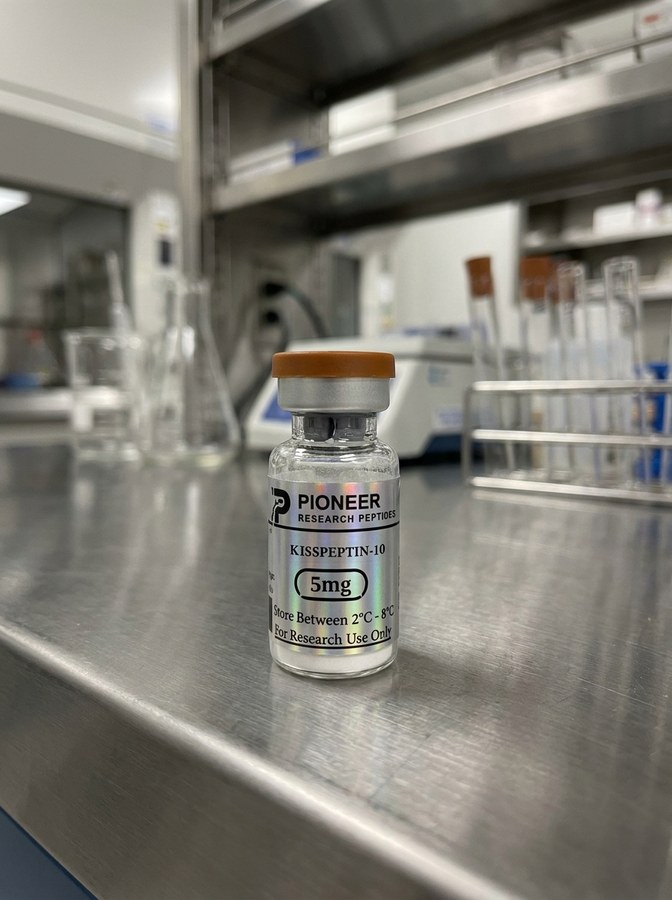
| Appearance | White lyophilised powder |
| Storage | 2–8°C, both sealed and once in solution |
Human or rodent? They are different compounds#
This is the specification most often got wrong, and it is worth a moment. The human and rodent forms of Kisspeptin-10 differ by a single terminal residue — phenylalanine in the human form, tyrosine in the mouse and rat form. One oxygen atom. About sixteen daltons. Completely different registry numbers.
| Human (this product) | Mouse / rat | |
|---|---|---|
| Sequence ends | …GLRF-NH2 | …GLRY-NH2 |
| Formula | C63H83N17O14 | C63H83N17O15 |
| Molecular weight | 1302.44 | 1318.45 |
| CAS | 374675-21-5 | 478507-53-8 |
Unqualified, “Kisspeptin-10” means the human decapeptide, which is what we supply. If a listing anywhere shows a weight of 1302 beside a sequence ending in tyrosine, or 1318 beside one ending in phenylalanine, the two halves of that specification do not describe the same molecule.
What it is#
Kisspeptin-10 is the C-terminal ten residues of kisspeptin-54, also called metastin, the product of the KISS1 gene — and it is the shortest fragment that retains full agonist activity at the kisspeptin receptor KISS1R, also known as GPR54. That receptor is Gq/11-coupled: binding drives phospholipase C activation, calcium mobilisation and ERK phosphorylation. Reported binding affinities are in the low nanomolar range at both the human and rat receptors.
The C-terminal amide is not a detail. Kisspeptin belongs to the RF-amide family and the amidated terminus is required for activity; the free acid is not the same pharmacological object.
Research areas#
Two largely separate literatures, which is unusual. In reproductive neuroendocrinology, KISS1R signalling on GnRH neurones sits at the top of the hypothalamic–pituitary–gonadal axis; loss-of-function mutations in the receptor cause hypogonadotropic hypogonadism, and the peptide is a standard tool for probing puberty onset and gonadotropin release. Separately, in oncology, KISS1 was originally identified as a melanoma metastasis suppressor gene, and the peptide is studied for effects on tumour-cell invasion. Vascular and placental work makes up a smaller third strand.
Salt form, and a figure we will not print#
Kisspeptin-10 is supplied as a trifluoroacetate or acetate salt. We quote the free-base weight, 1302.44, because we could not find a published salt weight from a source we trust, and with a single arginine the counter-ion content varies by lot in any case. Calculating one ourselves and presenting it as a specification would be inventing a number.
Handling and storage#
Supplied lyophilised. Keep the sealed vial at 2–8°C, dry and dark, and warm to room temperature before opening. Reconstitute gently down the side of the vial. Store the solution at 2–8°C and avoid repeated freeze-thaw cycles. See our reconstitution guide.
Sizes and pricing#
| Size | Price per vial | Availability |
|---|---|---|
| 5mg | £25 | In stock |
| 10mg | £34 | In stock |
Buying more than one? Mix and match any peptide vials: 3 vials 8%, 5 vials 12%, 10 or more 15% off the peptides in your basket. You get whichever is better, the bulk or the volume discount, never both — applied automatically at checkout. How it works.
Check your certificate#
- Molecular weight 1302.44 for the free base (monoisotopic 1301.63). On a mass spectrum, expect ions near 1302.6, 651.8 and 434.9.
- 1318.45 is the rodent form. Mouse and rat kisspeptin-10 end in tyrosine rather than phenylalanine: one oxygen, about sixteen daltons. A weight of 1302 beside a sequence ending in tyrosine does not describe one molecule.
- The amide is part of the identity. The free acid is about one dalton heavier (1303.4). A mass spectrum separates the two, but read the figure carefully.
- The salt is not in that figure. It is supplied as a trifluoroacetate or acetate salt, and with a single arginine the counter-ion content varies by lot.
- Purity, with the method named, measured on that batch rather than quoted as a minimum.
Ask about the documentation for the batch we would ship before you order. How to check a certificate yourself: verifying a COA.
What’s in the vial#
| Fill | 5mg or 10mg of peptide per vial |
|---|---|
| Appearance | White lyophilised powder |
| Salt form | Trifluoroacetate or acetate. A mass spectrum measures the peptide itself, so it should read 1302.44 whatever the salt. |
| Purity and content | Purity is the share of what was detected that is this peptide. Net peptide content, how much of the powder’s weight is peptide rather than salt and water, is a separate number. How much is in the vial. |
Handling at a glance#
| Solvent | Bacteriostatic or sterile water |
|---|---|
| Sealed vial | 2–8°C, dry and dark. Let it reach room temperature before opening. |
| Once in solution | 2–8°C. Avoid thawing and refreezing the same volume. |
| Worth knowing | We quote the free-base weight only. We could not find a salt weight from a source we trust, and with the counter-ion varying by lot, a calculated one would be an invented specification. |
Working out a concentration: the reconstitution calculator. Technique: the reconstitution guide and the storage guide.
What the research covers#
Kisspeptin research runs to thousands of papers in two largely separate strands: reproductive neuroendocrinology, where the receptor sits upstream of GnRH neurones, and cancer biology, where KISS1 was first identified as a metastasis suppressor gene. Most of it is cell, receptor and animal work. The human studies are mainly small, short experimental-medicine studies in volunteers measuring hormone levels in blood, and much of the clinical work in reproductive medicine used kisspeptin-54 rather than kisspeptin-10. No kisspeptin is a licensed medicine in the UK. Read the full guide, with sources: Kisspeptin-10: One Gene, Four Peptides, and Which One This Is.
Published literature#
- Ohtaki T, Shintani Y, Honda S, et al. (2001). Nature 411(6837):613–7. Takeda, Japan. Isolated the 54-residue peptide encoded by the KiSS-1 gene from human placenta, named it metastin, and identified it as the ligand of an orphan G-protein-coupled receptor. PubMed 11385580
- Muir AI, Chamberlain L, Elshourbagy NA, et al. (2001). J Biol Chem 276(31):28969–75. GlaxoSmithKline, Harlow, UK. Cloned the human receptor, the counterpart of rat GPR54, found that KiSS-1-derived peptides activate it, and mapped where receptor and peptide are expressed. PubMed 11387329
- George JT, Veldhuis JD, Roseweir AK, et al. (2011). J Clin Endocrinol Metab 96(8):E1228–36. MRC Human Reproductive Sciences Unit, Edinburgh. The first study of kisspeptin-10 in men: healthy volunteers, with LH pulse frequency, pulse size and testosterone measured. PubMed 21632807
- Jayasena CN, Nijher GM, Comninos AN, et al. (2011). J Clin Endocrinol Metab 96(12):E1963–72. Imperial College London. Compared healthy men and women. Gonadotrophin release rose in men and in women in the preovulatory phase, but not in women in the follicular phase of the cycle. PubMed 21976724
- Jayasena CN, Abbara A, Narayanaswamy S, et al. (2015). Hum Reprod 30(8):1934–41. Imperial College London. Direct comparison of kisspeptin-10, kisspeptin-54 and GnRH in healthy men. The two kisspeptin forms gave similar gonadotrophin responses, and GnRH was more potent than either. PubMed 26089302
Listed so the work can be read at source. A paper on this list is evidence of what was studied, not of what any product does.
Questions#
What is Kisspeptin-10?
The last ten residues of kisspeptin-54, Tyr-Asn-Trp-Asn-Ser-Phe-Gly-Leu-Arg-Phe-NH2, with an amidated C-terminus. It is residues 112-121 of the human KISS1 precursor, also called KP-10 or metastin (45-54).
What molecular weight should the certificate show?
1302.44 for the human free base (monoisotopic 1301.63), usually seen as ions near 1302.6, 651.8 and 434.9. 1318.45 is the rodent form, and about 1303.4 suggests the free acid rather than the amide.
How should it be stored?
Sealed vial at 2-8°C, dry and dark, brought to room temperature before opening. Once reconstituted, keep it at 2-8°C and avoid thawing and refreezing the same volume.
Is it the human or the rodent form?
Human. The sequence ends in phenylalanine; the mouse and rat form ends in tyrosine and has a different CAS number.
Is it for human use?
No. It is supplied for laboratory research only, and we do not give guidance on human or animal use.
A batch-specific Certificate of Analysis is available on request. New to handling lyophilised material? See our reconstitution guide, storage guide and how to read a COA.